How to Prune Trident Maple Bonsai: Timing and Technique

This post contains affiliate links. As an Amazon Associate, OurBonsai earns from qualifying purchases at no extra cost to you. Read our disclosure.
In this guide
- Why trident maples need regular pruning
- When to prune a trident maple bonsai
- Structural pruning in late winter
- How to prune new shoots in spring and summer
- Leaf pruning a trident maple
- Handling large cuts on trident maples
- Root pruning and its link to top pruning
- Pruning for different stages of development
- Common trident maple pruning mistakes
- Aftercare once you have pruned
- FAQ: how to prune trident maple bonsai
- Final thoughts
Learning how to prune trident maple bonsai is one of the most rewarding parts of growing this species. Trident maples (Acer buergerianum) are vigorous, heal quickly and back-bud readily on old wood. That makes them very forgiving of pruning, and it is why they are a favorite for developing fine twigs and thick, tapered trunks. But their strength also means they outgrow their shape quickly if left alone.
This guide explains when to prune, how to cut back new shoots, when leaf pruning makes sense, and how to handle large cuts.
Why trident maples need regular pruning
Trident maples have strong apical dominance: the top and outer parts of the tree grow much faster than the lower and inner branches. Without pruning:
- The top becomes thick and heavy while lower branches weaken.
- Internodes (the spaces between leaves) get long, giving coarse, leggy branches.
- Inner branches die back from lack of light.
Regular, well-timed pruning balances the tree, keeps internodes short and builds fine ramification, the dense, twiggy branching that makes a trident look mature.
When to prune a trident maple bonsai
| Season | Type of pruning | Notes |
|---|---|---|
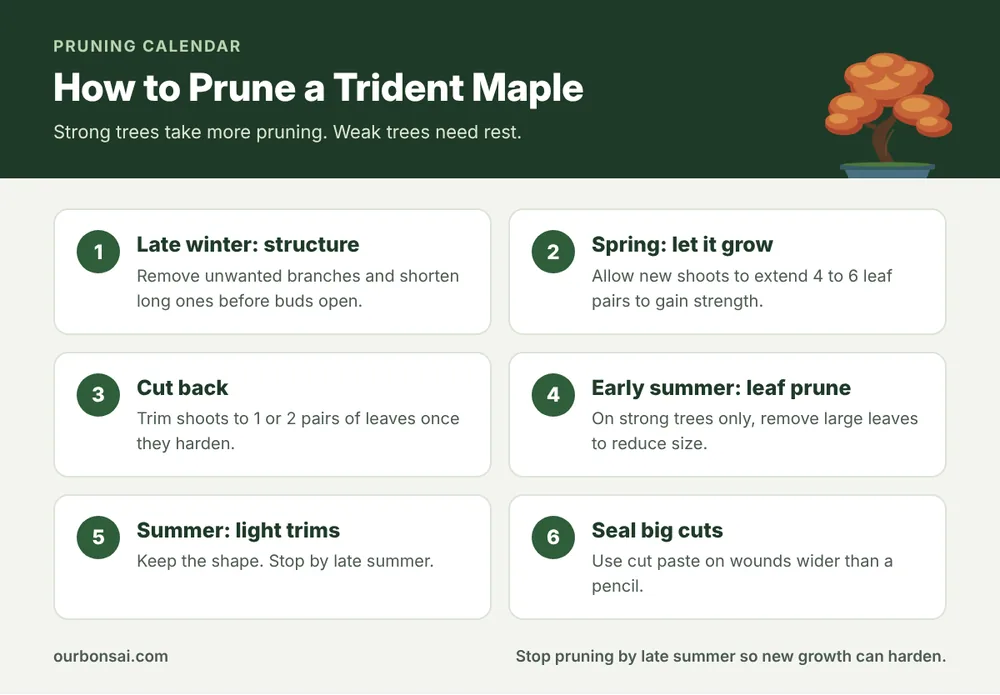
| Late winter | Structural pruning | Branch structure is clear; tree heals fast in spring |
| Spring | Let shoots grow, then cut back | Builds strength first |
| Early summer | Cut back, optional leaf pruning | Only on healthy, vigorous trees |
| Midsummer | Light maintenance trims | Keep the outline tidy |
| Autumn | Avoid heavy pruning | New growth will not harden before frost |
Our general guide on when to prune deciduous bonsai explains the reasoning behind this calendar.
Structural pruning in late winter
Late winter, just before buds start to swell, is the time for bigger decisions. With no leaves on the tree, you can see every branch.
- Remove dead and crossing branches.
- Remove branches growing straight up or down, or straight toward the viewer from the front.
- Reduce bar branches, where two branches leave the trunk at the same height on opposite sides. Keep one.
- Shorten long branches back to a bud or a side branch that points in the direction you want.
- Thin the top more than the bottom, to slow its growth.
Trident maples have opposite buds, so every cut leaves you a pair of new shoots. Choose cut points that give you a good fork.
How to prune new shoots in spring and summer
This is where most of the ramification is built. The basic method:
- Let new shoots grow. In spring, allow them to extend to about four to six pairs of leaves. This growth feeds the roots and thickens the branches.
- Wait for them to harden. The new stem changes from soft and green to slightly woody.
- Cut back to one or two pairs of leaves. Use sharp bonsai pruning shears and cut just above a leaf pair.
- Repeat with each new flush through early summer.
On branches you want to thicken, let them grow longer before cutting. On the top of the tree, cut harder and earlier.
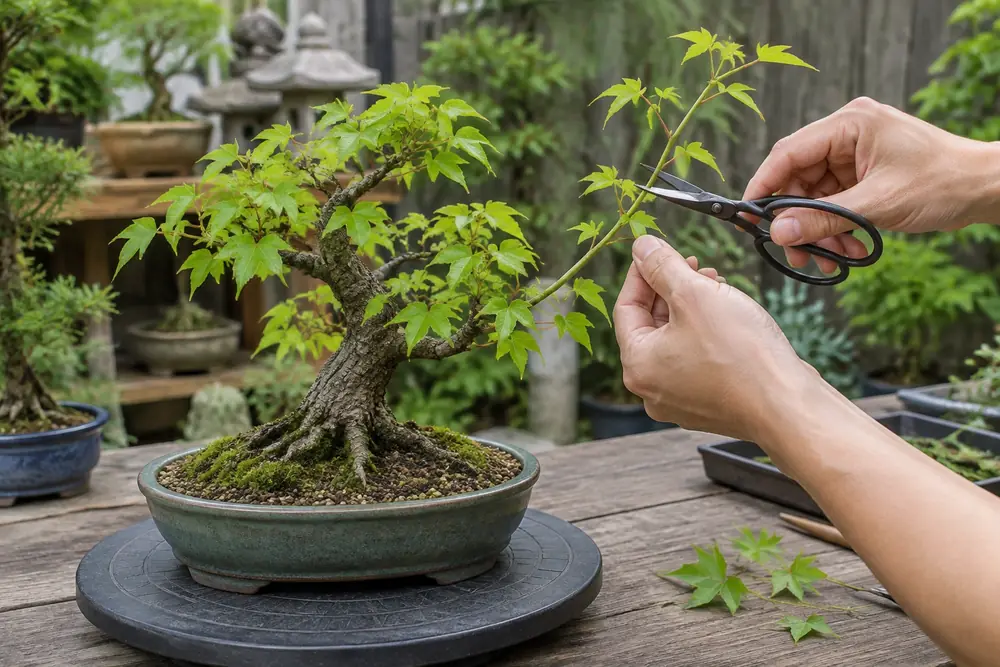
Leaf pruning a trident maple
Leaf pruning means cutting off some or all of the leaves in early summer, leaving the leaf stalks. The tree then pushes a second set of leaves, which are smaller, and more buds develop inside the canopy.
- Partial leaf pruning: Remove the largest leaves, or the leaves on the strongest parts of the tree. This balances vigor and lets light into the interior. It is safe on most healthy trees.
- Full defoliation: Removing all leaves is only for very healthy, well-established trees, and not every year. Never defoliate a weak tree or one that was repotted the same spring.
After leaf pruning, keep the tree out of harsh afternoon sun for a week or two, and keep watering carefully, as it uses less water with fewer leaves.
Handling large cuts on trident maples
Trident maples heal well, but large cuts still need care:
- Use a concave cutter for branch removal. It leaves a slight hollow that heals flatter. See our concave cutter review.
- For thick branches, use a small bonsai pruning saw first, then clean up with the concave cutter.
- Seal cuts wider than a pencil with cut paste to stop them drying out and help the edges roll over. Our guide to a bonsai cut paste alternative covers products.
- Make big cuts in late winter or early spring, when the tree heals fastest.
You can find bonsai concave cutters on Amazon and in most good tool kits.
Root pruning and its link to top pruning
Trident maples are often root pruned hard at repotting to build a wide, flaring base. If you root prune heavily in spring, go easier on top pruning that year, and skip leaf pruning. The tree needs its leaves to regrow roots. Balanced work above and below the soil keeps it healthy.
Pruning for different stages of development
- Young trees: Let them grow freely in a large pot or the ground to thicken the trunk. Prune only to set the first branches and trunk line.
- Developing trees: Use the “grow and cut back” method to build taper in each branch.
- Refined trees: Regular cut-back to one or two leaf pairs, and partial leaf pruning to keep leaves small and twigs fine.
The University of Minnesota guide to pruning trees and shrubs explains how trees respond to cuts in general, which applies to bonsai too.
Common trident maple pruning mistakes
- Cutting new shoots back too early, before they have fed the tree.
- Pruning the bottom branches as hard as the top, so the bottom weakens.
- Defoliating a weak or freshly repotted tree.
- Leaving long stubs that die back.
- Heavy pruning in autumn, which triggers soft growth that frost damages.
Aftercare once you have pruned
Pruning is only half of the job. What you do in the following weeks decides how well the tree responds.
- Keep feeding during the growing season. Trident maples need nutrients to push the new buds that pruning triggers. A balanced fertilizer every two weeks from spring to late summer works well. Our guide to bonsai fertilizer pellets vs liquid explains the options.
- Water steadily. A heavily pruned tree has fewer leaves and uses less water for a week or two, so check the soil before watering.
- Give full sun to strong trees. Light reaching the inner branches is what encourages back-budding.
- Watch the new buds. Where several buds appear at one spot, rub off the extras and keep the two best placed.
FAQ: how to prune trident maple bonsai
How often can I prune a trident maple?
Several times a season. Most growers cut back new growth after each flush from late spring to midsummer.
Will a trident maple bud back on old wood?
Yes. Tridents are known for back-budding well, which is one reason they are so popular for bonsai.
Should I prune my trident maple in autumn?
Avoid heavy pruning in autumn. Wait for late winter, when you can see the structure and the tree heals quickly in spring.
Do I need to seal pruning cuts?
Small cuts heal on their own. Seal cuts wider than about a pencil to help them heal cleanly.
Final thoughts
Now you know how to prune trident maple bonsai through the year: structural work in late winter, let spring shoots grow, cut them back to one or two leaf pairs once they harden, use leaf pruning only on strong trees, and seal large cuts. Trident maples respond quickly, so within a few seasons you will see denser branching and a more mature shape. For the right tools, see our guide to the best Japanese bonsai tool kit.