How Often to Water Fukien Tea Bonsai (Indoor & Outdoor Guide)


This post contains affiliate links. As an Amazon Associate, OurBonsai earns from qualifying purchases at no extra cost to you. Read our disclosure.
In this guide
- Why Fukien tea needs careful watering
- How often to water Fukien tea bonsai by season
- How to check if a Fukien tea needs water
- How to water a Fukien tea bonsai
- Soil makes watering easier
- Humidity and Fukien tea
- Indoors vs outdoors
- Signs of watering problems
- FAQ: how often to water fukien tea bonsai
- Final thoughts
If you are wondering how often to water fukien tea bonsai, the practical answer is every one to three days for most indoor trees, but always by checking the soil first. Fukien tea (Carmona microphylla, also called Ehretia microphylla) likes its soil kept evenly moist. Water as soon as the top of the soil starts to feel dry, and do not let it dry out completely. At the same time, it does not like sitting in wet soil, so good drainage matters as much as frequency. In winter, under lower light, you will water less often.
Fukien tea is one of the most popular indoor bonsai, thanks to its tiny dark leaves and small white flowers. It is also known as a little fussy, and watering is the main reason. Get this part right and the rest of its care becomes much easier.
Why Fukien tea needs careful watering
Fukien tea is a subtropical shrub from southern China and Taiwan, where it grows in warm, humid conditions. The Wikipedia page on Ehretia microphylla describes it as an evergreen shrub of warm regions, which explains its love of steady moisture and humidity.
In a bonsai pot it has a dense network of fine roots. Those fine roots die quickly if the soil dries out completely, and the tree shows it within a day or two by dropping leaves or browning at the tips. On the other hand, roots kept wet for days lose oxygen and rot. That narrow window is why Fukien tea has its reputation. The trick is to check often and water at the right moment, rather than on a fixed schedule.
How often to water Fukien tea bonsai by season
| Situation | Typical frequency | What to watch |
|---|---|---|
| Indoors, spring and summer, bright window | Every 1 to 2 days | Small pots may need water daily |
| Indoors, autumn and winter | Every 2 to 4 days | Heating dries the surface, light is lower |
| Outdoors, warm summer | Daily, sometimes twice | Check morning and late afternoon |
| Under grow lights | Every 1 to 3 days | Steady growth, steady water use |
| After repotting | Keep just moist for 2 to 3 weeks | Fewer roots, so do not drown it |
Use these as a starting point. Pot size, soil and placement change the timing more than the calendar does.
How to check if a Fukien tea needs water
- Touch the surface. Lightly press the top of the soil. If it feels dry to the touch and slightly lighter in color, it is time to water. With Fukien tea, you do not wait for the soil to dry deeper down.
- Watch the akadama. If your mix contains akadama, it turns from dark brown to light tan as it dries, a handy visual cue.
- Lift the pot. A dry pot feels noticeably lighter than a freshly watered one.
- Use a moisture meter if you are unsure. Our guide to the best soil moisture meter for indoor plants covers good options.
How to water a Fukien tea bonsai
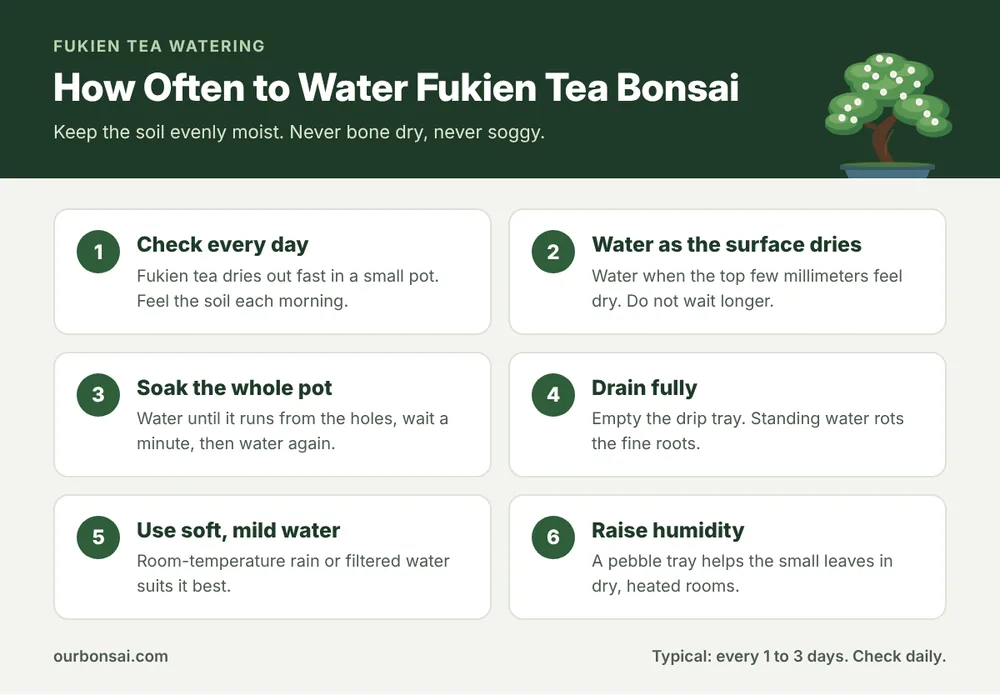
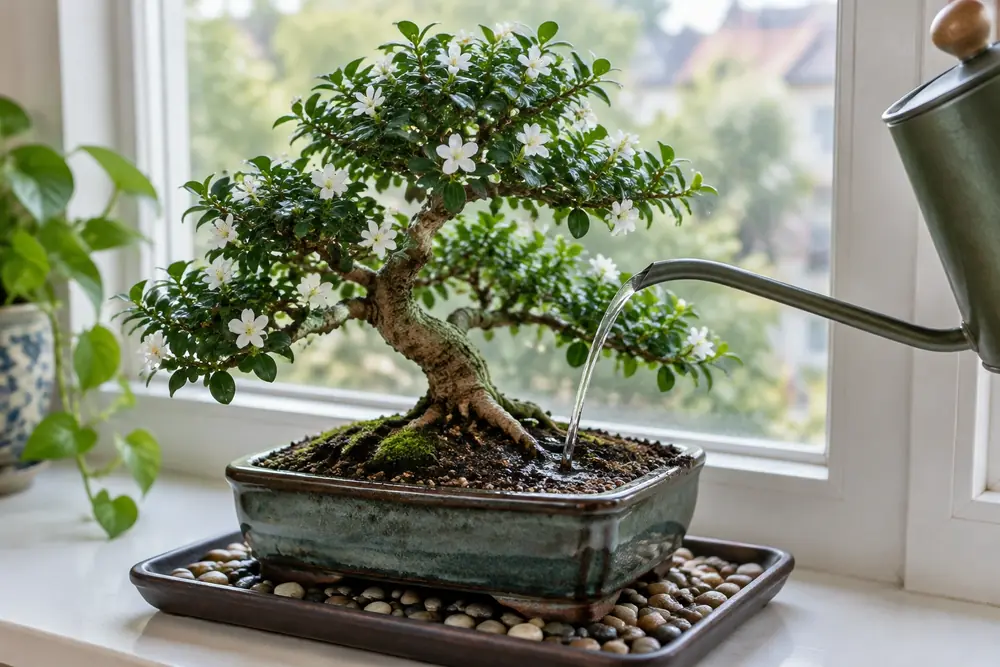
- Water gently over the whole surface with a fine rose or a long-spout can, so you do not wash soil away. Our pick of the best Japanese watering can for bonsai has some good ones, or browse bonsai watering cans.
- Keep going until water drains from the holes, then wait a minute and water again so the whole root ball is soaked.
- Let it drain completely and empty the drip tray after ten minutes.
- Use room-temperature water. Fukien tea can react to cold water with leaf drop.
- Prefer soft water. If your tap water is hard, use rain water or filtered water when you can, to avoid salt and lime build-up.
Soil makes watering easier
The right soil gives you a wider margin for error. A mix that holds some water but drains freely, such as akadama with pumice and a little lava, keeps the roots moist without waterlogging them. Dense potting soil stays wet too long in the center while the surface dries, which confuses the soil check and often leads to rot. Our list of the top 10 best soil for Fukien tea bonsai compares ready-made options.
Humidity and Fukien tea
Fukien tea grows naturally in humid air. Indoors, especially in winter with heating, the air can be very dry, and the small leaves lose water fast. Water the soil properly first, then raise humidity around the tree:
- Set the pot on a humidity tray of pebbles and water, with the pot above the water line. See our pick of the best humidity trays for bonsai.
- Group plants together to create a more humid microclimate.
- Keep the tree away from radiators and heating vents.
- Mist the leaves in the morning if you like, but misting is a small extra, not a replacement for a humidity tray.
Indoors vs outdoors
Indoors, Fukien tea wants a bright window and stable temperatures between about 60 and 75°F (15 to 24°C). Check the soil every day, because the combination of a small pot and dry indoor air can dry it fast. Our guide to watering indoor bonsai in winter has more on the heating season.
Outdoors, in summer, a Fukien tea in bright shade grows strongly and needs water every day, sometimes twice in a heat wave. Bring it back indoors before nights fall below about 55°F (13°C).
Signs of watering problems
| Too little water | Too much water |
|---|---|
| Sudden leaf drop, often of green leaves | Yellowing leaves that fall slowly |
| Leaf tips turning brown and crisp | Soil that stays dark and wet for days |
| Soil pulling away from the pot edge | Sour smell, fungus gnats, white mold |
| Flower buds falling before they open | Black, soft roots when you check |
If the tree dried out badly, soak the pot in a bowl of water for ten minutes, then let it drain and keep it out of direct sun for a day or two.
FAQ: how often to water fukien tea bonsai
Should I water my Fukien tea every day?
Check every day, and water whenever the surface feels dry. In summer that is often daily; in winter it may be every few days.
Can a Fukien tea bonsai recover from drying out?
Usually, if you catch it early. It will drop leaves, but it often re-buds within a few weeks once watering is consistent.
Should I mist my Fukien tea bonsai?
Misting is fine in the morning, but a humidity tray does more. Avoid misting the flowers, which can spot.
Why does my Fukien tea drop leaves after watering?
Usually cold water, or the soil was allowed to dry out completely before that watering. Use room-temperature water and water a little sooner.
Final thoughts
Now you know how often to water fukien tea bonsai: check daily, water as soon as the surface starts to dry, soak the whole root ball and drain well. Add a humidity tray and a bright, stable spot, and this beautiful flowering tree becomes far less fussy than its reputation. For shaping ideas, see our guide to Fukien tea bonsai styles.