How to Water Bonsai: The Right Technique, Step by Step

Learning how to water bonsai properly is the single most important skill in growing small trees. The technique is simple once you know it: check the soil first, and when the top centimeter is starting to dry, water slowly with a fine-rose can over the whole soil surface until water runs out of the drainage holes. Wait a minute and water again, so the entire root ball is soaked, then let the pot drain completely. Do this whenever the soil needs it, not on a fixed day, and most of the common bonsai problems disappear.
In this guide
- Why bonsai need a special watering technique
- Step 1: Decide whether to water
- Step 2: Use the right watering can
- Step 3: Water the whole surface slowly
- Step 4: Keep going until water drains out
- Step 5: Water a second time
- Step 6: Let the pot drain completely
- What water to use
- When to water: time of day
- Indoor vs outdoor watering
- Special cases
- Common mistakes when watering bonsai
- FAQ: how to water bonsai
- Final thoughts
This guide goes step by step through the technique, the tools, the water to use and the mistakes to avoid.
Why bonsai need a special watering technique
A bonsai lives in a small, shallow pot with very little soil. That soil is usually a gritty, fast-draining mix, so water passes through quickly. If you water like a houseplant, with a quick splash in the middle of the pot, most of the water runs straight through one channel and out of the bottom. The top looks wet, but large parts of the root ball stay dry.
Dry soil also repels water. Once it has dried out completely, water beads on the surface or runs down the gap between soil and pot. Good technique overcomes both problems.
Step 1: Decide whether to water
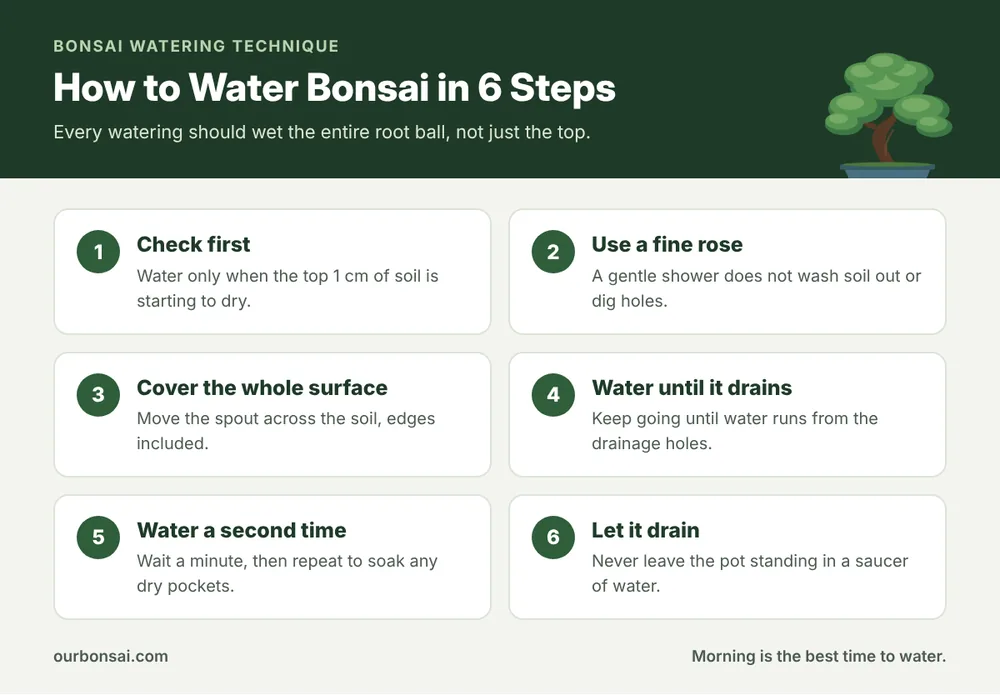
Before you pick up the can, check the soil. Push a finger about 1 cm into it, look at the color (most bonsai soils turn lighter when dry), or feel the weight of the pot. Water if the top is starting to dry. If it is still damp, wait.
Checking every day takes seconds and is far more reliable than a calendar. Our guide on watering bonsai in summer explains how often to check in hot weather.
Step 2: Use the right watering can
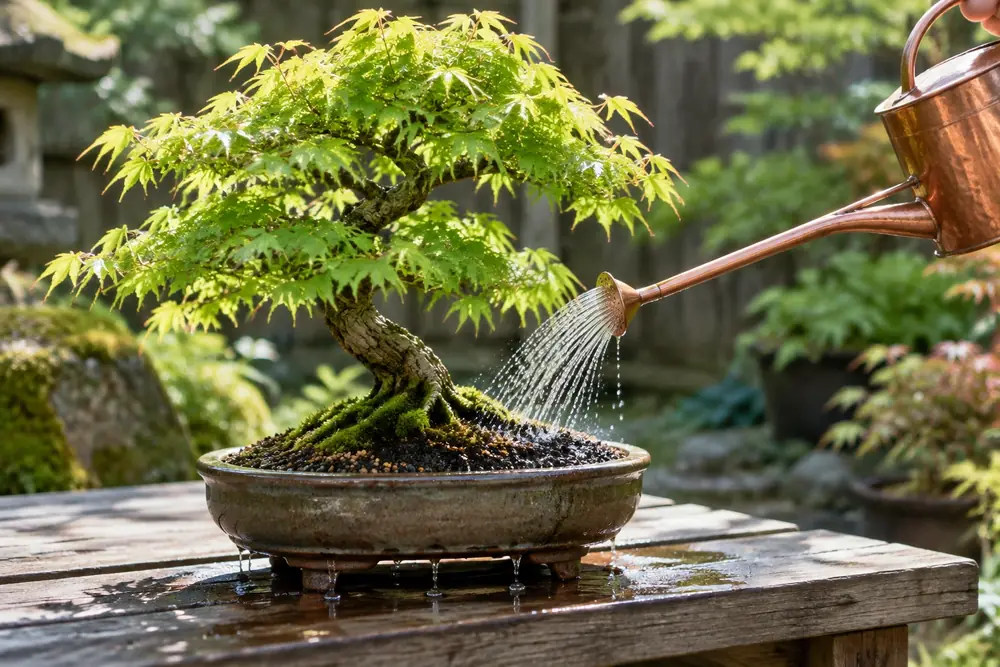
The ideal bonsai watering can has a long spout and a fine “rose” head that turns the flow into a gentle shower. It lets you water slowly and precisely, without washing soil out of the pot or blasting holes in moss. Our guide to the best Japanese watering can for bonsai compares classic designs. If you have many trees, a bonsai watering wand on a hose does the same job faster.
Step 3: Water the whole surface slowly
Move the spout steadily over the entire soil surface, including the edges next to the pot rim. Do not stand in one spot. Pour slowly enough that water soaks in rather than pooling and running off.
Step 4: Keep going until water drains out
Continue until water runs freely from the drainage holes. That tells you the water has passed all the way through the soil. In gritty bonsai soil, this happens quickly.
Step 5: Water a second time
Wait about a minute and water the whole surface again until it drains. The first pass wets the soil particles. The second soaks into pockets the first pass missed and makes sure the whole root ball is moist. Many growers water three times in hot weather.
Step 6: Let the pot drain completely
Let excess water run out freely. Never leave a bonsai standing in a saucer of water, because the bottom of the root ball stays soggy and roots start to rot. Indoors, empty drip trays after watering, or set the pot on a humidity tray with pebbles so the pot sits above the water.
What water to use
| Water | Suitable? | Notes |
|---|---|---|
| Rain water | Ideal | Soft, slightly acidic, no chlorine |
| Tap water (soft) | Good | Fine for almost every tree |
| Tap water (hard) | Mostly fine | Use rain water for azaleas and other acid lovers |
| Filtered water | Good | Useful indoors if tap water is very hard |
| Softened water | Avoid | Contains sodium, which harms roots |
| Very cold water | Avoid for tropicals | Use room temperature for indoor trees |
Hard water is rich in dissolved calcium and magnesium, and it leaves a white mineral crust on the soil and pot over time. Flushing with rain water now and then helps. Lime-hating trees such as azaleas show yellow leaves with green veins if the soil becomes too alkaline.
When to water: time of day
Morning is best. The tree has a full supply of water before the hottest part of the day, and wet leaves dry quickly, which reduces fungal problems. On very hot days, check again in the late afternoon and water small pots again if needed. Watering in full midday sun is not harmful to the tree, despite the myth about water droplets burning leaves, but it is less efficient because more evaporates.
Indoor vs outdoor watering
Outdoor trees dry faster because of sun and wind. In summer, most need water every day. In winter they need much less, but never let them dry out completely.
Indoor trees dry more slowly but suffer from dry air from heating and air conditioning. Water when the top is dry, often every two to four days, and add humidity with a tray. Our guide to watering indoor bonsai in winter explains the cold-season routine.
Special cases
- Bone-dry root ball: stand the pot in a basin of water for 10 minutes so the soil can rehydrate from below, then let it drain.
- Freshly repotted trees: water thoroughly once, then water carefully. A smaller root system uses less water.
- Trees with fresh moss: use the finest rose you have, or water from below, so the moss is not washed away.
- Holidays: group trees in light shade and set up a simple system. See our guide to the best automatic watering system for bonsai.
Common mistakes when watering bonsai
- Watering on a fixed schedule. Weather changes daily. Check first.
- A quick splash in the middle. Only part of the root ball gets wet.
- Letting it dry out completely. Fine roots die quickly in dust-dry soil.
- Keeping it soggy. Constant wetness causes root rot. See root rot in bonsai.
- Using regular potting soil. It holds too much water. Our bonsai soil vs regular soil guide explains why.
- Only misting. Misting raises humidity but never replaces watering the soil.
FAQ: how to water bonsai
How much water should I give my bonsai?
Enough to soak the whole root ball. Water until it drains from the bottom, wait a minute and repeat.
Should I water bonsai from the top or the bottom?
From the top for your normal routine, because it flushes the soil. Water from below only to rescue a dried-out root ball or to protect seeds and fresh moss.
Can I water my bonsai with tap water?
Yes, for most trees. If your tap water is very hard, use rain water for lime-sensitive species like azaleas.
Is it OK to water bonsai in the evening?
It is fine, but morning is better. Evening watering leaves the foliage and soil wet overnight, which can encourage fungus.
Final thoughts
Now you know how to water bonsai the way experienced growers do: check first, water slowly with a fine rose over the whole surface, keep going until it drains, repeat, and let it drain fully. Use soft or room temperature water where it matters, water in the morning, and adjust for the season. Get this habit right and you have mastered the foundation of bonsai care. For everything else, see our main bonsai care guide.