Leggy Bonsai: How to Fix Long, Thin Growth

This post contains affiliate links. As an Amazon Associate, OurBonsai earns from qualifying purchases at no extra cost to you. Read our disclosure.
In this guide
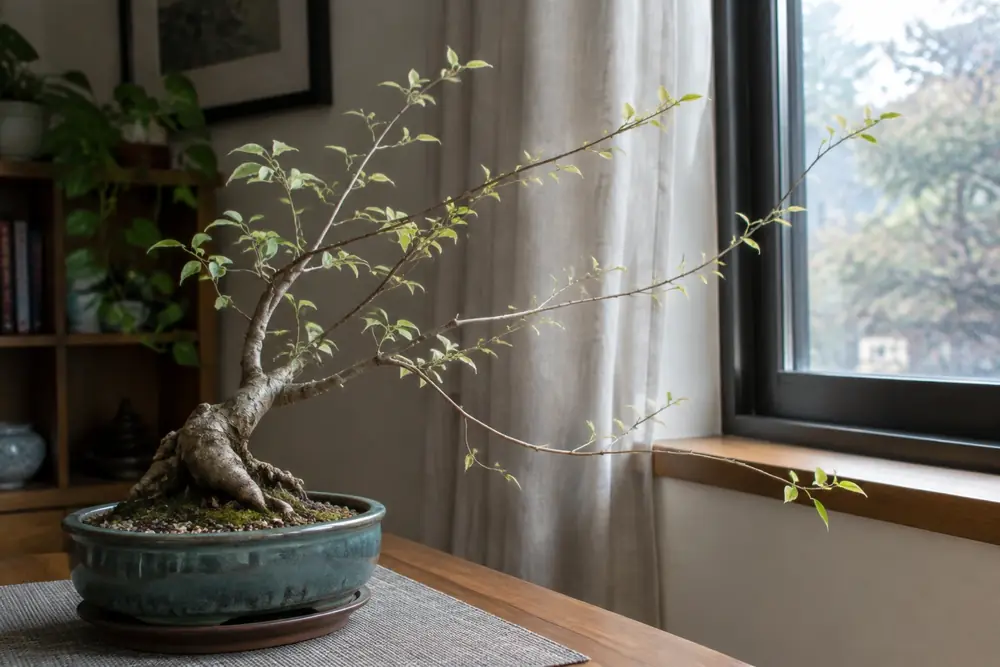
A leggy bonsai has long, thin shoots with big gaps between the leaves, often stretching toward the nearest window. It looks untidy and loses the compact shape that makes a bonsai look like a miniature tree. The good news is that legginess is one of the easiest bonsai problems to fix. In most cases the cause is too little light, sometimes combined with missed pruning or too much nitrogen fertilizer. Fix the cause, cut back the long shoots and the tree will fill in with shorter, denser growth.
This guide explains what causes a leggy bonsai, how to fix it step by step, and how to prevent it from coming back.
What does a leggy bonsai look like?
- Long, thin shoots growing much faster than the rest of the tree
- Large gaps (internodes) between leaves on new growth
- Smaller, paler leaves than usual
- Growth leaning or stretching toward a window
- An open, sparse canopy instead of dense foliage pads
Some long shoots in spring and summer are normal on healthy, vigorous trees. They become a problem when the tree is not pruned or when all new growth is thin and pale.
Why bonsai get leggy
1. Not enough light (the main cause)
When a plant gets too little light, it stretches to reach more. It grows long, thin stems with widely spaced, smaller leaves. This is called etiolation, and the Wikipedia article on etiolation explains the biology. Indoor bonsai are especially prone to it, because homes are far darker than they look to our eyes. Our guide on how much light a bonsai tree needs explains how to judge light levels.
2. No pruning
Trees naturally put their energy into the strongest, highest shoots. Without regular pruning, those shoots keep extending while inner and lower growth weakens. Within a season, the tree looks leggy even in good light.
3. Too much nitrogen
Fertilizers high in nitrogen push soft, fast leafy growth with long internodes. Overfeeding, especially in low light, makes legginess worse.
4. Keeping an outdoor tree indoors
Junipers, maples, elms and pines kept indoors get far too little light. They respond with weak, pale, leggy shoots before declining.
5. Warmth without light in winter
Indoors in winter, warm rooms encourage growth while light is at its weakest. The result is long, pale shoots.
How to fix a leggy bonsai step by step
Step 1: fix the light
This comes first. Pruning a leggy tree without improving light just produces more leggy shoots.
- Move indoor bonsai right next to the brightest window, ideally south or west facing.
- Move outdoor species outside, introducing full sun over a week or two.
- In dark homes or in winter, add a full spectrum grow light for 12 to 14 hours a day. Our guide to the best indoor grow lights for bonsai compares good options, and a simple clip-on LED grow light works for a single small tree.
Step 2: cut back the long shoots
Once the tree is in good light and growing, cut each leggy shoot back to one or two leaves close to where it started. New buds will form at the base of those leaves, giving shorter, denser growth. Use sharp bonsai scissors and cut just above a leaf. Our guide to the best bonsai pruning shears for beginners can help you choose a pair.
If the whole tree is leggy, do not remove more than about a third of the foliage at once. Cut back the worst shoots first, then the rest a few weeks later.
Step 3: pinch new growth
As new shoots appear, pinch or trim them when they have grown three to five leaves, back to one or two. This stops shoots from stretching and encourages branching closer to the trunk.
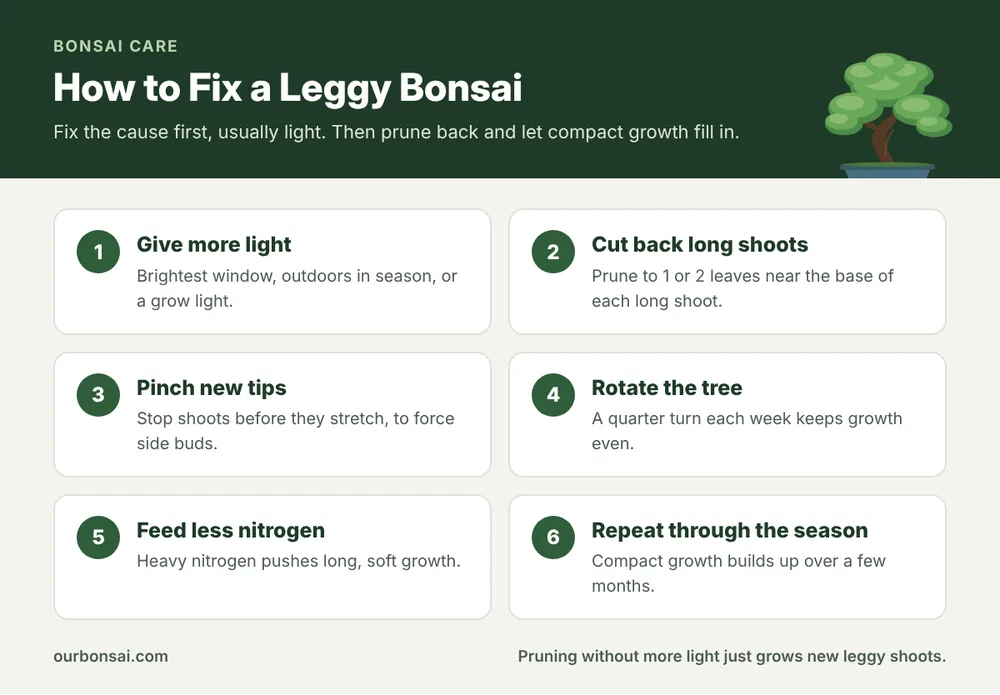
Step 4: rotate the tree
Indoors, light comes from one side. Turn the tree a quarter turn every week so all sides get light and growth stays balanced.
Step 5: adjust feeding
Use a balanced fertilizer at normal strength during the growing season and reduce feeding in low-light winter months. Avoid high-nitrogen feeds on trees that tend to get leggy. Our article on bonsai fertilizer pellets or liquid helps you choose.
Step 6: be patient
Compact growth builds up over a few months of good light and regular pruning. Each round of trimming produces more, shorter shoots, which is how bonsai develop dense foliage pads.
How to fix a very leggy tree with hard pruning
Sometimes a bonsai has been leggy for a long time, with long bare branches and leaves only at the tips. Trimming the tips will not fix that, because there are no buds left near the trunk. In that case, a harder cut back is needed.
- Make sure the tree is healthy and in good light first. Hard pruning a weak tree in a dark spot can kill it.
- Choose the right season. For most outdoor deciduous species, late winter or early spring. For tropical indoor species like ficus, late spring or early summer when they grow fastest.
- Cut long branches back to a point where you want new growth, ideally just above a visible bud or a small side shoot. Ficus, Chinese elm and many tropicals bud back readily from bare wood. Junipers and pines do not, so never cut them back to bare wood without foliage.
- Seal larger cuts with cut paste.
- Let the new shoots grow for a few weeks before trimming them, so the tree regains strength.
Done in stages over one or two seasons, this transforms a long, sparse tree into a compact one.
Leggy bonsai by species
| Species | Common cause | Fix |
|---|---|---|
| Ficus | Low indoor light | Brightest window, grow light, regular trimming |
| Chinese elm | Strong vigor, missed pruning | Trim shoots back often in summer |
| Juniper | Kept indoors | Move outside, pinch new growth tips |
| Jade | Low light, overwatering | More sun, water less often |
| Schefflera | Low light | Brighter spot, cut back to a leaf node |
For a deeper look at timing for each type of tree, see our guide on when to start pruning bonsai.
When long shoots are useful
Not every long shoot is a problem. Bonsai growers sometimes let a shoot grow long on purpose to thicken a branch or the trunk, or to fill a gap in the design. This is called a sacrifice branch. If the tree is in good light and the shoot is deliberate, it is not legginess. Once the branch or trunk has thickened enough, the sacrifice shoot is cut off.
Preventing a leggy bonsai
- Give the tree the strongest light it can handle
- Keep outdoor species outdoors
- Trim new shoots regularly during the growing season
- Rotate indoor trees weekly
- Feed in balance with light: less feeding in darker months
- Use a grow light in winter for indoor trees
FAQ: leggy bonsai
Can a leggy bonsai be fixed?
Yes. Improve the light, cut back the long shoots and keep trimming new growth. Most trees fill in within a few months.
Why is my indoor bonsai growing long and thin?
Almost always too little light. Move it right next to a bright window or add a grow light.
Should I cut off leggy branches?
Cut them back to one or two leaves near the base, rather than removing them completely, unless you no longer need the branch.
Will a leggy bonsai fill out on its own?
No. Without more light and pruning, it will keep growing long, thin shoots.
Final thoughts
A leggy bonsai is telling you it needs more light, more pruning or both. Fix the light first, cut back the long shoots, pinch new growth and rotate the tree regularly. Within a season, the stretched, sparse look gives way to compact, dense growth. For the full care routine, see our main bonsai care guide.