Semi-Cascade Bonsai Style: How to Create It Step by Step

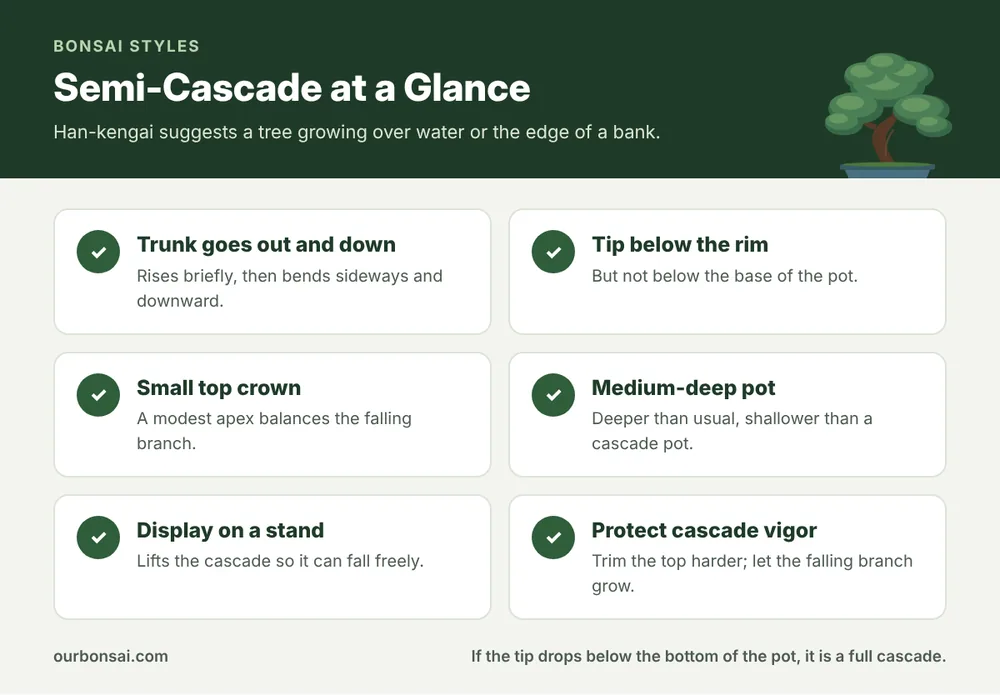
The semi-cascade bonsai style, or han-kengai, is a tree whose trunk rises a short way from the soil, then bends out and down over the edge of the pot. The tip of the falling trunk drops below the pot rim but stays above the bottom of the pot. If it goes lower than the base of the pot, the tree is a full cascade instead. Semi-cascades are usually planted in medium-deep round, square or hexagonal pots and displayed on a stand. Junipers, pines, cotoneaster, azalea and wisteria are common choices, and the main challenge is keeping the falling branch strong, because trees naturally push energy upward.
In this guide
Semi-cascade vs full cascade vs slanting
| Style | Trunk direction | Tip position | Typical pot |
|---|---|---|---|
| Slanting (shakan) | Leans at an angle, stays above the soil | Above the rim | Shallow oval or rectangle |
| Semi-cascade (han-kengai) | Out and down past the rim | Below the rim, above the pot base | Medium-deep |
| Full cascade (kengai) | Down steeply | Below the bottom of the pot | Tall, deep pot |
The semi-cascade is the middle ground. It has the drama of a cascade but needs a less extreme pot and is easier to water and display. In nature, it suggests a tree growing out from a riverbank or the edge of a cliff, bending toward water or light without falling all the way down a rock face.
Trees that suit the semi-cascade bonsai style
You want a species with flexible young growth and the ability to grow strongly on a branch that points downward.
- Juniper. Procumbens and shimpaku junipers are the most common semi-cascade material because they are naturally low and spreading and take wire well. Our juniper bonsai styles guide shows several options.
- Pine. Black and mugo pine make handsome semi-cascades, though they need more care to keep the low branch vigorous.
- Cotoneaster. Small leaves, berries and a naturally sprawling habit. See our ideas for cotoneaster bonsai styles.
- Azalea and wisteria. Flowering trees whose blossoms look striking on a falling trunk.
- Bougainvillea. Flexible stems and bright bracts in warm climates; our bougainvillea bonsai styles article covers it.
Avoid trees with stiff, brittle trunks or strongly upright habits, such as most spruces and ginkgo.
How to create a semi-cascade, step by step
1. Start with suitable material. A nursery juniper or cotoneaster with a long, flexible lower trunk or a strong low branch is ideal. A tree that already leans is a bonus.
2. Decide where the trunk will fall. Turn the tree and pick the side it will cascade toward. The cascade should not fall straight toward the viewer; it reads best when it moves sideways and slightly forward.
3. Repot at an angle. Tilt the tree in the pot so the trunk already heads in the cascading direction. This reduces how much you need to bend. Repotting is best done in spring.
4. Wire the trunk. Use wire about a third the thickness of the trunk. Wrap from the base outward, then bend: a short rise, a firm turn over the rim, and a downward sweep. Add some side-to-side movement so the trunk does not look like a straight drop. Bend slowly, supporting the outside of each curve with your thumbs.
5. Create a small crown. Many semi-cascades have a modest upright crown near the bend, either the original apex shortened or a branch wired upward. It balances the falling branch visually.
6. Arrange branches into pads. Along the cascade, keep branches on the outside of curves and wire them into flat, slightly downward pads, with the tips turned up.
7. Leave it to grow. After a styling session, let the tree recover for a season before cutting back hard.
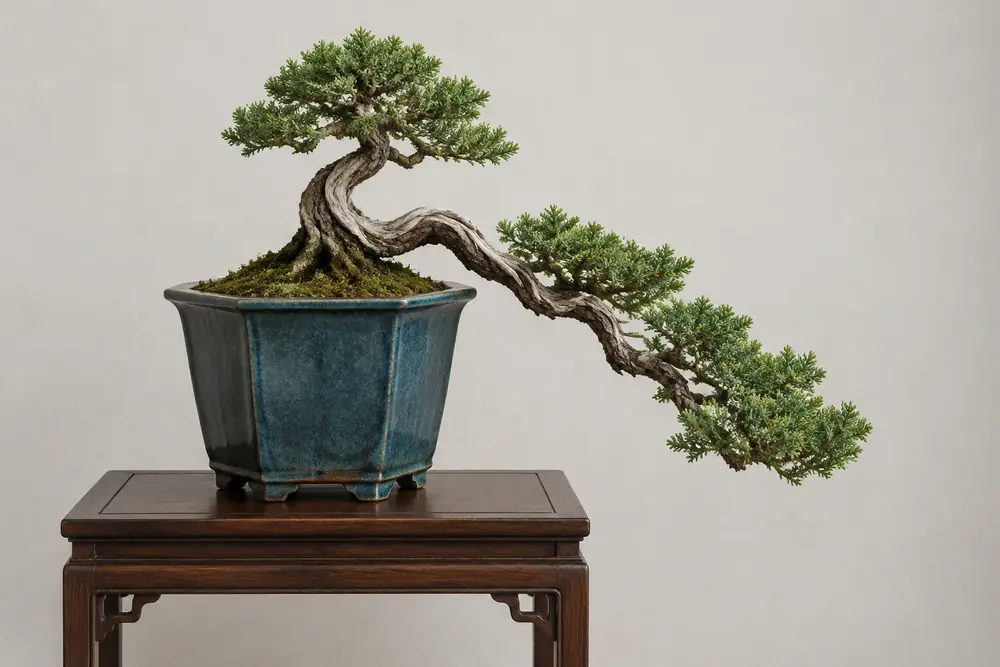
Keeping the cascade branch strong
Trees are apically dominant: the highest growth gets the most energy. In a semi-cascade, the falling trunk is the lowest part of the tree, so it tends to weaken over time while the crown gets bushy. To counter that:
- Prune the top harder than the cascade. Remove strong shoots in the crown first.
- Let the cascade grow longer before trimming it.
- Give it light. Turn the tree so the cascade gets good sun, and keep the crown thinned so it does not shade the branch below.
- Feed well during the growing season; a weak tree loses its lowest branches first.
If the cascade branch dies back despite this, check that the roots on that side are healthy. A cascade often draws water from one side of the root ball.
Pots and display
A semi-cascade pot is deeper than a standard bonsai pot but not as tall as a full cascade pot. Round, square and hexagonal shapes are typical. The extra depth helps balance the tree and holds more water, which the cascade branch needs. Our guide to tall bonsai pots for cascade styles covers sizes, and our review of a large cascade ceramic pot looks at one option in detail.
On display, place the tree on a stand or at the edge of a table so the cascade can fall freely. A low accent plant on the opposite side balances the arrangement.
Watering a semi-cascade
Water the whole surface slowly. The side of the pot under the cascade tends to dry faster because that side of the root ball feeds the long, sun-exposed branch. Check both sides with a chopstick, especially in summer.
Common mistakes
- The cascade falls too far, turning a semi-cascade into a full cascade that the pot cannot balance.
- A big, heavy crown that overshadows the falling trunk.
- Straight, pipe-like cascade with no movement or taper.
- Branches on the inside of bends.
- The cascade aimed at the viewer, which hides its shape.
Frequently asked questions
Can I make a semi-cascade from an upright tree?
Yes, if the trunk is young and flexible. Repot it at a steep angle and wire the trunk down. Thick, mature trunks are much harder to bend.
How long does it take to develop?
The basic shape can be set in one wiring session. Filling out the pads and keeping the cascade vigorous takes several years.
Is a semi-cascade harder to care for than an upright?
Slightly. Watering and keeping the low branch healthy need more attention. The basic care of the species stays the same; for junipers, see our Japanese juniper bonsai care guide.
Does the cascade need to go to the left or right?
Either. Choose the side that suits the trunk’s natural movement and the best root view.
Final thoughts
The semi-cascade sits between the slanting and full cascade styles: out and down, but not too far. Pick a flexible species, set the angle at repotting, wire with movement, and keep the falling branch stronger than the crown. For classic style names and their meanings, the Wikipedia article on bonsai aesthetics is a good reference, and our overview of types of bonsai compares all the main styles.