When to Fertilize Bonsai After Repotting (and What to Use)

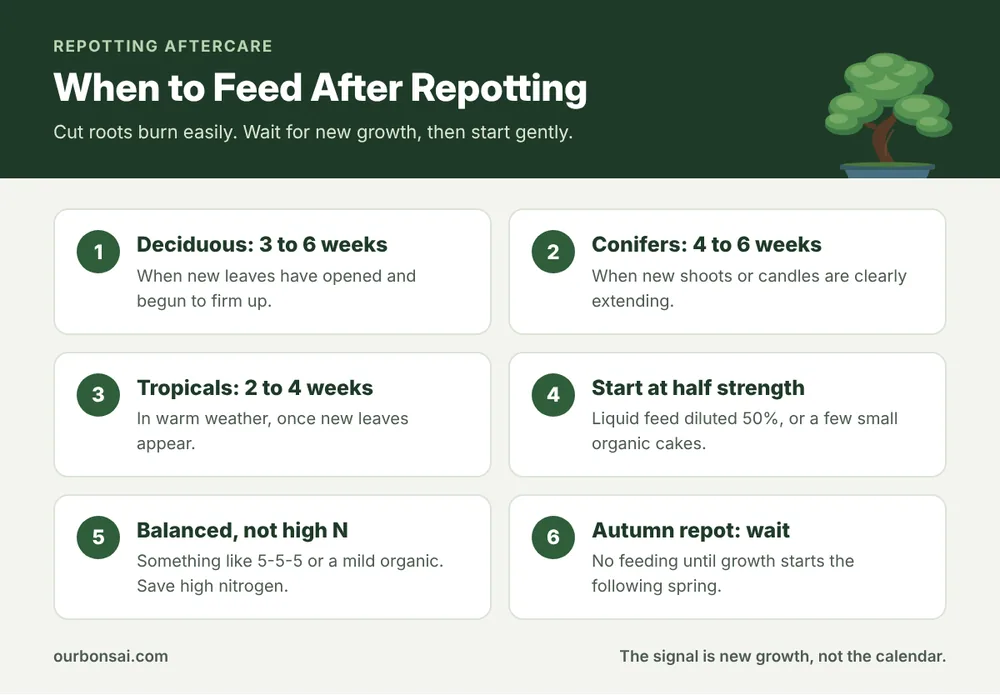
The safe time to fertilize bonsai after repotting is when the tree shows new growth, which is usually 3 to 6 weeks for deciduous trees, 4 to 6 weeks for conifers, and 2 to 4 weeks for tropical species repotted in warm weather. Start at half strength, with a diluted liquid fertilizer or a few small organic cakes, and work up to the normal dose over the following 2 to 4 weeks. Feeding on the day of repotting is the classic mistake: fresh root cuts and new root tips are easily damaged by fertilizer salts, and the tree is running on stored energy at that stage anyway. If you repotted in autumn, wait until growth starts in spring.
In this guide
Why waiting matters
When you repot, you cut and tear roots. The tips that remain, and the new ones that grow over the next few weeks, are where water and nutrients get absorbed. They are also the most sensitive part of the tree.
Fertilizer is salt. In the soil, dissolved fertilizer raises the concentration of salts around the roots. Healthy, established roots cope. Freshly cut roots and tender new root tips can lose water to the surrounding soil instead of taking it up, which is the mechanism behind fertilizer burn. The result is brown leaf edges, wilting despite wet soil, and slower recovery.
At the same time, the tree does not need much from the soil right after repotting. Deciduous trees in spring draw on starch stored in their trunk and roots over winter to open their buds. That reserve carries them through the first few weeks.
Why you should not wait too long either
Most bonsai soils are largely inorganic: akadama, pumice, lava. They start with almost no nutrients. Once new leaves are out and actively photosynthesizing, the tree’s demand rises and its stored reserves have been spent on the spring flush. If you leave it unfed for months in fresh inorganic soil, growth stalls, leaves pale, and the roots it needed to grow do not.
So the goal is not “never feed” or “feed immediately.” It is “start once new growth is under way, and start gently.”
Timing to fertilize bonsai after repotting, by tree type
| Tree type | Examples | When to start | First feed |
|---|---|---|---|
| Deciduous | Maple, elm, zelkova, beech | When new leaves have opened and started to firm, about 3 to 6 weeks | Half-strength liquid or a few small cakes |
| Conifers | Juniper, pine, spruce | When new shoots or candles are extending, about 4 to 6 weeks | Half-strength, then normal after 2 to 3 weeks |
| Flowering | Azalea, pomegranate, wisteria | After new leaves harden; some growers wait until after flowering | Low-nitrogen, half strength |
| Tropical indoor | Ficus, schefflera, Fukien tea | 2 to 4 weeks in warm weather, once new leaves appear | Half-strength liquid every 2 weeks |
| Repotted in autumn | Any | Next spring, when growth begins | Normal spring start |
| Weak or rescued tree | Any | Only once it is clearly growing again | Very dilute, quarter strength |
Tropical trees recover faster because they are typically repotted in warm weather, when roots regrow within days. Our guide to the best time to repot tropical bonsai explains why summer repotting suits them.
What to use for the first feeds
Liquid fertilizer, diluted. The easiest to control. Mix at half the label’s bonsai dose and apply to damp soil, never dry soil. Our roundup of liquid fertilizers for bonsai covers some popular choices.
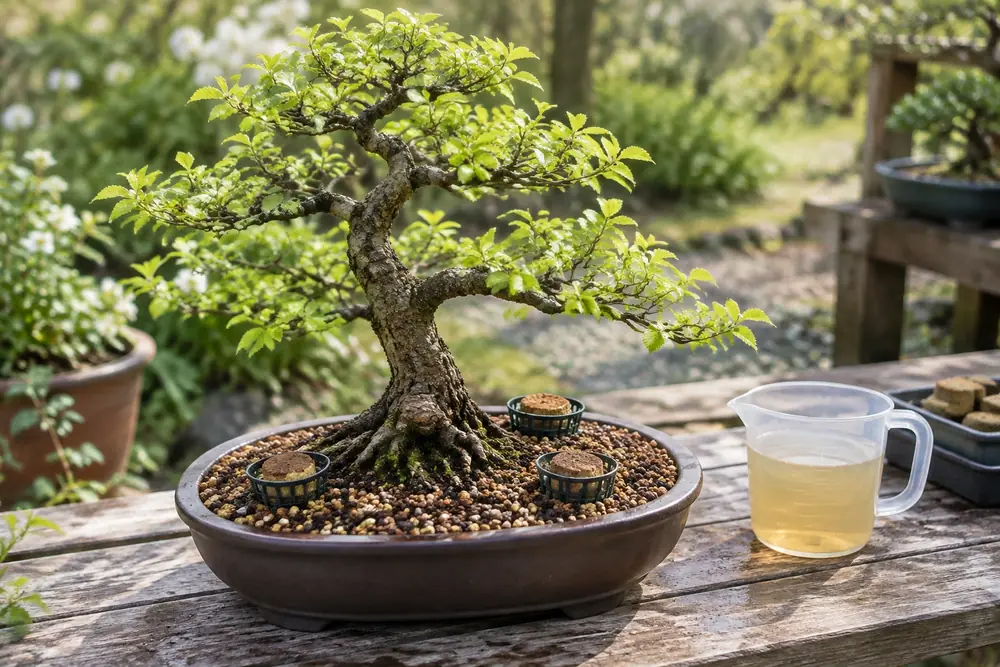
Organic cakes or pellets. Slow-release and gentle, because nutrients are released as soil organisms break them down. Place two or three small cakes on the soil surface, away from the trunk, rather than the full number. Many growers use small plastic baskets to stop them washing around. Our comparison of pellet and liquid bonsai fertilizer weighs the pros and cons.
Balanced ratios. Something close to an even NPK ratio, or a mild organic, is a sensible start. High-nitrogen feeds push soft, fast shoots on a tree whose roots are still catching up.
Products marketed for transplant shock
You will see vitamin B1 tonics, “root boosters” and seaweed extracts sold for transplant shock. The evidence for vitamin B1 helping established plants recover from transplanting is weak. Seaweed extract is a mild fertilizer with trace elements and is generally safe at label rates, but it is not a substitute for careful repotting and the right aftercare. If you use one, treat it as a very light feed and still wait for new growth.
Signs you fed too early or too strong
- Leaf edges turning brown and crisp a week or two after feeding.
- Sudden wilting while the soil is moist.
- New shoots blackening at the tip.
- A white crust forming on the soil surface.
If you see these, flush the pot thoroughly with clean water (three or four times the pot volume), remove any fertilizer cakes, and stop feeding for 2 to 3 weeks.
A simple post-repot feeding schedule
- Week 0: Repot. Water thoroughly. No fertilizer.
- Weeks 1 to 3: Shelter from wind and strong sun. Water when the surface dries. Still no fertilizer.
- First new growth: Half-strength liquid feed, or two or three small organic cakes.
- Two to four weeks later: Normal dose for your species and season.
- Rest of the season: Your usual feeding plan.
Our bonsai fertilizer NPK guide covers how to adjust the ratio through the rest of the year.
Frequently asked questions
Can I mix slow-release fertilizer into the new soil when repotting?
It is better not to. Granules mixed into the root zone release nutrients right next to the cut roots. Add fertilizer to the surface once the tree is growing.
My tree was repotted a month ago and shows no new growth. Should I feed it?
Not yet. Feeding a tree that is not growing does not wake it up and may harm the roots. Check that the soil is not staying wet and the tree is not too cold, and be patient.
Is it OK to use the same fertilizer as before repotting?
Yes, just at a lower dose for the first few feeds.
Should I fertilize a tree repotted in late summer?
Lightly, once it shows new root growth, but stop by early autumn for outdoor temperate trees so new growth can harden before winter.
Final thoughts
The rule is simple: after repotting, wait for new growth, then feed gently and build up. That protects new roots from salt damage while giving the tree what it needs once it starts growing in fresh, nutrient-poor soil. For how fertilizer burn happens, see the Wikipedia article on fertilizer burn, and if your repot was in autumn, read our notes on repotting bonsai in autumn.