When and How to Repot Chinese Elm Bonsai

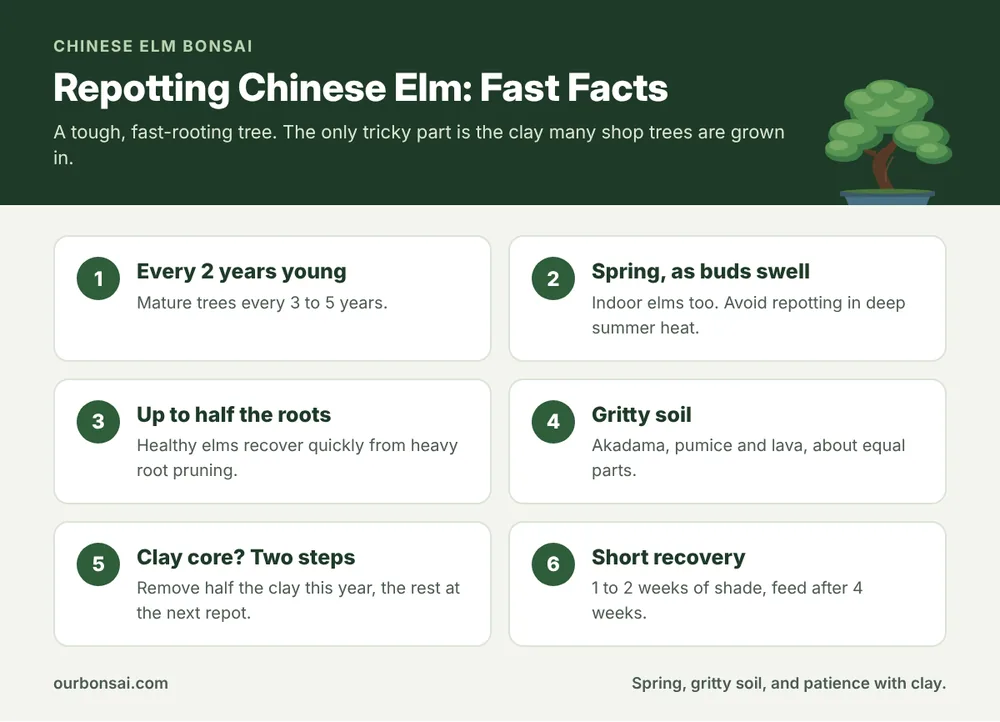
Here is how to repot chinese elm bonsai: repot every 2 years while the tree is young and every 3 to 5 years once mature, in spring as the buds begin to swell. Chinese elm (Ulmus parvifolia) is one of the most forgiving bonsai, and a healthy tree can lose up to half its roots and still recover quickly. Use a gritty mix of roughly equal parts akadama, pumice and lava. The one complication is that many mass-produced elms sold as “indoor bonsai” arrive in heavy clay soil; replace that clay in two stages, half at this repot and the rest at the next.
In this guide
Why Chinese elm is easy to repot
Chinese elm grows wild across China, Korea, Japan and Vietnam, in a range of soils and climates. It is vigorous, roots quickly, and heals cuts fast. It also back-buds freely above ground, so a tree that loses some vigor after a repot soon catches up. Those qualities are a big part of why it is one of the most popular beginner bonsai.
It is semi-evergreen. Outdoors in cold climates it drops its leaves in winter; indoors or in mild climates it may keep many of them. Either way, spring is the time for root work.
When to repot
| Tree | Interval | Timing |
|---|---|---|
| Young tree in development | Every 1 to 2 years | Early spring as buds swell |
| Mature tree in display pot | Every 3 to 5 years | Early spring as buds swell |
| Indoor or mall elm | When soil drains poorly | Spring, when new growth begins |
| Tree in distress (rot, compacted soil) | Now, if spring or summer | Avoid hot midsummer days |
Signs it is time: water pooling on the surface, roots circling or poking out of drainage holes, and growth slowing even with good care. Our main Chinese elm bonsai care guide covers the rest of the year.
The clay problem in mass-produced elms
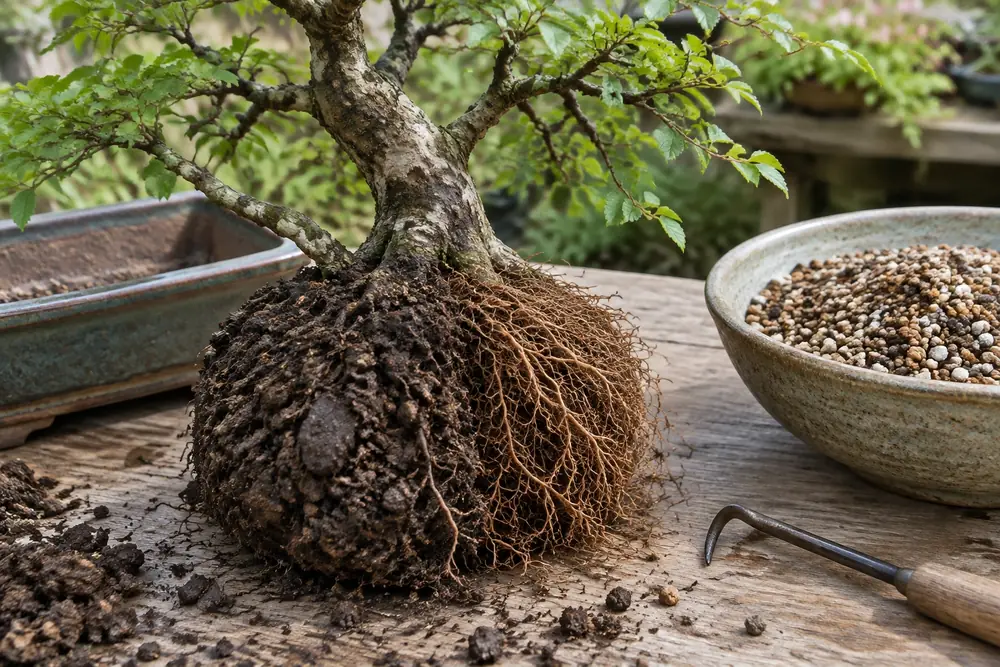
Many Chinese elms sold in shops and online are field-grown in Asia in heavy clay, then lifted and potted with that clay still around the roots, sometimes topped with a thin layer of gravel or glued pebbles. The clay holds water for a long time in the center of the pot while the edges dry out, which makes watering confusing and invites root rot.
Do not wash all of it off at once, especially on a tree that has just arrived and is already stressed. Instead:
- First repot: remove the outer half of the clay and roots, trim, and fill with fresh gritty soil.
- Second repot (1 to 2 years later): remove the rest of the clay from the core.
If there are glued stones on the surface, crack and remove them as soon as you buy the tree; they block water and air.
Soil
A mix of about equal parts akadama, pumice and lava, sieved to 2 to 6 mm, suits Chinese elm well. In hot, dry climates add more akadama. For indoor elms, use a little extra pumice so the soil does not stay wet in low light. Our guide to the best soil for Chinese elm bonsai compares ready-made options.
How to repot chinese elm bonsai, step by step
- Prepare the pot, mesh and tie-in wires, and sieve the soil.
- Remove the tree. Cut the old wires, run a knife around the inside of the pot and lift it out.
- Comb out the roots from the outside in, using a root hook. Elm roots are tough and tolerate firm combing.
- Cut thick roots growing straight down, and shorten long roots to fit the new pot.
- Remove up to half the root mass on a healthy tree. On a weak or newly bought tree, take less.
- Spread the surface roots outward to improve the nebari.
- Pot up, tie in firmly, and work soil into all gaps with a chopstick.
- Water thoroughly until it runs clear.
Our list of the best bonsai repotting tools covers the root hook, scissors and knife you need.
Aftercare
- Shade and shelter for 1 to 2 weeks, then return to full sun (outdoor) or the brightest window or grow light (indoor).
- Water when the top 1 cm dries. Fresh gritty soil dries faster than old clay, so check daily.
- Feed after about 4 weeks at half strength, then normally. Our guide to the best Chinese elm bonsai fertilizer lists good options.
- Light pruning is fine once new shoots are growing well.
- Protect outdoor trees from late frost for a few weeks after an early spring repot.
Indoor vs outdoor elms after repotting
Chinese elms kept outdoors recover fastest, because they get strong light and steady temperatures that suit new root growth. Indoor elms recover more slowly in a window, especially if they are repotted early in spring when daylight is still short. If your elm lives inside, consider giving it a few weeks outdoors in a sheltered, bright spot once nights stay above about 10 C (50 F). Many growers keep their “indoor” elms outdoors from spring to autumn anyway, since the species is hardy and grows much better outside. In winter, an unheated but frost-free room or a sheltered spot outdoors suits it better than a warm living room.
Mistakes to avoid
- Leaving glued pebbles on the soil. Remove them on day one.
- Washing out all the clay in one go on a weak tree. Do it in two stages.
- Repotting in deep summer heat. Elm handles it better than most trees, but recovery is faster in spring.
- Watering on a schedule after the repot. Gritty soil dries faster; check, do not guess.
Frequently asked questions
Can I repot a Chinese elm in summer?
In an emergency, yes. Elm is tough. For routine repotting, spring as buds swell is better.
How much root can I remove from a Chinese elm?
Up to about half on a healthy tree. Weaker trees should lose less.
Should I repot a Chinese elm I just bought?
If it is in heavy clay or has glued stones, remove the stones right away, and plan a partial repot for the coming spring. If it is in decent soil, wait until spring.
Does Chinese elm need a deep pot?
No. A medium or shallow pot works once the root system is established. Use a deeper training pot while building trunk size.
Final thoughts
Chinese elm forgives a lot, which makes it a great tree to learn repotting on. Repot in spring, use gritty soil, and deal with shop clay in two steps. If you have a cork bark variety, the same rules apply; see our cork bark elm bonsai care guide. For the species itself, read the Wikipedia article on Ulmus parvifolia.