When and How to Repot Bougainvillea Bonsai

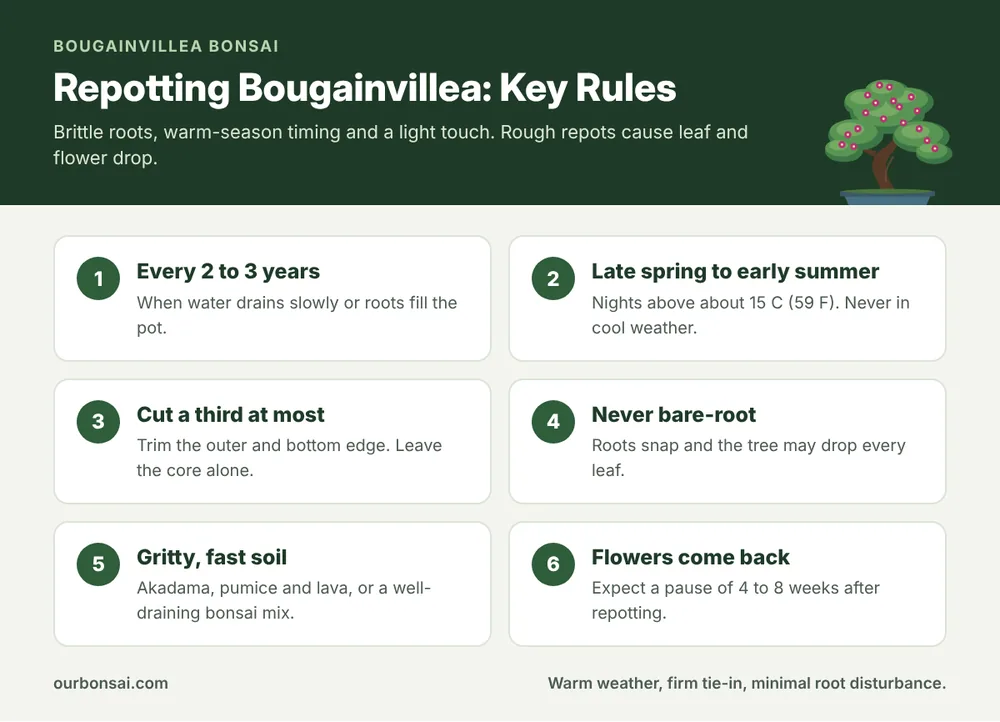
Here is how to repot bougainvillea bonsai without losing leaves and flowers: repot every 2 to 3 years, in late spring or early summer once nights stay above about 15 C (59 F); trim no more than a third of the root mass from the outer edge and bottom; never bare-root it; and use a gritty, fast-draining soil. Bougainvillea roots are thick but brittle and recover slowly, so the tree often drops leaves and pauses flowering for 4 to 8 weeks after even a careful repot. That pause is normal. A rough repot in cool weather is what kills them.
In this guide
Three facts to know before you start
The roots snap. Bougainvillea roots are fleshy and break easily, and the plant does not regrow fine roots as quickly as a ficus or elm. In gardens, landscapers often plant it without disturbing the root ball at all.
It is a warm-season grower. Native to South America, it grows actively only when it is warm. Root cuts made in cool weather sit unhealed and can rot.
It flowers best a little root-bound. A tree in a pot that is slightly tight blooms more freely than one with lots of fresh space. So do not repot more often than you need to, and do not jump to a much bigger pot.
When to repot
| Sign | What it means |
|---|---|
| Water sits on the surface or drains slowly | Soil has broken down |
| Roots circle the pot or push out of holes | Pot is full |
| Tree dries out within hours in summer | Too many roots, not enough soil |
| Weak growth despite feeding and sun | Roots are struggling |
The best window is late spring to early summer, when the tree is growing strongly. In tropical climates, any time outside the coolest months works. Our guide on the best time to repot tropical bonsai covers the general timing for warm-climate species.
The right soil
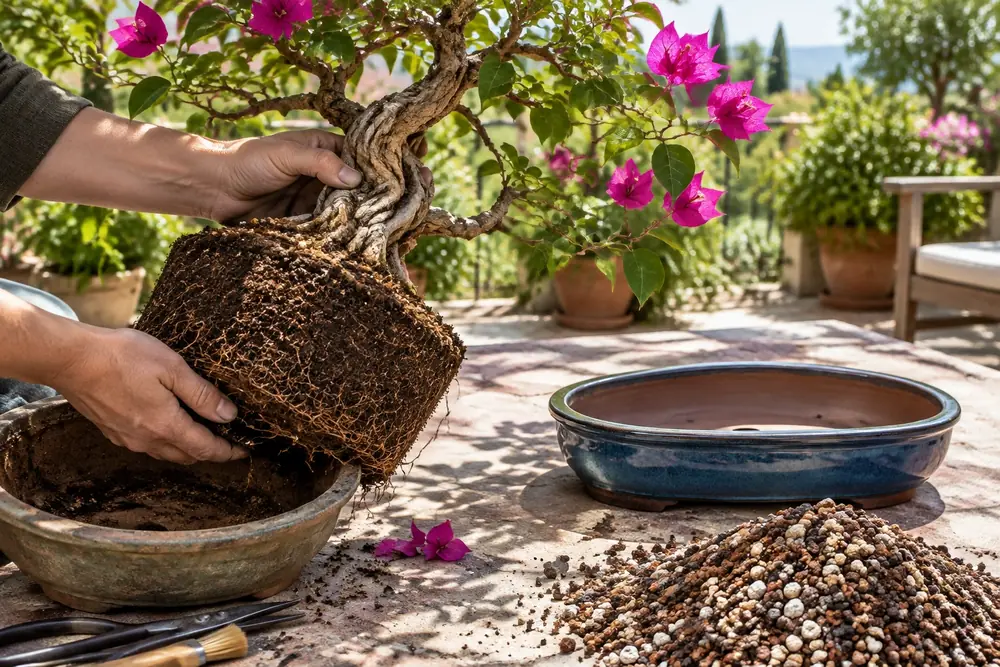
Bougainvillea wants fast drainage. Waterlogged soil quickly rots its roots, especially indoors in winter. A mix of akadama, pumice and lava in roughly equal parts works well. Some growers add a little fine bark for extra moisture in hot, dry climates.
For product options and recipes, see our guide to the best soil for bougainvillea bonsai.
How to repot bougainvillea bonsai, step by step
- Water the day before so the root ball is moist and holds together. Dry roots snap more easily.
- Prepare the pot. Mesh over the holes, tie-in wires in place, a thin layer of coarse soil at the bottom.
- Remove the tree. Cut old tie wires. Run a thin knife round the inside of the pot, then ease the tree out by the base of the trunk. Do not pull on branches; they are thorny and brittle at junctions.
- Loosen only the outer edge. With a chopstick, gently tease out roots on the outer 2 to 3 cm and the bottom. Stop if roots start breaking in large numbers.
- Trim. Cut circling and dangling roots with sharp scissors, removing no more than a third of the root mass. Leave the central core around the trunk untouched.
- Position and tie in firmly. Bougainvillea is often top-heavy. A tree that rocks in the pot will tear its new roots. Our guide to bonsai repotting wire shows how to anchor it.
- Fill and settle. Add soil and work it into the gaps with a chopstick, gently. Do not push hard on the root ball.
- Water thoroughly until it runs clear.
Choosing the new pot
Because bougainvillea flowers best when slightly snug, the new pot should be the same size or only a little larger than the old one after root pruning. Glazed pots in cream, blue or green set off the magenta, orange or white bracts well, and a medium-depth pot holds enough water for a sun-loving plant without staying wet. Very shallow display pots dry out in hours in summer heat, so save those for mature trees with well-developed, compact root systems. Make sure the drainage holes are large; bougainvillea is far more likely to suffer from too much water than too little.
Aftercare
- Bright light, sheltered from wind. A week of light shade helps, then return to full sun. Bougainvillea needs a lot of sun to grow and flower.
- Keep it on the dry side of moist. Water when the top 1 to 2 cm is dry. Too much water on cut roots invites rot.
- No fertilizer for 4 weeks. Then resume with a feed that is not too high in nitrogen.
- Expect some leaf drop. Bougainvillea often sheds leaves and bracts after root disturbance. New leaves usually follow within a few weeks if the tree is warm and in sun.
- Do not prune hard right away. Wait until new growth is clearly underway.
Troubleshooting after a repot
| Problem | Likely cause | Fix |
|---|---|---|
| All leaves drop within days | Too many roots cut, or cold | Keep warm, bright, slightly dry; wait |
| Leaves yellow and soil stays wet | Overwatering after repot | Let soil dry more between waterings |
| Tree wobbles | Not tied in | Re-tie firmly |
| No flowers for months | Too much nitrogen, not enough sun, or pot too large | Full sun, low-nitrogen feed, patience |
For other bougainvillea issues, our article on bougainvillea bonsai styles covers shaping, and best flowering indoor bonsai trees compares it with other flowering species.
Frequently asked questions
Can I repot a bougainvillea bonsai while it is flowering?
You can, but it will probably drop many of its bracts. Repotting right after a flowering cycle is kinder.
How much root can I cut from a bougainvillea?
No more than about a third, and only from the outer edge and bottom of the root ball.
Why did my bougainvillea drop its leaves after repotting?
Root disturbance, cold, or too much water after the repot. Keep it warm, in bright light, and slightly dry. New leaves usually appear within a few weeks.
What size pot should a bougainvillea bonsai go in?
One that is only slightly larger than the root ball, or the same size after root pruning. A snug pot encourages flowering.
Final thoughts
Repot bougainvillea only when it needs it, only when it is warm, and only lightly. Keep the core intact, tie it in firmly, and give it sun. For more on the plant itself, Clemson Extension’s bougainvillea factsheet explains its needs as a garden plant, and the Wikipedia article on Bougainvillea covers its origins.