When and How to Repot Boxwood Bonsai

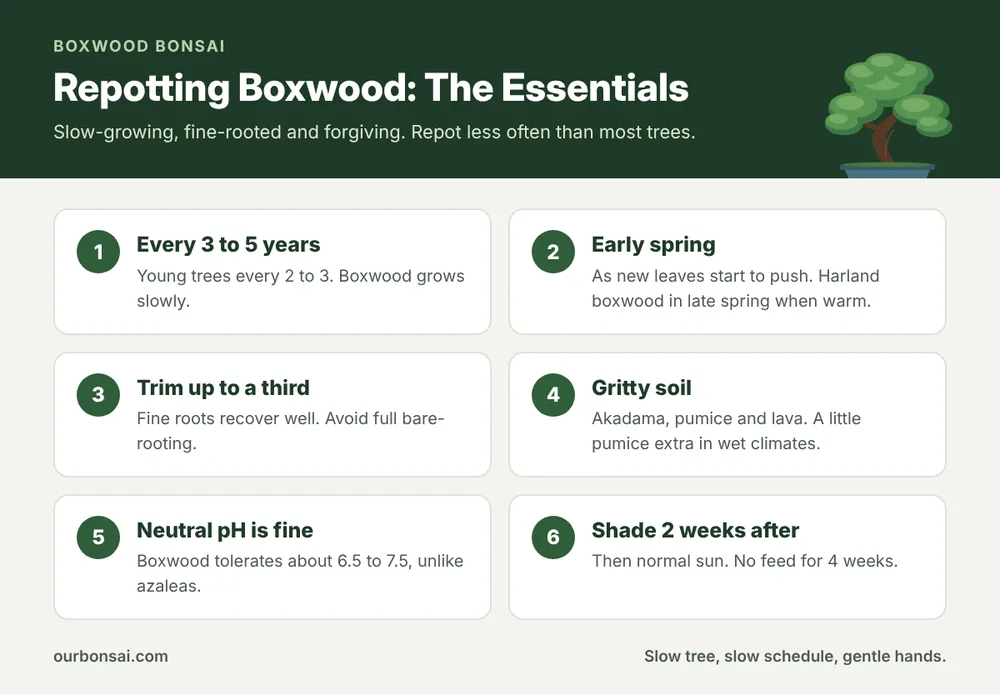
Here is how to repot boxwood bonsai: repot every 3 to 5 years (every 2 to 3 while young), in early spring as the first new leaves begin to push, trim up to about a third of the fine roots, and use a gritty mix of akadama, pumice and lava. Boxwood is slow-growing and tough, and it tolerates root work better than many evergreens. It also tolerates a near-neutral soil pH of about 6.5 to 7.5, so you do not need acidic soils like kanuma. The one exception to the timing is Harland boxwood, a warmer-climate species that is best repotted in late spring once nights are warm.
In this guide
Which boxwood do you have?
Three kinds are common as bonsai, and the timing differs slightly.
| Type | Botanical name | Climate | Best repot time |
|---|---|---|---|
| Common or English boxwood | Buxus sempervirens | Hardy outdoor tree, about USDA 5 to 8 | Early spring |
| Japanese and Korean boxwood | Buxus microphylla and relatives | Hardy outdoor tree, about USDA 5 to 9 | Early spring |
| Harland boxwood | Buxus harlandii | Subtropical, light frost only (about USDA 7 to 10 in the ground) | Late spring, nights above 15 C |
Harland boxwood is often sold as an “indoor bonsai” in the United States. It has narrow, spoon-shaped leaves and an upright habit. Our Brussels Harland boxwood bonsai review shows a typical tree.
When boxwood needs repotting
Boxwood fills a pot slowly, so look for real signs rather than counting years:
- Water runs off the surface or takes a long time to soak in.
- A dense mat of roots circles the pot.
- Growth has been weaker for two seasons despite feeding.
- The tree dries out much faster than it used to.
If you see none of these, leave it another year. Boxwood is happy in the same pot for a long time. A quick check is to tip the tree gently out of its pot in late winter and look at the outside of the root ball. If you see mostly soil with a few white root tips, it can wait. If you see a solid wall of roots, plan the repot for the coming spring.
Soil for boxwood
Boxwood has fine, fibrous roots that need air. A standard mix of roughly equal parts akadama, pumice and lava, sieved to 2 to 6 mm, suits it well. In wet climates, add a little extra pumice. In hot, dry climates, add a little extra akadama.
Unlike azaleas, boxwood does not need acidic soil. It is happy around neutral, and many garden boxwoods grow well in slightly alkaline soil. Our bonsai soil mix ratio guide explains each component.
How to repot boxwood bonsai, step by step
- Prepare everything first. Sieve the soil, cover the pot holes with mesh and set tie-in wires. A repotting mat keeps the bench tidy.
- Unpot the tree. Cut old wires, run a knife around the inside edge and lift the tree out.
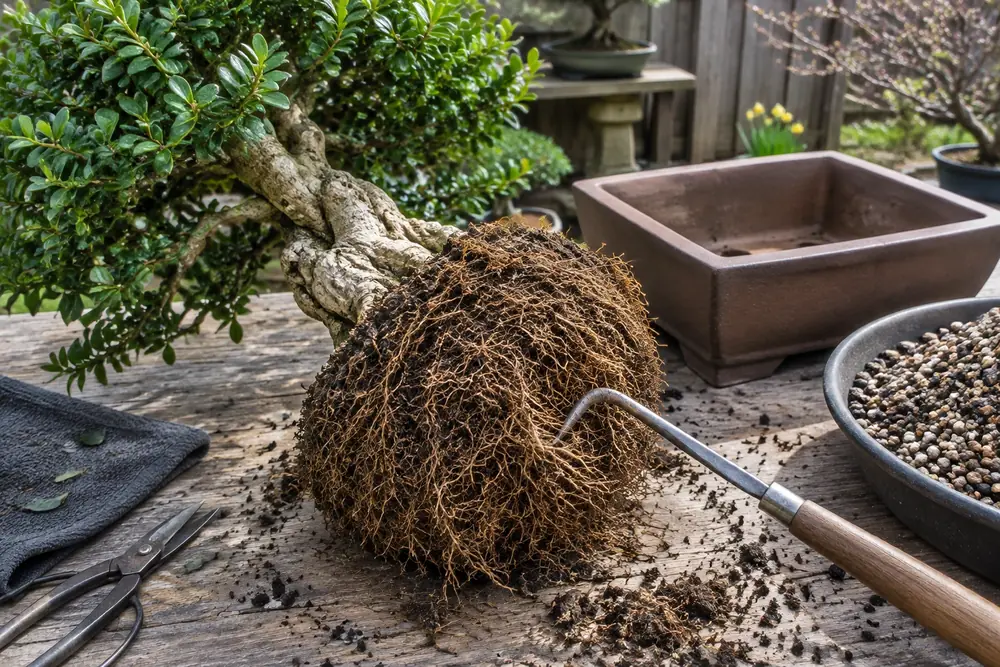
- Comb out the roots. With a root hook, work from the outside in and from the bottom up. Boxwood roots are dense; take your time.
- Remove old soil from the outer half of the root ball. Leave the core near the trunk.
- Cut back. Trim thick roots that grow straight down and shorten circling roots. Remove up to about a third of the root mass on a healthy tree.
- Check the root spread. Boxwood often has poor surface roots. Spread the ones you have outward to improve the base over time.
- Repot. Set the tree on a mound of fresh soil, tie it in firmly, and work soil in around the roots with a chopstick.
- Water well until it runs clear.
Our list of the best bonsai repotting tools covers root hooks and scissors.
Root pruning and the nebari
Many boxwood bonsai start life as garden hedging plants, and hedge plants often have a lopsided root system with one or two thick roots and few surface roots. Repotting is your chance to improve that, a little at a time. Each repot, cut back one or two thick downward or crossing roots and encourage the finer roots that spread outward near the surface. After two or three repots over several years, the base usually looks much better. Trying to fix it all at once, by cutting most thick roots in one session, is the quickest way to set a boxwood back by a year or more.
Aftercare
- Light shade for about 2 weeks, out of wind. Then return the tree to its normal spot. Hardy boxwoods like sun to part shade; Harland boxwood likes bright light.
- Water when the top centimeter dries. Do not keep the soil soaking wet.
- No fertilizer for about 4 weeks, then a balanced feed at half strength, building up to normal.
- Frost protection. Hardy boxwood repotted in early spring should be sheltered from hard frost for a few weeks. Harland boxwood in a pot should be kept above freezing.
Mistakes to avoid
- Repotting in autumn. Roots do not recover before winter.
- Bare-rooting an old tree. Fine roots dry out quickly. Keep a core of old soil.
- Using heavy garden soil. It compacts and starves the roots of air.
- Repotting too often. Boxwood is slow; disturbing it every year keeps it weak.
If your boxwood looks pale or bronzed after winter, that is often cold or wind damage rather than a root problem. For other issues, see our general guide to bonsai pests and diseases, and for shaping ideas, our article on boxwood bonsai styles.
Frequently asked questions
How often should I repot a boxwood bonsai?
Young trees every 2 to 3 years, older trees every 3 to 5 years, or when water stops draining well.
Can I repot boxwood in summer?
Hardy boxwood is better repotted in spring. Harland boxwood is fine in late spring to early summer. Avoid repotting in high summer heat.
Does boxwood need acidic soil?
No. It grows well in neutral to slightly alkaline soil. A standard akadama, pumice and lava mix is ideal.
How much root can I remove from a boxwood?
About a third on a healthy tree. Weak trees should lose less.
Final thoughts
Boxwood is one of the calmest trees to repot: slow, tough and forgiving. Wait until it truly needs it, repot in early spring, trim moderately and use a gritty soil. For more about the species, Clemson Extension’s boxwood factsheet is useful, and the Wikipedia article on Buxus sempervirens covers common boxwood.