How Often to Water Beech Bonsai: Season-by-Season Guide


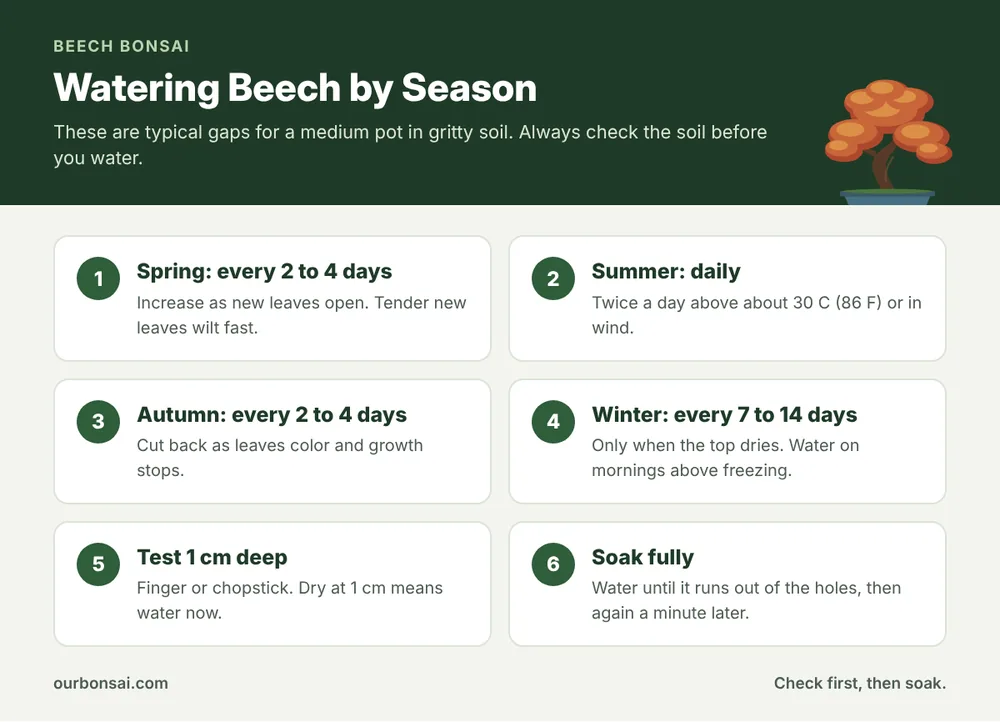
How often to water beech bonsai depends on the season: about once a day in summer (twice in heat waves), every 2 to 4 days in spring and autumn, and every 7 to 14 days in winter for a dormant tree outdoors. Those numbers are for a medium pot, roughly 15 to 25 cm across, in a gritty akadama-based mix. The real rule is simpler: water when the top 1 cm of soil feels dry, and then soak the pot until water runs from the drainage holes. Beech scorches quickly if it dries out in summer and its fine roots rot if they stay wet in winter, so checking every day beats any fixed schedule.
In this guide
Why beech is particular about water
European beech (Fagus sylvatica) and Japanese beech (Fagus crenata) grow in forests on well-drained slopes, under steady rainfall and high humidity. Their leaves are thin and soft, so they lose water fast in sun and wind. Their roots are fine and shallow and live alongside soil fungi that need air.
In a shallow bonsai pot, that leaves a narrow window. A beech that dries out on a hot afternoon gets brown, crispy leaf edges within a day. A beech that sits in wet soil for weeks in winter loses roots, and you see it as weak leaves in spring.
How often to water beech bonsai in each season
| Season | Typical interval | What the tree is doing |
|---|---|---|
| Early spring (buds lengthening) | Every 3 to 5 days | Roots waking; little leaf area yet |
| Late spring (leaves open) | Every 2 to 3 days | Leaves expanding; very tender |
| Summer | Daily, twice in heat | Full canopy, highest water use |
| Early autumn | Every 2 to 3 days | Growth slowing |
| Late autumn | Every 3 to 5 days | Leaves coloring and drying |
| Winter | Every 7 to 14 days | Dormant; uses very little |
Small pots, shallow pots, windy spots and full sun all shorten the gap. Large pots, light shade, cool damp weather and moss on the soil lengthen it.
How to check if a beech needs water
Use one of these checks every day in the growing season, and every few days in winter.
- Finger test. Press a finger 1 cm into the soil. Dry and crumbly means water now. Cool and slightly damp means wait.
- Chopstick test. Push a wooden chopstick 3 to 4 cm into the soil and leave it. Pull it out before watering. If the tip is dark and damp, wait.
- Weight test. Lift the pot right after watering to learn how heavy it feels wet. A noticeably lighter pot is dry.
- Color test. Akadama turns from dark brown when wet to light tan when dry.
A cheap soil moisture meter can help beginners learn the feel. Our review of the best soil moisture meter for indoor plants works for outdoor pots too.
How to water a beech properly
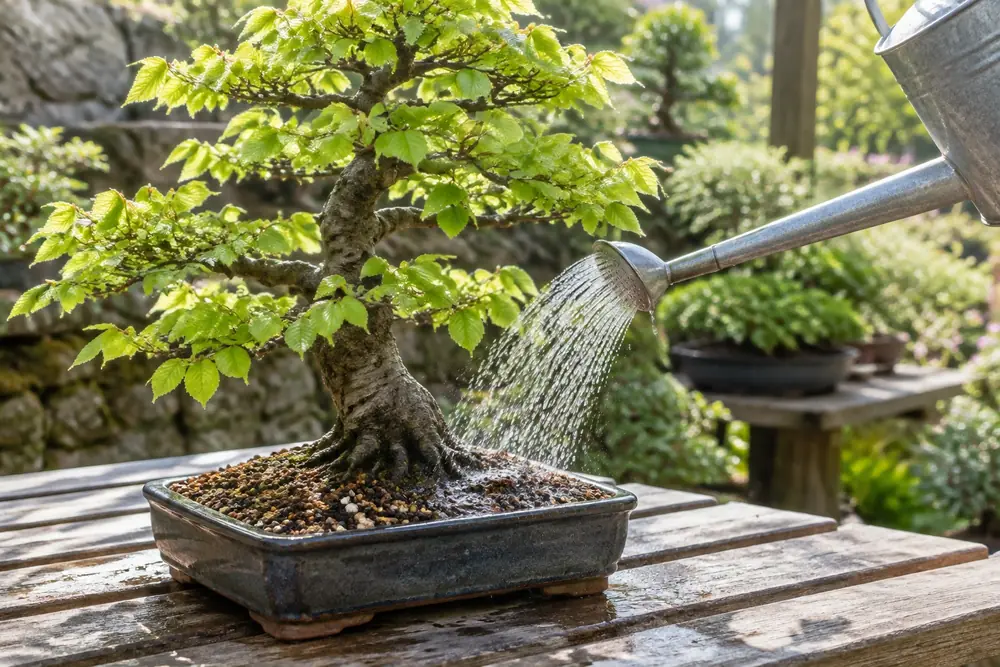
- Use a fine rose so the water does not wash soil out. A long-spouted bonsai can helps reach under a dense canopy. See our pick of the best Japanese watering can for bonsai.
- Water the whole surface until water runs out of the drainage holes.
- Water again a minute later. The first pass wets the grains; the second fills the gaps and flushes stale air.
- Water in the morning in summer, so the tree starts the hot part of the day full. Add an evening check in heat waves.
- Use rainwater when you can. Beech prefers slightly acidic soil, and hard tap water slowly raises the pH.
Signs you are watering too little
- Leaves wilt or droop in the afternoon and recover overnight.
- Leaf edges turn brown and crispy, starting with the leaves in the most sun.
- Soil shrinks away from the pot wall.
- Leaves drop in midsummer.
If the root ball dried out completely, sit the pot in a bucket of water for 10 minutes to rewet it fully. Our guide to why bonsai leaves wilt explains how to tell drought from root damage.
Signs you are watering too much
- Soil still dark and wet a day or two after watering in summer.
- Green algae and moss spreading quickly over the surface.
- Yellowing leaves and weak new growth even though you feed.
- A sour smell from the soil.
Overwatering is usually a soil problem as much as a watering problem. If your mix stays wet, it needs more pumice and lava. A mix of about half akadama with pumice and lava suits beech; our bonsai soil mix ratio guide explains how to adjust it.
Winter watering
Beech holds dry, coppery leaves through much of the winter, which can fool people into thinking it is still active. It is not. Water only when the top of the soil has dried, on a morning above freezing, so excess drains before night. Trees in a cold frame or under eaves get no rain and need checking every week or so. Trees out in the open may not need watering at all in a wet winter.
When you go away
In summer, a beech cannot safely go more than a day or two without water. Options:
- Ask someone to water it, and show them the finger test.
- Move it to light shade and set the pot on a tray of wet gravel.
- Use a drip or automatic watering system. Our guide to the best automatic watering system for bonsai compares options.
Frequently asked questions
Should I water my beech bonsai every day?
In summer, usually yes. In spring, autumn and winter, no. Check the soil daily and water only when the top 1 cm is dry.
Can I mist my beech bonsai?
Misting does little for watering, but a light spray of the foliage on hot, dry evenings can help reduce leaf scorch.
Why are my beech bonsai leaves browning in summer?
Usually drought or strong afternoon sun. Check the soil more often and give afternoon shade during heat waves.
Does a beech bonsai need water in winter?
Yes, a little. Dormant roots still need moisture. Water when the soil dries, which may be only every week or two.
Final thoughts
There is no perfect schedule for beech, only a habit: check the soil every day, water deeply when the top is dry, and adjust for the season. For more on the species, see the Wikipedia article on Fagus sylvatica.