Bougainvillea Bonsai Pests and Diseases: Identification and Treatment

Quick Answer
Bougainvillea bonsai pests and diseases commonly include aphids, mealybugs, scale insects, spider mites, caterpillars, leaf spot, powdery mildew, and root rot. Identify the problem by inspecting leaf undersides, new shoots, stems, and the soil before treating the tree. Most minor infestations respond to physical removal, improved growing conditions, and an appropriate labeled treatment.
Common problems and their signs
- Aphids: Clusters of tiny insects on tender shoots, curled leaves, and sticky honeydew.
- Mealybugs and scale: White cottony patches or fixed bumps on stems and leaf joints.
- Spider mites: Fine webbing, pale stippling, and dull or bronzed leaves.
- Caterpillars: Ragged leaf edges, missing sections, and small dark droppings.
- Leaf spot: Brown, reddish, or black lesions that may spread in persistently damp conditions.
- Root rot: Persistent wilting, yellowing, and declining roots in poorly drained, waterlogged soil.
What to do first
- Isolate an affected tree, inspect it with a magnifier, and remove visible pests or badly damaged leaves.
- Check soil moisture and drainage before changing your watering routine.
- Choose a treatment suited to the identified pest or disease, and follow its label carefully.
Bougainvillea bonsai pests and diseases can spoil fresh growth, reduce flowering, and weaken a carefully shaped tree. Fortunately, many problems become manageable when you recognize their early signs and correct the conditions that allow them to spread.
In this guide, I’ll explain how to distinguish insect damage from disease and ordinary care problems, which treatments are appropriate, and how to protect your bonsai through the changing seasons.
In This Guide
- How do you identify bougainvillea bonsai pests and diseases?
- Which pests attack bougainvillea bonsai?
- What diseases affect bougainvillea bonsai?
- How do you treat an infected bougainvillea bonsai?
- How can you prevent pests and diseases?
- How should you manage seasonal risks and recovery?
- Frequently asked questions
How do you identify bougainvillea bonsai pests and diseases?
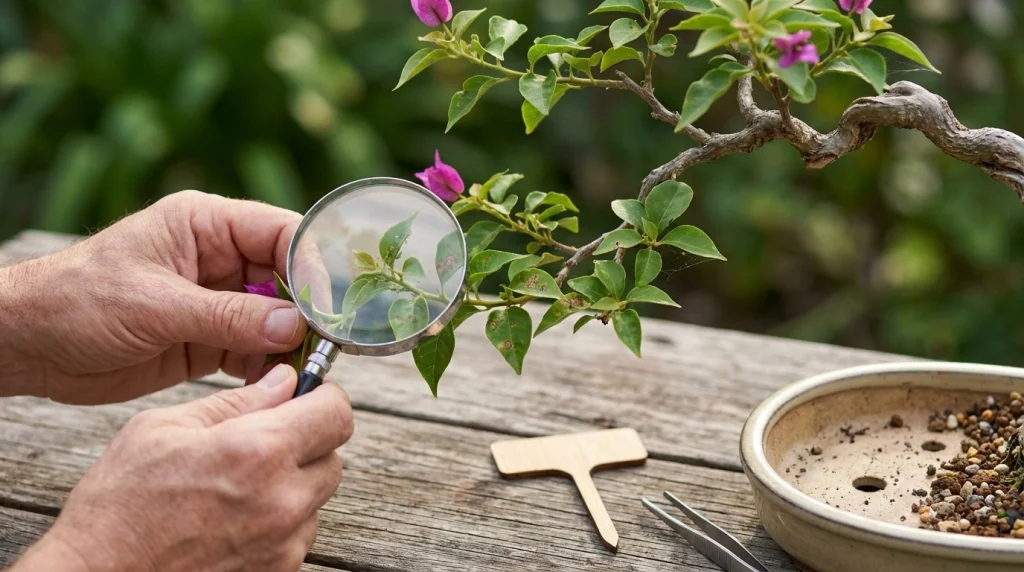
The fastest way to diagnose a sick bougainvillea bonsai is to match the visible symptoms with the location and pattern of the damage. Check the actual leaves, stems, growing tips, and soil rather than assuming every yellow leaf or dropped bract indicates an infection.
Bougainvillea is a warm-climate woody plant that generally grows well with strong light and freely draining soil. Poor growing conditions can weaken it, but environmental stress and infectious disease require different responses.
Start with a close inspection
Examine the entire tree in good light before applying any pesticide or fungicide. A 10× hand lens can help reveal tiny mites, immature insects, and the fine details of leaf lesions.
- New shoots: Look for aphids, distorted leaves, sticky residue, and damaged growing tips.
- Leaf undersides: Check for spider mites, whitefly nymphs, insect eggs, and developing leaf spots.
- Stems and leaf joints: Look for scale insects, mealybugs, and cottony deposits.
- Leaf edges: Search for irregular chewing, caterpillars, and small droppings.
- Soil and drainage holes: Check whether the root zone remains saturated long after watering.
- Branches and trunk: Look for sunken lesions, blackened tissue, or progressive dieback.
Inspect neighboring plants, too. Pests can move between closely grouped trees, and a new bonsai may introduce an infestation to an otherwise healthy collection.
Use the symptoms to narrow the diagnosis
| Symptom | Likely causes | First check |
|---|---|---|
| Curled, sticky new leaves | Aphids or other sap-feeding insects | Tender shoots and leaf joints |
| Fine webbing and pale speckles | Spider mites | Leaf undersides with a magnifier |
| Chewed or scalloped leaves | Caterpillars, snails, or slugs | Nighttime inspection and pot rim |
| Brown or black leaf spots | Leaf spot disease, water stress, or chemical injury | Lesion pattern and recent watering or spraying |
| Yellow leaves and persistent wilting | Watering stress, root damage, or root rot | Soil moisture and drainage |
| White cottony deposits | Mealybugs or, less commonly, fungal growth | Whether distinct insects are present |
These signs are clues, not definitive diagnoses. Several unrelated problems can produce similar symptoms, so confirm the cause before choosing a treatment.
Section Takeaway: Inspect the whole tree and verify the likely cause first. A targeted treatment is safer and more effective than spraying every time a leaf changes color.
Which pests attack bougainvillea bonsai?
Bougainvillea bonsai can attract aphids, mealybugs, scale insects, spider mites, whiteflies, and leaf-chewing caterpillars. The most useful clue is often how the pest feeds: sap feeders distort growth or leave sticky residue, while chewing insects remove pieces of foliage.
Aphids: curled leaves and sticky shoots
Aphids are small, soft-bodied insects that gather on tender shoots, developing leaves, and flower buds. They may be green, black, or another color, depending on the species.
As aphids feed, they can distort new growth and produce honeydew, a sugary substance that makes leaves and stems sticky. Ants may visit the affected branches to feed on this residue.
To control a small infestation, use a gentle stream of water to dislodge the insects or remove heavily infested shoot tips when doing so won’t spoil the tree’s structure. If the problem persists, consider an insecticidal soap labeled for the plant and pest.
Mealybugs and scale insects: hidden sap feeders
Mealybugs often resemble small white cottony patches tucked into leaf axils, branch junctions, or protected crevices. Scale insects can look like stationary brown, gray, or pale bumps attached to stems and leaves.
Both groups feed on plant sap, and some produce honeydew. Heavy infestations can weaken shoots, cause yellowing, and encourage black sooty mold to grow on the sugary residue.
Check beneath loose bark and around branch forks without damaging the tree. Remove accessible insects by hand, wipe small affected areas carefully, and repeat inspections because newly hatched insects may be much harder to see.
Horticultural oil or insecticidal soap may help when the product label permits use on bougainvillea and the target insect. Coverage matters, particularly for scale crawlers, the mobile immature stage of many scale insects.
Spider mites: stippling and fine webbing
Spider mites are tiny relatives of spiders that feed on individual plant cells. Their damage often appears as numerous pale speckles that gradually give leaves a dull, bronze, or dusty appearance.
Fine webbing can appear during heavier infestations, but the absence of visible webs doesn’t rule out mites. Hot, dry conditions and stressed plants can make mite problems more noticeable.
Inspect leaf undersides closely and gently rinse the foliage when appropriate. If you use a miticide or another labeled treatment, confirm that it targets the mite species involved; ordinary insecticides may not control mites and can sometimes worsen outbreaks by harming beneficial predators.
Whiteflies: tiny insects that rise when disturbed
Whiteflies are small, pale, winged insects that may flutter around the tree when you move its foliage. Their immature stages often remain attached to leaf undersides while feeding on sap.
Look for yellowing leaves, honeydew, and clusters of small insects underneath the foliage. Yellow sticky cards can help monitor adult activity, but they won’t eliminate eggs or immature stages.
Rinse affected foliage when practical and use a labeled treatment if necessary. Repeat inspections are essential because one application may leave some life stages unaffected.
Bougainvillea loopers and other leaf-chewing pests
Bougainvillea looper caterpillars feed on foliage and may create ragged edges, scalloped leaves, or substantial sections of missing tissue. These caterpillars can be easier to find after dark than during a daytime inspection.
Look for fresh feeding damage and small droppings on branches, leaves, or the soil surface. Hand-picking is a reasonable first step when you can safely reach the pest without breaking delicate branches.
For a persistent caterpillar problem, a product containing Bacillus thuringiensis (Bt) may be suitable if its label covers the relevant caterpillar and ornamental plant. Bt works against susceptible feeding larvae, not aphids, mites, or scale insects.
Section Takeaway: Identify the insect before selecting a product. Aphids, mites, scale, and caterpillars feed differently, so the best treatment for one may do little against another.
What diseases affect bougainvillea bonsai?
The main disease concerns for bougainvillea include leaf spot, powdery mildew, and root or stem rot. Persistent moisture, poor air circulation, and damaged roots can increase the risk, although the exact cause depends on the symptoms and growing conditions.
Leaf spot: brown, reddish, or black lesions
Leaf spot can result from fungal or bacterial pathogens. Depending on the cause, affected leaves may develop circular or irregular brown, reddish, or black patches, sometimes with pale centers or yellow margins.
Infections can spread more readily when foliage remains wet for long periods or branches grow too closely together. Severe spotting may cause premature leaf drop and damage to young foliage.
Remove fallen leaves and dispose of badly affected foliage rather than leaving it beneath the pot. Water at the soil surface when practical, and improve airflow without removing so much foliage that the bonsai loses important structure.
Fungicides do not cure every type of leaf spot, and bacterial problems require a different diagnosis. If lesions continue to spread despite improved conditions, seek a reliable identification before applying a pesticide.
Powdery mildew: white, powder-like growth
Powdery mildew can produce pale, powder-like patches on leaf surfaces and tender growth. It differs from mealybugs because the white material resembles a coating rather than clusters of distinct insects.
Some powdery mildew fungi thrive under conditions that don’t require a film of water on the leaf surface. Therefore, reducing prolonged humidity and improving airflow are useful measures, but simply avoiding wet leaves won’t solve every case.
Remove severely affected material when appropriate and avoid crowding the bonsai among other plants. If the problem persists, choose a fungicide specifically labeled for powdery mildew and ornamental plants.
Root rot: when the root zone stays too wet
Root rot is a broad term for root decay associated with harmful organisms and conditions that damage roots. Poor drainage and prolonged saturation can encourage organisms such as Phytophthora and Pythium, although not every case of waterlogged roots involves the same pathogen.
Affected trees may wilt even when the soil is wet, develop yellow leaves, lose vigor, or show declining branches. Damaged roots may become dark and soft instead of remaining firm and healthy.
Check drainage holes and the moisture deeper in the root zone before watering again. If serious root disease is suspected, avoid repeatedly soaking the pot or applying fertilizer to a struggling tree.
Repotting may be necessary in severe cases, but root disturbance can add stress to an already weakened bonsai. Seek experienced help if substantial root removal is being considered.
Pro tip: Root pruning is difficult to reverse. If you suspect advanced root rot, consult an experienced bonsai grower before removing significant roots or performing an aggressive repot.
Is it a disease, or simply a care problem?
Not every damaged leaf signals a pathogen. Excess water, dry soil, insufficient light, cold exposure, and chemical injury can all cause symptoms that resemble disease.
- Yellow leaves throughout the tree: Review watering, light, temperature, and root health.
- Sudden leaf drop after a location change: Consider environmental stress before assuming infection.
- Brown patches after spraying: Check whether the product was applied in strong sun, during heat, or at an unsuitable concentration.
- Sticky leaves with dark surface growth: Check for honeydew-producing insects and possible sooty mold.
- Wilting in saturated soil: Investigate drainage and root condition rather than adding more water automatically.
For reliable background on common bougainvillea pests and disorders, consult the University of California’s bougainvillea pest management guide. It covers common insect pests as well as environmental problems that can be mistaken for disease.
Section Takeaway: Leaf spots, mildew, and root rot need different responses. Confirm the likely disease and correct the growing conditions before reaching for a fungicide.
How do you treat an infected bougainvillea bonsai?
The safest treatment plan starts with isolation, identification, and correction of the underlying problem. Avoid combining pesticides or applying several treatments at once, because doing so can injure the foliage and make it harder to determine what worked.
Follow a simple treatment sequence
- Isolate the tree: Move an affected bonsai away from healthy plants when practical, while preserving its normal light and temperature requirements.
- Confirm the cause: Inspect leaves, stems, branch junctions, and soil before choosing a treatment.
- Remove visible pests: Hand-pick caterpillars, dislodge accessible insects, and remove badly damaged or diseased leaves where appropriate.
- Correct the environment: Address poor drainage, prolonged leaf wetness, overcrowding, or unsuitable light.
- Apply a targeted treatment: Use an appropriate labeled product only when physical removal and cultural changes are insufficient.
- Recheck the tree: Inspect affected areas again over the following days and weeks, following the product label’s directions for repeat applications.
Don’t expect damaged leaves to return to normal after treatment. Judge recovery by whether new growth emerges healthy, active pest numbers decline, and existing damage stops spreading.
Which treatment works for each problem?
| Problem | First-line response | When further treatment may help |
|---|---|---|
| Aphids | Rinse shoots and remove heavily infested tips if appropriate. | Use labeled insecticidal soap if colonies persist. |
| Mealybugs and scale | Remove accessible insects and inspect protected crevices. | Consider labeled horticultural oil or insecticidal soap. |
| Spider mites | Rinse foliage where practical and check leaf undersides. | Use a product labeled for the identified mite and plant. |
| Caterpillars | Inspect at night and hand-remove accessible larvae. | Consider a suitable Bt product for susceptible caterpillars. |
| Leaf spot | Remove affected debris and improve airflow. | Use a labeled fungicide when the diagnosis supports it. |
| Root rot | Correct persistent saturation and assess root health. | Seek diagnosis and carefully planned root or soil intervention. |
This table is a starting point rather than a substitute for diagnosis. Different pest species, pathogens, and product formulations can require different approaches.
Use pesticides carefully on a small bonsai
A bonsai has relatively little foliage and a small root zone, so treatment mistakes can affect the whole tree. A product that is safe on one ornamental plant may not be labeled for another.
- Read the label for permitted plants, target pests, dilution, application frequency, and protective equipment.
- Test a small area when the label allows, then check for leaf injury before treating the entire tree.
- Avoid spraying a heat-stressed, wilted, or sun-heated tree unless the product instructions specifically allow those conditions.
- Protect pollinators and beneficial insects, particularly when the bonsai is flowering.
- Keep spray solutions away from children, pets, ponds, and other sensitive areas as directed by the label.
Don’t assume homemade detergent mixtures, concentrated essential oils, or household cleaning products are safe pesticides. They may damage delicate leaves and bracts without reliably controlling the pest.
The Clemson University bougainvillea growing guide also identifies insect pests and leaf-spot problems, reinforcing the importance of diagnosing the issue before choosing a control method.
Section Takeaway: Start with targeted physical control and better growing conditions. Use a compatible, correctly labeled product when needed, then monitor the tree rather than assuming one treatment ends the problem.
How can you prevent pests and diseases?
Consistent care is the strongest foundation for preventing recurring bougainvillea bonsai problems. Good light, suitable watering, adequate drainage, clean growing conditions, and regular inspections reduce many of the stresses associated with pest outbreaks and disease.
Provide enough light and suitable warmth
Bougainvillea generally performs best with abundant direct sunlight and warm growing conditions. A shaded indoor location can weaken growth and reduce flowering, while cold exposure may trigger leaf loss and decline.
Give the tree a bright position appropriate to your climate, and acclimate it gradually when moving it from shade to stronger sun. Sudden exposure to intense sunlight can scorch foliage, especially after a period indoors.
Protect this frost-sensitive tropical or subtropical plant from freezing conditions. If you move it indoors for protection, provide as much suitable light and airflow as possible.
Water according to soil moisture, not a fixed calendar
Watering mistakes are among the most important issues to rule out when a bougainvillea bonsai develops yellow leaves or wilts. The goal is to water thoroughly when needed while allowing excess water to drain freely.
- Check the soil surface and moisture within the root zone before watering.
- Water thoroughly when the growing medium has begun to dry appropriately for the tree and conditions.
- Allow excess water to escape through unobstructed drainage holes.
- Never leave the bonsai standing in a tray of stagnant water.
- Adjust your checks during hot, windy weather, when a small pot may dry quickly.
Don’t deliberately keep a sick tree bone-dry to prevent root rot. Severe drought can damage fine roots and add stress, making recovery harder.
Maintain an airy, well-draining growing medium
A bonsai’s shallow container holds much less growing medium than a landscape bed. This makes drainage and moisture management particularly important, especially in warm, humid climates or during periods of frequent rain.
Use a suitable bonsai mix that balances water retention with air space and drainage. Avoid compacted, persistently saturated soil, and make sure drainage holes remain clear.
Don’t repot simply because a leaf turns yellow. Repotting can stress a declining tree, so first establish whether the root zone is genuinely unhealthy and whether intervention is necessary.
Keep foliage and tools clean
Sanitation reduces the chance that infected plant material or contaminated equipment will contribute to recurring problems. It also makes inspections easier because fresh damage stands out against clean foliage.
- Remove fallen leaves and spent, rotting bracts from the pot and growing area.
- Clean pruning tools between plants, particularly when disease is suspected.
- Inspect new trees before placing them near your existing collection.
- Avoid excessive crowding, which can restrict airflow and make pest inspections harder.
- Check regularly for ants, sticky honeydew, and new leaf damage.
Prune only as needed to maintain healthy structure and airflow. Excessive pruning during a period of stress can reduce the foliage available to support recovery.
Pro tip: If a major structural cut or root reduction is necessary, consult an experienced bonsai grower or local bonsai club before proceeding. A pest problem rarely justifies hurried, irreversible styling work.
Use a simple inspection routine
During active growth, a quick inspection every few days is a practical habit, especially in warm weather when insect populations can build rapidly. Examine new growth, leaf undersides, and the soil rather than checking only the colorful bracts.
Increase inspection frequency when you notice sticky leaves, fresh chewing, repeated leaf drop, or a new pest on a neighboring plant. Keep a brief record of symptoms, watering changes, and treatments so you can distinguish improvement from continued decline.
For additional species-specific guidance, the Bonsai Empire bougainvillea care guide discusses light, watering, winter protection, and common pest and disease concerns.
Section Takeaway: Healthy growing conditions won’t make a bonsai immune to pests, but they make problems easier to detect and manage. Regular inspection is more useful than routine, unnecessary pesticide applications.
How should you manage seasonal risks and recovery?
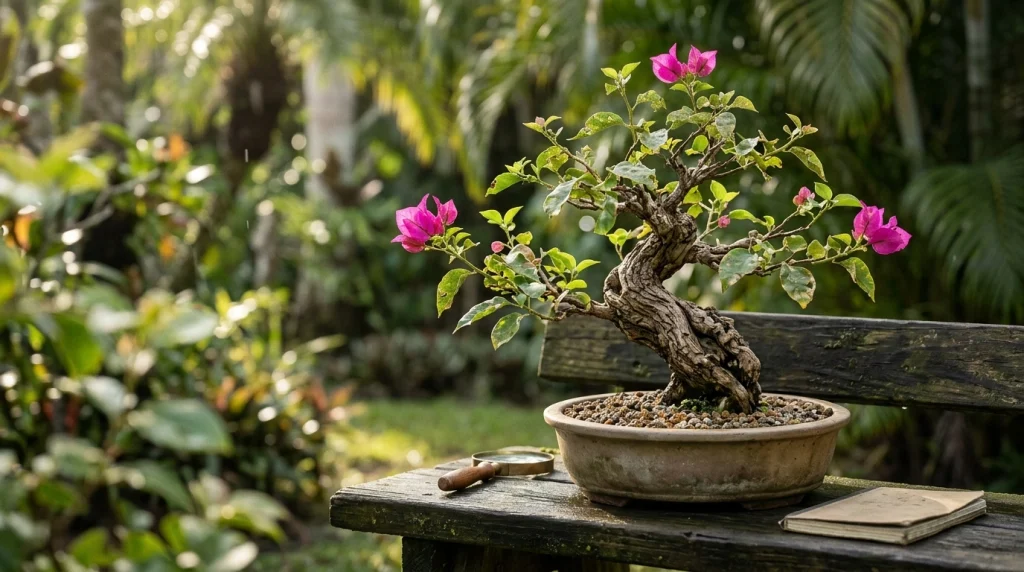
Bougainvillea bonsai problems often change with the weather and the tree’s growth cycle. Warm conditions can favor rapid insect activity, while prolonged rain, cold exposure, and unsuitable indoor conditions may increase other risks.
During warm, active growth
Fresh shoots provide attractive feeding sites for aphids and other sap-feeding insects. Inspect tender growth closely as the tree produces new leaves and branches.
Hot, dry weather can also favor spider mite problems, particularly when airflow is poor or the tree is under water stress. Check the leaf undersides rather than relying on visible webbing alone.
During rainy or humid periods
Frequent rain and prolonged leaf wetness can increase the risk of certain leaf spot diseases, especially when branches are crowded. Remove fallen debris and position the tree where excess water drains freely.
Protect the bonsai from extended waterlogging without placing it in deep shade. Bougainvillea still needs suitable light, and a persistently dark, damp location can create additional growing problems.
During cooler weather or indoor protection
Bougainvillea is sensitive to frost, so provide suitable winter protection where temperatures approach freezing. Moving a tree indoors may reduce cold injury but can also change light levels and encourage pests such as spider mites or mealybugs.
Inspect the tree after moving it, and keep it separate from established houseplants if pests are present. Avoid increasing watering simply because the tree is indoors; reduced light and slower growth may mean the soil dries more slowly.
How long does recovery take?
Recovery depends on the cause, severity, root health, and growing conditions. A small aphid infestation may be brought under control relatively quickly, while severe root damage or a persistent disease can take much longer to resolve.
Look for these signs of improvement:
- Fewer live pests during repeated inspections.
- No continued spread of leaf spots or stem lesions.
- Stable soil moisture and normal drainage.
- Healthy new leaves without fresh distortion or spotting.
- Gradual restoration of vigor under suitable light and temperature.
Old damaged leaves may remain discolored or eventually fall off, even after successful treatment. Don’t keep spraying solely because previously injured foliage hasn’t returned to its original appearance.
If the tree continues to decline, revisit the diagnosis. Persistent symptoms may indicate an incorrect pest identification, root damage, environmental stress, or a disease requiring professional assessment.
Section Takeaway: Match your inspection and care routine to the season. Recovery is best judged by healthy new growth and the absence of fresh damage, not by whether old leaves look perfect again.
Frequently asked questions
What are the most common pests on bougainvillea bonsai?
Common pests include aphids, mealybugs, scale insects, spider mites, whiteflies, and bougainvillea looper caterpillars. Aphids often cluster on tender shoots, mealybugs look cottony, scale resembles fixed bumps, and caterpillars leave missing or ragged sections of foliage.
Why are my bougainvillea bonsai leaves turning yellow?
Yellow leaves can result from overwatering, underwatering, poor drainage, insufficient light, cold exposure, nutrient problems, or sap-feeding pests. Check soil moisture, drainage, light, and the undersides of leaves before treating the tree for a disease or adding fertilizer.
How do I get rid of white bugs on my bougainvillea bonsai?
Inspect the white material closely to distinguish mealybugs, whiteflies, and possible fungal growth. Remove accessible pests and consider an appropriate labeled insecticidal soap or horticultural oil if necessary. Follow the product directions and repeat inspections to detect surviving insects.
Can I use neem oil on bougainvillea bonsai?
Some neem-based products are labeled for particular ornamental pests, but suitability depends on the formulation, target pest, and application instructions. Check the label, avoid unsuitable heat or sunlight conditions, and test a small area when permitted before treating the entire tree.
Why does my bougainvillea bonsai have brown or black spots?
Brown or black spots may indicate fungal or bacterial leaf spot, chemical injury, sun scorch, or other stress. Remove fallen debris, avoid unnecessarily wet foliage, and improve airflow. If the lesions continue spreading, seek a more precise diagnosis before choosing a fungicide.
Can a bougainvillea bonsai recover from root rot?
Recovery is possible when the damage is limited and the underlying problem is corrected, but severe root decay can be fatal. Improve drainage, avoid persistent saturation, and assess root health carefully. Significant root removal or emergency repotting may require guidance from an experienced bonsai grower.
How often should I check my bougainvillea bonsai for pests?
Inspect the tree every few days during active growth or when pests are common, and check it carefully whenever symptoms appear. Examine leaf undersides, tender shoots, stem joints, and the soil surface. Increase monitoring after treatment to catch recurring infestations early.
Keep your bougainvillea bonsai healthy
Bougainvillea bonsai pests and diseases are easier to manage when you catch them early and identify the cause correctly. Aphids, mealybugs, scale insects, spider mites, caterpillars, leaf spot, and root rot each leave different clues, even when their symptoms overlap.
Start with a careful inspection, correct the growing conditions, and use a targeted treatment only when appropriate. With good drainage, sufficient sunlight, sensible watering, and regular monitoring, you can protect your bonsai’s foliage and give it a better chance of producing healthy growth and colorful bracts.
If a problem keeps returning or the trunk and roots begin to decline, seek advice from an experienced bonsai grower or a qualified horticultural specialist rather than repeatedly applying treatments without a confirmed diagnosis.