Pine Bonsai Pests and Diseases: Identification, Treatment, and Prevention

Quick Answer
Pine bonsai pests and diseases can cause yellow needles, white scale-like spots, sticky resin, premature needle loss, and dying shoots. Common problems include spider mites, pine needle scale, aphids, needle blight, fungal cankers, and root rot. The safest treatment starts with identifying the cause, correcting care problems, and choosing a targeted response rather than spraying every tree. For a broader diagnostic reference, consult the University of California’s pine pest and disease guide.
Common warning signs
- Fine webbing: Inspect for spider mites and tiny feeding marks on needles.
- White or brown bumps: Check needles and twigs for scale insects.
- Spotted needles: Look for fungal needle blight or needle-cast diseases.
- Sticky resin: Examine damaged shoots and bark for insects, wounds, or cankers.
- Soft, dark roots: Investigate poor drainage and possible root disease.
- Sudden shoot death: Check for borers, shoot blight, and damage from environmental stress.
What to do first
- Inspect needles, buds, bark, and drainage holes before choosing a treatment.
- Keep the tree outdoors in suitable conditions, with adequate sunlight and airflow.
- Isolate a suspected infestation and avoid unnecessary pruning, repotting, or fertilizing while the tree is stressed.
Pine bonsai are resilient when their growing conditions suit the species, but pests and diseases can become serious in a small pot. Needle discoloration doesn’t always mean infection, so diagnosis matters.
In this guide, I’ll explain how to recognize common pine bonsai problems, distinguish disease from ordinary needle aging, and choose practical treatments that protect the tree’s long-term health.
In This Guide
- How do you identify pine bonsai pests and diseases?
- Which pests commonly attack pine bonsai?
- What diseases affect pine bonsai?
- Why is your pine bonsai turning yellow or losing needles?
- How do you treat pine bonsai pests and diseases?
- How can you prevent future pine bonsai problems?
- Frequently asked questions
How do you identify pine bonsai pests and diseases?
Identify the problem by examining the affected needles, shoots, bark, and roots before changing your care routine. The location and pattern of the damage often provide better clues than needle color alone.
What counts as a pine bonsai pest or disease?
A pine bonsai pest is an insect, mite, or other organism that damages a pine by feeding on its needles, shoots, roots, or bark. A pine bonsai disease is a disorder caused by an infectious organism, such as a fungus, or another harmful biological agent.
Environmental problems can produce similar symptoms without an infectious disease. Overwatering, drought, inadequate sunlight, unsuitable temperatures, and root damage can all weaken a pine.
Inspect the whole tree, not just the discolored needles
I recommend checking the tree in a consistent order so you don’t overlook less obvious signs.
- Needles: Look for stippling, spots, bands, webbing, unusual yellowing, and premature browning.
- Buds and new shoots: Check for distorted growth, dead tips, insects, and resin deposits.
- Bark and branches: Look for holes, cankers, swollen areas, and sticky pitch.
- Soil surface: Check for standing water, persistent saturation, moss growth, and unusual fungal growth.
- Drainage holes: Look for blocked openings and signs of decaying roots without pulling apart the root system unnecessarily.
Use a hand lens if possible. Spider mites and some immature insects are difficult to see without magnification.
Separate normal needle aging from disease
Pines naturally shed older needles, although the timing and amount vary by species and growing conditions. Older inner needles may yellow and fall while healthy buds and newer needles remain intact.
Widespread browning, premature needle loss across several age groups, progressive branch dieback, or dying buds deserve closer investigation. These signs are more concerning than a few aging inner needles.
Section takeaway: Diagnose the pattern before treating the tree. Needle age, affected locations, visible pests, and root-zone conditions help narrow the possibilities.
Which pests commonly attack pine bonsai?
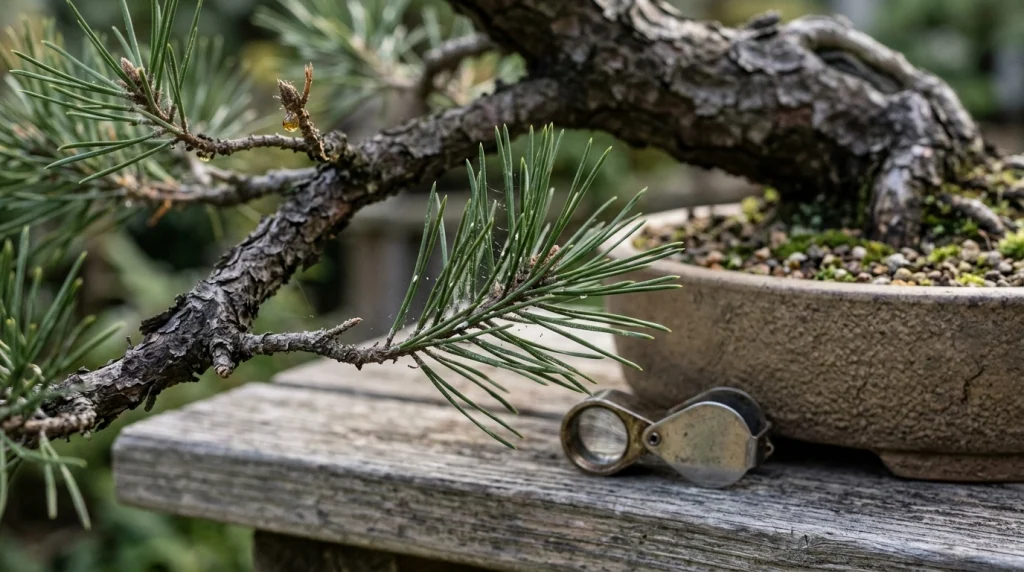
Pine bonsai can be affected by spider mites, scale insects, aphids, adelgids, sawfly larvae, and certain shoot- or bark-feeding insects. The exact risk depends on the pine species, local climate, and growing environment.
Spider mites
Spider mites are tiny sap-feeding relatives of spiders that can cause pale speckles, dull needles, and bronzed foliage. Fine webbing may appear during heavier infestations, although its absence doesn’t rule out mites.
Check the undersides of needles and sheltered areas around shoots. Tap an affected branch over white paper and look for tiny moving specks.
To respond, isolate the tree when practical, remove dust with a gentle water spray when appropriate, and confirm that mites are present before selecting a treatment. Avoid repeatedly applying broad-spectrum insecticides, which can kill beneficial mite predators and sometimes worsen mite outbreaks.
Scale insects and pine needle scale
Scale insects attach to needles or woody tissues and feed on plant fluids. Pine needle scale often appears as narrow, white, shell-like flecks, while other scale species may look brown or rounded.
Heavy infestations can cause needle yellowing, premature needle loss, and branch decline. Some soft scales also produce honeydew, a sticky substance that may support black sooty mold.
Inspect the coverings carefully because dead scales may remain attached after the insects have died. Horticultural oil can help control certain scales when applied at the appropriate life stage and under suitable conditions.
Aphids and adelgids
Aphids are small, soft-bodied insects that cluster around tender growth and may leave sticky honeydew. Adelgids are related sap-feeding insects that can appear as white, woolly deposits on bark or shoots.
Look closely around buds, branch junctions, and young shoots. Ant activity or black surface growth may accompany some sap-feeding infestations, but neither sign proves the diagnosis by itself.
For small outbreaks, removing a few affected insects by hand or using a carefully directed water spray may help. Choose an appropriate labeled treatment if the infestation persists or threatens the tree.
Sawflies, borers, and shoot-feeding insects
Sawfly larvae can consume needles, sometimes leaving branches partly stripped. Borers and certain shoot-feeding insects can cause dead leaders, distorted shoots, small holes, or conspicuous resin deposits.
Examine damaged branches for larvae, frass (insect droppings and feeding debris), entry holes, and fresh pitch. A dead shoot alone isn’t enough to establish that a borer is responsible.
Remove only clearly infested material when doing so won’t compromise the bonsai’s structure. If damage reaches the main trunk or major branches, obtain a reliable identification before cutting or applying pesticides.
For additional identification help, the Utah State University ornamental pest guide provides descriptions and management information for several common scale insects and other pests.
Section takeaway: Match treatment to the pest. Mites, scale, aphids, sawflies, and borers differ in appearance, feeding habits, and control methods.
What diseases affect pine bonsai?
The main diseases to investigate include needle blight and needle cast, fungal cankers, rust diseases, and root rot. Their symptoms overlap, so severe or progressive cases may require diagnosis by a plant disease laboratory or local horticulture specialist.
Needle blight and needle-cast diseases
Needle blight produces discolored or dead areas on needles, while needle-cast diseases can cause infected needles to drop prematurely. Different fungi cause these problems, and their symptoms often vary with pine species and season.
Look for these warning signs:
- Yellow, tan, red-brown, or dark-brown spots on needles.
- Distinct bands or lesions that develop along the needle length.
- Small black fungal structures on dead needle tissue.
- Premature needle loss, especially when several branches show similar symptoms.
Lower branches and older needles may show symptoms first, depending on the disease. However, that pattern alone doesn’t confirm a fungal infection.
Remove fallen, clearly diseased needles from the growing area and improve airflow around the foliage. Avoid keeping the canopy wet for prolonged periods, and water the root zone without routinely soaking the needles.
Fungal cankers and shoot blight
A canker is a localized area of dead or damaged bark and underlying tissue. On pines, some canker diseases cause resin to ooze from branches, followed by shoot death or progressive branch dieback.
Shoot blight can kill emerging growth before the needles reach full size. Dead tips, persistent dead needles, and resin around damaged shoots are reasons to inspect the tree closely.
Check whether the damage follows a recent wiring injury, pruning cut, frost event, or insect attack. Wounds can provide entry points for some pathogens, but the presence of a wound doesn’t prove that infection has occurred.
Don’t immediately remove every branch showing resin. Pine resin can also appear as a response to ordinary injury or insect feeding.
Root rot and other root diseases
Root rot is particularly concerning in a bonsai because damaged roots can no longer supply sufficient water and nutrients. The foliage may become dull, yellow, sparse, or reddish-brown as the root system deteriorates.
Persistent saturation and poor drainage can favor root problems, although the precise cause may be a pathogen, oxygen-starved roots, or a combination of factors. Healthy pine roots need both moisture and access to air.
Watch for these clues:
- The soil remains wet long after watering under conditions where it normally dries.
- Water drains poorly from the pot.
- The tree declines despite an apparently adequate watering routine.
- Roots visible through drainage holes appear dark, soft, or decayed rather than firm.
Don’t assume that every dark root is diseased. Root color varies, and the texture and condition of the tissue are more informative than color alone.
For further reading, Penn State Extension’s pine disease guide describes several needle diseases, cankers, rusts, and root problems, including their characteristic symptoms.
How do the main pine bonsai problems compare?
Use this table to narrow the possibilities before taking action. These are diagnostic clues, not definitive diagnoses.
| Problem | Typical signs | First response |
|---|---|---|
| Spider mites | Fine stippling, bronzing, possible webbing | Inspect with magnification and confirm mites |
| Pine needle scale | White, narrow coverings on needles | Identify scale and check infestation severity |
| Aphids or adelgids | Clusters of insects, sticky honeydew, or white woolly deposits | Inspect buds and shoots for live insects |
| Needle blight or cast | Spots, bands, browning, premature needle drop | Check symptom progression and moisture exposure |
| Canker or shoot blight | Dead tips, damaged bark, localized resin flow | Inspect wounds and identify the cause |
| Root disease or waterlogging | Poor drainage, declining foliage, soft damaged roots | Assess drainage and root condition carefully |
| Normal needle shedding | Older inner needles fall while newer growth remains healthy | Check the species, season, and overall vigor |
Section takeaway: Needle spots, resin, and yellowing are clues rather than diagnoses. Consider the whole tree and its growing conditions before deciding whether a disease treatment is needed.
Why is your pine bonsai turning yellow or losing needles?
Yellow needles and needle loss can result from natural aging, water stress, inadequate sunlight, pests, disease, or root damage. The timing, location, and speed of the decline help distinguish these causes.
Is the yellowing limited to older inner needles?
If older needles near the interior of the canopy are yellowing while the newest growth remains healthy, seasonal needle shedding may be responsible. Compare the affected needles with those on other branches and check whether the pattern matches the species’ normal growth cycle.
If yellowing spreads across newer needles or appears alongside weak buds and dying shoots, investigate further. Widespread symptoms are more concerning than isolated older-needle loss.
Could watering or drainage be responsible?
Both underwatering and overwatering can cause needle discoloration. A small bonsai pot may dry quickly in hot, windy weather, while compacted or poorly draining soil can keep roots saturated.
Check the soil and drainage instead of watering according to a rigid calendar. Water thoroughly when the tree’s growing conditions and substrate indicate it needs water, then allow excess water to drain freely.
Don’t respond to yellowing by automatically watering more. If the roots already lack oxygen, additional water may make the problem worse.
Is your pine getting enough sunlight?
Most commonly cultivated pine bonsai need substantial outdoor sunlight and seasonal exposure appropriate to their species. A pine kept indoors for extended periods may weaken because ordinary indoor light and temperatures don’t provide suitable growing conditions.
Move a stressed tree toward suitable light gradually if it has been sheltered for a long time. An abrupt change from shade to intense sun can add further stress.
Could it be fertilizer, salt buildup, or root damage?
Excess fertilizer can damage roots and cause needle-tip browning or general decline. Repeated fertilizer applications to a dry root ball can be especially risky.
Also consider whether the tree was recently repotted, heavily pruned, wired tightly, or exposed to unusual heat or cold. Multiple stress factors can occur together, making the symptoms harder to interpret.
For a practical diagnosis, record which needles are affected, whether new buds are healthy, how quickly symptoms are spreading, and how long the soil stays moist. These observations help distinguish a localized pest problem from a broader decline.
Section takeaway: Don’t treat yellow needles as proof of disease. Rule out normal aging and environmental stress, then investigate pests and pathogens when the evidence supports them.
How do you treat pine bonsai pests and diseases?
The best treatment depends on the confirmed cause, the severity of damage, and the tree’s current health. Start with targeted inspection and low-risk corrective steps before considering pesticides, fungicides, or major root work.
Step 1: Isolate and document the problem
If you suspect an infectious disease or a spreading pest infestation, move the tree away from nearby susceptible plants when practical. Avoid moving it into unsuitable indoor conditions simply to isolate it.
Photograph affected needles, shoots, and bark before treatment. Record when the symptoms appeared and whether new damage develops over the following days.
Step 2: Correct the growing conditions
Care corrections won’t eliminate every pest or pathogen, but they can reduce additional stress and help the tree recover. Focus on the specific problem rather than changing several care practices at once.
- For suspected water stress: Check soil moisture and adjust watering to the substrate and weather.
- For poor drainage: Clear blocked drainage holes and make sure excess water can escape.
- For overcrowded foliage: Improve airflow around the tree without stripping healthy branches.
- For poor light: Restore suitable outdoor exposure gradually.
- For fertilizer injury: Stop additional feeding until the cause and the tree’s condition are clearer.
Avoid repotting, heavy pruning, and major styling work on a severely weakened pine unless urgent root problems or another compelling reason makes intervention necessary. Multiple stressful procedures can reduce the tree’s chance of recovery.
Step 3: Choose the correct pest treatment
Insecticidal soaps and horticultural oils can help control certain soft-bodied pests, mites, and scale insects when the product is labeled for the target and the intended use. They aren’t interchangeable, and neither is a universal cure.
Before applying any product, check the label for the following:
- The target pest and permitted plant use.
- Application rate, timing, and repeat-treatment interval.
- Temperature limits and restrictions for stressed plants.
- Compatibility with conifers and sensitive foliage.
- Protective equipment and environmental precautions.
Test a small area when the label permits and monitor for injury before treating the entire canopy. Never mix products or increase their concentration to make treatment stronger.
For scale insects, treatment timing can matter because newly hatched crawlers are often more vulnerable than protected adults. Confirm the species and life stage whenever possible.
Step 4: Manage suspected fungal disease carefully
Fungicides can help prevent or manage certain fungal diseases when the correct active ingredient and application timing are used. They cannot reliably restore needles or shoots that have already died.
Remove clearly diseased material only when identification and the tree’s condition justify pruning. Disinfect tools between affected trees and follow local guidance for disposing of infected debris.
Don’t apply a fungicide merely because needles have turned brown. Root damage, drought, insects, and natural shedding can produce similar symptoms.
For persistent needle blight, extensive branch dieback, or suspected root rot, seek a diagnosis from a plant disease clinic or qualified local horticulturist. A laboratory diagnosis may be needed before choosing a disease-specific treatment.
Step 5: Know when to seek expert help
Some problems can be managed at home, but advanced damage deserves professional assessment.
- Needles are browning rapidly across much of the canopy.
- The main trunk or several major branches show cankers or extensive resin flow.
- The tree has widespread dieback despite appropriate care adjustments.
- Roots appear extensively decayed, or the tree is losing stability in its pot.
- The pest cannot be identified and repeated treatments haven’t helped.
*Pro tip: Before making irreversible cuts to the trunk, major branches, or roots, consult an experienced pine bonsai grower or local bonsai club. Severe decline can make recovery harder, and unnecessary structural work may compound the damage.*
Section takeaway: Confirm the cause, correct avoidable stress, and select a treatment specifically suited to the problem. Seek expert diagnosis when the damage is severe or unexplained.
How can you prevent future pine bonsai problems?
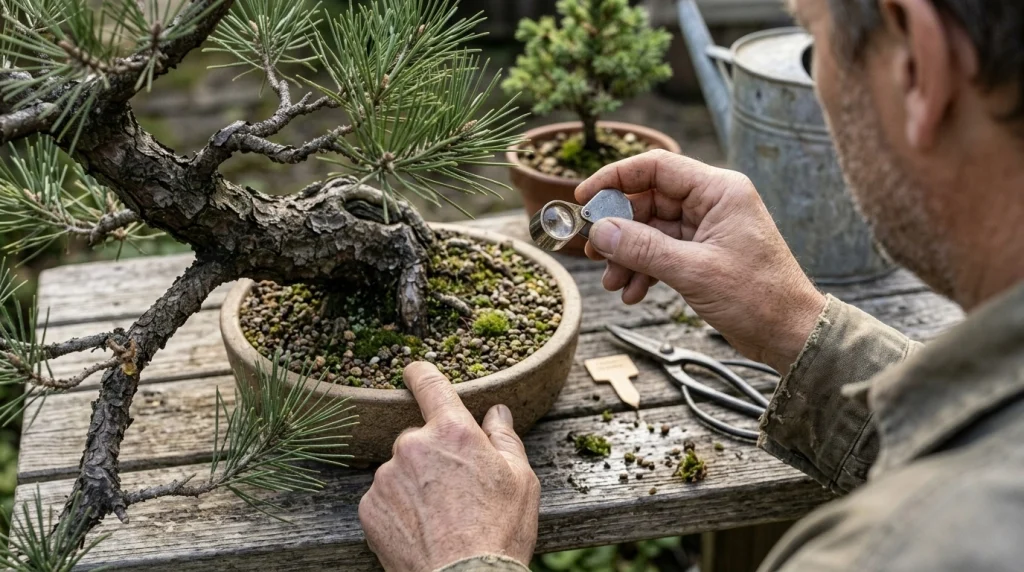
Prevention starts with suitable outdoor growing conditions, consistent inspection, and careful watering. Healthy growing conditions improve a pine’s resilience, although they cannot eliminate every pest or disease risk.
Maintain a suitable watering and soil routine
Pine bonsai need a well-draining substrate that retains enough moisture for the species and local climate. The correct balance depends on particle size, pot dimensions, root density, sunlight, wind, and temperature.
Check moisture before watering rather than following a fixed daily schedule. During hot weather, a shallow pot may dry much faster than it does during cool, cloudy periods.
Make sure the drainage holes remain open. Don’t leave the pot standing in a tray of water, and don’t assume that a dry-looking soil surface means the entire root ball needs watering.
Give pine bonsai appropriate light and seasonal care
Most pine bonsai are outdoor trees that require strong light and a seasonal growth cycle. Their precise sun exposure and winter protection needs depend on the species, cultivar, and local climate.
For example, Japanese black pine (*Pinus thunbergii*) and Japanese white pine (*Pinus parviflora*) don’t have identical care requirements. Identify your pine before applying species-specific watering, pruning, or overwintering advice.
Avoid keeping a temperate pine indoors year-round. Protect it from unsuitable extremes while preserving the seasonal conditions its species needs.
Inspect regularly and quarantine new trees
Inspect needles, shoots, bark, and drainage at least weekly during active growing periods, increasing checks when weather or previous infestations warrant it. Look especially closely after introducing a new tree or noticing unusual needle discoloration.
Keep newly acquired trees separate from established bonsai while you inspect them for pests and symptoms. Use clean tools and avoid sharing contaminated substrate between trees.
Prevent stress during pruning, wiring, and repotting
Heavy styling and root work can weaken a pine if performed at an unsuitable time or on an already stressed tree. Match the work to the species, growth stage, and condition of the roots and foliage.
After significant work, monitor watering carefully and avoid stacking unnecessary interventions. A pine that is struggling with pests or root damage may need stabilization before further styling.
*Pro tip: Pine root pruning and major branch removal can have lasting consequences. If you’re uncertain about timing or how much material to remove, ask an experienced pine bonsai grower before proceeding.*
Use a simple prevention checklist
- Inspect the tree for pests and unusual needle patterns.
- Check soil moisture and confirm that water drains freely.
- Maintain appropriate outdoor light and seasonal conditions.
- Remove fallen debris and clean tools between trees.
- Avoid unnecessary fertilizer, pesticides, and major styling work.
- Photograph changes so you can spot progressive decline early.
As of 2026, integrated pest management remains a useful approach: identify the organism, monitor the severity, correct growing conditions, and use targeted treatments only when justified.
Section takeaway: Consistent observation and suitable care make problems easier to detect early. Prevention works best when it reflects the needs of your particular pine species.
Frequently asked questions about pine bonsai pests and diseases
What are the most common pests on pine bonsai?
Common pine pests include spider mites, pine needle scale, aphids, adelgids, sawfly larvae, and certain shoot- or bark-feeding insects. The likely pest depends on the pine species and region. Inspect the affected needles, buds, and bark before choosing a treatment.
Why is my pine bonsai turning brown?
Brown needles may result from natural aging, drought, waterlogged roots, pests, needle blight, or other diseases. Check which needle age groups are affected, whether the soil drains properly, and whether you can find pests or lesions. Rapid browning across the canopy warrants prompt investigation.
Should I remove all brown needles from my pine bonsai?
No. Remove loose, clearly dead needles when appropriate, but don’t strip the tree indiscriminately. Some brown needles may reflect normal aging, while premature needle loss can signal stress or disease. Preserve healthy foliage and investigate the underlying cause before making extensive changes.
Can I use neem oil on pine bonsai?
Only consider neem-based products if the label permits use on the target pest and the intended plant. Products differ in composition and application instructions. Test cautiously when allowed, follow temperature restrictions, and avoid spraying stressed foliage under conditions that increase the risk of plant injury.
Can pine bonsai recover from root rot?
Recovery depends on the extent of root damage and whether the underlying cause can be corrected. Early problems associated with poor drainage may improve after care adjustments, but severe pathogen-related root decay can be fatal. Avoid aggressive root pruning without a clear reason and seek expert advice if the tree continues to decline.
How often should I inspect my pine bonsai for pests?
Weekly inspections during active growth are a useful starting point, with more frequent checks during hot, dry weather or when pests are already present. Inspect new trees before placing them near your collection. Record changes in needle color, shoot health, resin deposits, and visible insects.
Should I spray a fungicide whenever pine needles develop spots?
No. Needle spots can have fungal, environmental, or other causes, and different diseases require different management. Identify the likely problem first. A fungicide is appropriate only when the suspected disease, product label, and treatment timing support its use.
Keep your pine bonsai healthy with early diagnosis
Pine bonsai pests and diseases are easier to manage when you recognize the warning signs before damage becomes widespread. White scale coverings, fine webbing, spotted needles, resin deposits, and declining roots each point toward different possibilities.
Start with careful inspection, check the growing conditions, and avoid treating symptoms without understanding their cause. When the diagnosis remains uncertain or the tree is deteriorating quickly, seek help from a qualified horticulturist or experienced pine bonsai specialist.
With appropriate care, regular monitoring, and targeted intervention, you can give your pine bonsai a better chance of maintaining healthy foliage, strong roots, and long-term vigor.