Is My Ginkgo Bonsai Dying? Signs and How to Save It

This post contains affiliate links. As an Amazon Associate, OurBonsai earns from qualifying purchases at no extra cost to you. Read our disclosure.
In this guide
A ginkgo bonsai dying can be hard to recognize at first, because a healthy ginkgo (Ginkgo biloba) also spends several months each year looking lifeless. It drops all its leaves in autumn after turning gold and stands bare through winter. That is normal dormancy. Real decline looks different: leaves browning and falling in summer, branches drying out, or buds that fail to open in spring. Ginkgo is one of the toughest trees on Earth in the ground, but in a pot its fleshy roots are vulnerable to rot, drought and frost.
This guide helps you tell dormancy from decline, check what is still alive, understand the common causes and follow a clear rescue plan.
Dormant or dying?
| Season | Normal | Worrying |
|---|---|---|
| Autumn | Leaves turn bright gold and drop over a week or two | Leaves turn brown and fall green or in midsummer |
| Winter | Completely bare, firm plump buds | Shriveled buds, wrinkled bark, branches snapping dry |
| Spring | Buds swell and leaves open | No buds opening by late spring |
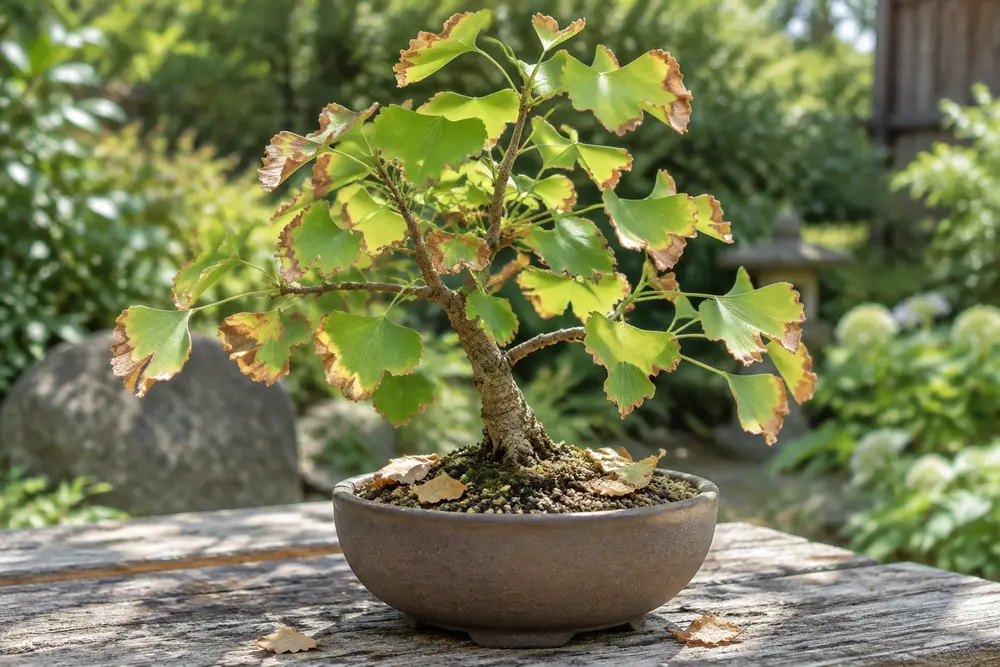
| Summer | Fresh green fan-shaped leaves | Brown, crispy edges, yellowing, early leaf drop |
If your ginkgo is bare in winter but the buds are firm and the bark is smooth, it is simply resting.
How to check if a ginkgo bonsai is alive
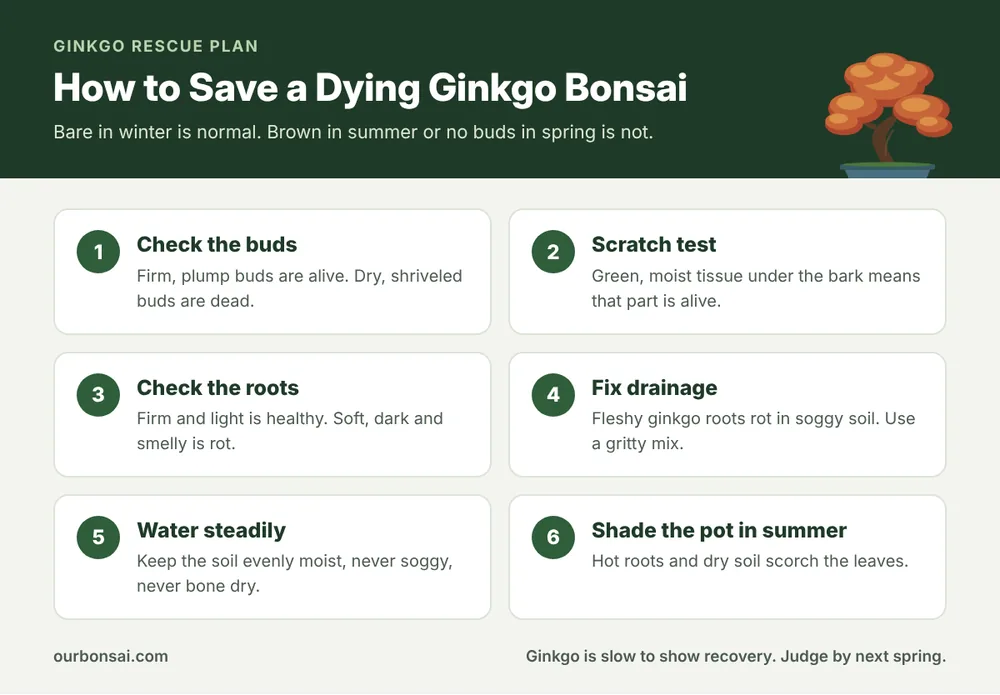
- Buds. Ginkgo buds sit at the tips of shoots and on short spur shoots. Healthy buds are firm and plump. Gently squeeze one; if it is dry, hollow or crumbles, it is dead.
- Scratch test. Scrape a tiny area of bark on a thin branch with a fingernail. Moist green tissue means alive. Brown and dry means dead. Work back toward the trunk to see how far any dieback goes.
- Roots. Ease the tree out of the pot. Healthy ginkgo roots are thick, firm and light colored. Rotten roots are soft, dark and smell sour.
Common causes of a ginkgo bonsai dying
Root rot from wet soil
Ginkgo roots are thick and fleshy, and they rot faster than most bonsai roots when soil stays wet. Dense potting soil, a pot without enough drainage, or frequent watering in cool weather are the usual culprits. Leaves yellow and drop early, and spring growth is weak. Our guide to root rot in bonsai explains what to look for.
Summer drought and hot roots
Ginkgo leaves are thin and lose water quickly. If a small pot dries out, or the roots overheat in strong afternoon sun, leaf edges turn brown and crispy, sometimes over the whole tree. Repeated stress weakens the tree for the following year. Our article on watering bonsai in summer has tips for hot weather.
Kept indoors
Ginkgo is an outdoor tree that needs full light and a cold winter rest. Kept indoors, it weakens, produces small, pale leaves, and eventually fails to come out of dormancy properly. Our guide to types of outdoor bonsai trees lists ginkgo among species that should live outside.
Frost damage to roots
Ginkgo itself is extremely cold hardy, but roots in a small pot are exposed on all sides. A long, hard freeze in a wet pot can kill fleshy roots. The damage shows in spring, when buds fail to open or open and then wilt.
Too much work at once
Repotting, heavy pruning and defoliation all take energy. Ginkgo recovers more slowly than maples or elms, and does not reliably produce a second flush of leaves if it is defoliated. Doing too much in one season can push it into decline.
Pests and disease
Ginkgo is famously resistant to pests and disease, which is one reason it has survived for millions of years. Aphids or scale occasionally appear on soft new shoots, but they rarely cause serious decline. If your ginkgo is failing and you find no pests, look at the roots, watering and placement first; the cause is almost always there.
How to save a dying ginkgo bonsai
Step 1: Find out what is alive
Use the bud and scratch tests to map live and dead areas. Do not cut anything yet, unless it is clearly dead.
Step 2: Fix the roots
If the soil is soggy and roots are rotting, cut away soft, dark roots with clean scissors. If it is early spring, repot into a gritty, free-draining mix of akadama, pumice and lava. At other times of year, improve drainage without disturbing the roots: remove any saucer, tilt the pot to drain and keep it out of long rainy spells.
Step 3: Get watering steady
Water when the top centimeter of soil starts to dry, then soak the pot. Keep it evenly moist through the growing season and just moist in winter.
Step 4: Give the right spot
Morning sun and light afternoon shade are ideal in summer. In winter, keep it outdoors in a sheltered spot, protecting the pot from hard frosts by sinking it in mulch or placing it in an unheated shed during the coldest spells.
Step 5: No pruning or feeding until it grows
Wait until healthy new leaves appear. Then feed lightly and cut away any dead wood back to live tissue, just above a bud.
How long does a ginkgo take to recover?
Ginkgo is slow. A tree damaged in summer may not show what survived until the next spring, when the live buds open. Do not give up on a tree that looks bad in late summer; give it steady care through autumn and winter and judge it in spring. The Wikipedia page on Ginkgo biloba notes that ginkgo trees survived even the Hiroshima bombing and re-sprouted, a reminder of how resilient this species can be when its roots survive.
How to keep a ginkgo bonsai healthy
- Grow it outdoors all year, with a cold winter rest.
- Use a gritty, free-draining soil.
- Water by checking the soil, never on a fixed schedule.
- Shade the pot in summer heat.
- Protect roots from hard freezes in winter.
- Feed in spring and summer; see our guide to the best bonsai plant food, or browse organic bonsai fertilizer.
- Do one big job per year at most.
FAQ: ginkgo bonsai dying
Is my ginkgo dead or dormant?
If it is autumn or winter, the buds are firm and the bark is moist and green underneath, it is dormant.
Why are my ginkgo leaves turning brown in summer?
Usually the soil dried out or the roots overheated. Water more consistently and shade the pot in the afternoon.
Can a ginkgo bonsai recover from root rot?
Yes, if some healthy roots remain. Cut away the rot, repot into gritty soil in early spring and water carefully.
Can I keep a ginkgo bonsai indoors in winter?
No. It needs cold dormancy. Keep it outside in a sheltered spot and protect the pot from hard frost.
Final thoughts
A ginkgo bonsai dying is usually reacting to wet roots, summer drought, life indoors or frost in the pot. Check the buds and bark, fix the roots and watering, give it the right outdoor spot and be patient until spring. Ginkgo is slow to recover, but its resilience is legendary. For styling once it recovers, see our overview of deciduous bonsai tree types.