How to Prune Ginkgo Bonsai: Step-by-Step Guide

This post contains affiliate links. As an Amazon Associate, OurBonsai earns from qualifying purchases at no extra cost to you. Read our disclosure.
In this guide
Learning how to prune ginkgo bonsai starts with understanding how ginkgo grows, because it is quite different from a maple or an elm. Ginkgo (Ginkgo biloba) grows in two ways: long shoots that extend the tree, and short “spur” shoots that produce clusters of fan-shaped leaves year after year. It does not back-bud readily on old wood, so cuts need to be made with care, just above a bud. The best time for structural pruning is late winter, before the buds open, and long new shoots can be shortened in summer. Most ginkgo bonsai are shaped in a natural upright, flame-like form that follows the tree’s own habit.
This guide explains when to prune, how ginkgo branching works, the step-by-step method, and the mistakes to avoid.
How ginkgo grows and why it matters
A ginkgo has two kinds of shoots:
- Long shoots grow several centimeters or more each year, extend branches and carry single leaves spaced along them.
- Short (spur) shoots grow only a few millimeters a year and carry a cluster of leaves at the tip. They can live for many years and give older ginkgo their distinctive look.
Ginkgo does not readily produce new buds from bare old wood. That means a branch cut back to a bare section may simply die back to the next bud or the trunk. It also means ginkgo bonsai develop slowly, and it is best to plan each cut. The Wikipedia page on Ginkgo biloba describes the long and short shoot system in detail.
When to prune a ginkgo bonsai
| Type of pruning | Best time | Notes |
|---|---|---|
| Structural pruning | Late winter, before buds swell | Bare tree, clear view, fast healing in spring |
| Shortening long shoots | Early to mid summer | Once the new shoots have hardened |
| Light tidying | Summer | Remove misplaced shoots |
| Root pruning | Early spring, at repotting | Every 2 to 3 years for young trees |
| Avoid | Autumn and midwinter frosts | Cuts heal slowly and may die back |
Our guide to when to prune deciduous bonsai covers the general calendar that ginkgo follows.
Tools you need
- Sharp bonsai scissors for shoots.
- A concave or knob cutter for branches. See our concave cutter review.
- Cut paste for larger wounds; our list of bonsai cut paste alternatives helps if you have none.
You can also browse bonsai concave cutters.
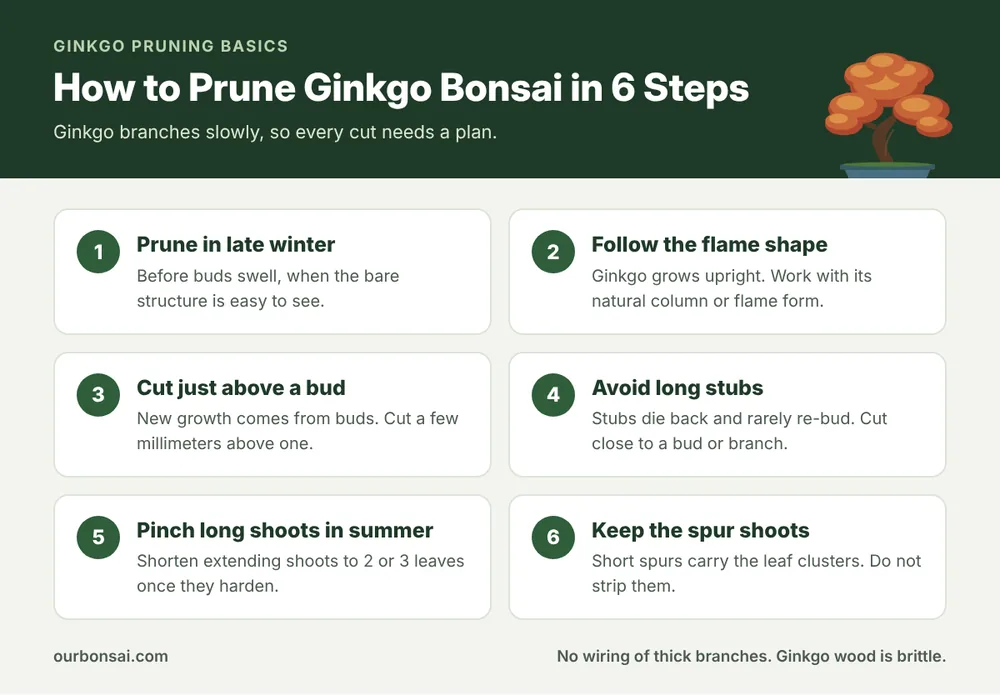
How to prune ginkgo bonsai step by step
Step 1: Decide on the shape
Ginkgo naturally grows upright with branches angled up. The most convincing ginkgo bonsai follow this, either as a slender column or as a flame shape that is wider in the middle and narrows to a soft point. Trying to force ginkgo into horizontal, layered pine-like pads rarely works, because the branches are brittle and resist wiring.
Step 2: Remove problem branches in late winter
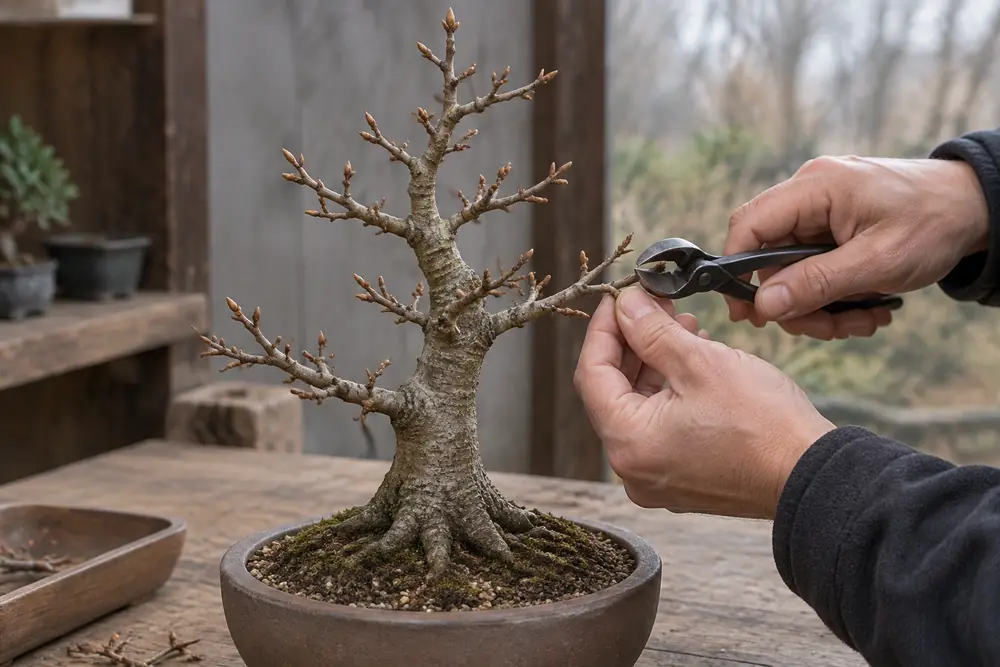
With the tree bare, remove branches that cross, rub, or grow straight inward. Thin out crowded areas where several branches come from the same point. Use a concave cutter close to the trunk, and seal larger cuts.
Step 3: Shorten branches just above a bud
When shortening a branch, cut a few millimeters above an outward-facing bud or a healthy spur shoot. Do not leave a long bare stub. Ginkgo stubs dry back and rarely produce new shoots.
Step 4: Shorten long shoots in summer
During spring and early summer, new long shoots extend quickly. Once they have hardened a little, cut them back to two or three leaves. This keeps the outline compact and encourages new buds to form near the cut.
Step 5: Leave the spur shoots alone
The short spur shoots carry the leaf clusters that make a ginkgo look mature. Do not strip or cut them unless they are dead or badly placed.
Pruning a young ginkgo vs a mature one
A young ginkgo, still thin and with few branches, needs growth more than pruning. Let it grow freely for one or two seasons in a larger pot so the trunk thickens. Prune only to remove branches you will never use and to cut the leader back in late winter once the trunk is the thickness you want at that height. A new leader will grow from a bud just below the cut, which builds taper over the years.
A mature ginkgo with its shape already set needs mostly maintenance: shorten long shoots each summer, thin crowded spurs every few years, and remove the odd branch that has grown out of place. Cutting back to existing spurs keeps the canopy compact without risking dieback.
Can you wire a ginkgo bonsai?
Only with great care. Ginkgo branches are brittle, especially older ones, and the bark marks easily. Young, flexible shoots can be lightly wired to adjust their angle, but most shaping is done by pruning. Guy wires anchored to the pot are a gentler way to lower a branch slightly. Never try to bend thick ginkgo branches.
Working with ginkgo’s slow branching
Because ginkgo branches slowly, patience pays. A few tips:
- Let the tree grow vigorously for a season before a structural prune, so it has energy to push buds.
- Use the strongest shoots to build new branches and let them extend before cutting.
- Avoid heavy pruning every year. Alternate years of growth and refinement.
- Do not defoliate. Ginkgo often fails to produce a second flush of leaves in the same season.
Feeding well in spring and early summer helps the tree produce strong buds; our guide to the best bonsai plant food covers suitable fertilizers.
Common ginkgo pruning mistakes
- Leaving long stubs that die back.
- Cutting into bare wood expecting it to bud.
- Trying to wire thick branches into horizontal pads.
- Defoliating as you might a maple.
- Heavy pruning in autumn, leaving open wounds over winter.
- Pruning a weak tree. Let it grow strongly first.
FAQ: how to prune ginkgo bonsai
When is the best time to prune a ginkgo bonsai?
Late winter, before the buds swell, for structural cuts. Shorten long new shoots in early to mid summer.
Does ginkgo back-bud after pruning?
Not readily on bare old wood. It buds from existing buds and spur shoots, so cut just above them.
Can I keep my ginkgo bonsai small?
Yes, by shortening long shoots each summer and keeping the tree in a bonsai pot, but leaves will stay relatively large. Ginkgo is best suited to medium and larger bonsai.
What style suits ginkgo bonsai?
Upright styles, especially a flame or column shape that follows the tree’s natural habit. See our overview of deciduous bonsai tree types for how ginkgo compares.
Final thoughts
Now you know how to prune ginkgo bonsai: make structural cuts in late winter just above a bud, follow the tree’s natural upright flame shape, shorten long shoots in summer and protect the spur shoots that carry the leaves. Ginkgo rewards patience with a tree that looks ancient and turns a brilliant gold every autumn. If you are still choosing a tree, our Brussels ginkgo bonsai review is a good place to start.