Best Soil for Japanese Maple Bonsai: Mix Recipe and Ratios

This post contains affiliate links. As an Amazon Associate, OurBonsai earns from qualifying purchases at no extra cost to you. Read our disclosure.
In this guide
- Why Japanese maples need the right soil
- What makes a good Japanese maple bonsai soil
- Best soil components for Japanese maple bonsai
- 3 best soil mixes for Japanese maple bonsai
- Soils to avoid for Japanese maple bonsai
- How to repot a Japanese maple bonsai into new soil
- How soil affects watering
- Soil, feeding and leaf size
- FAQ: best soil for japanese maple bonsai
- Final thoughts
The best soil for japanese maple bonsai is a mix that holds moisture evenly but still drains freely and lets plenty of air reach the roots. A proven recipe is 2 parts akadama, 1 part pumice and 1 part lava rock, sieved to remove dust. Japanese maples (Acer palmatum) have very fine, fibrous roots and thin, delicate leaves that scorch quickly if the soil dries out, so they need more water-holding capacity than pines or junipers, but they still rot in soggy soil. An akadama-rich mix gives that balance.
This guide explains what Japanese maple roots need, gives three easy recipes for different climates, lists soils to avoid, and shows how and when to repot.
Why Japanese maples need the right soil
Japanese maples grow naturally in the understory of mountain forests in Japan, Korea and China, in cool, moist, well-drained, slightly acidic soil rich in leaf litter. The Wikipedia page on Acer palmatum describes its preference for partial shade and moist, well-drained soil. In a bonsai pot, you are trying to copy those conditions in a few centimeters of soil:
- Steady moisture. Fine roots and thin leaves suffer quickly in dry soil. Leaf edges scorch and turn brown.
- Air. Fine roots also need oxygen. Dense, wet soil suffocates them.
- Slight acidity. Maples prefer a pH of about 5.5 to 6.5. Akadama and pine bark naturally sit in this range.
- Fine particles. A slightly finer mix than you would use for pines encourages a dense mat of fine roots, which supports the fine branching that makes a maple bonsai beautiful.
What makes a good Japanese maple bonsai soil
| Property | Why it matters |
|---|---|
| Good water retention | Prevents leaf scorch on warm days |
| Free drainage | Water should flow through quickly after watering |
| Air space | Fine roots need oxygen |
| Slightly acidic | Matches the maple’s natural preference |
| Particle size 2 to 5 mm | Encourages fine, dense roots |
Best soil components for Japanese maple bonsai
- Akadama. Japanese baked clay granules. Holds water and nutrients, is slightly acidic and encourages fine root growth. The foundation of most maple mixes.
- Pumice. Light and porous. Keeps the mix open and helps roots branch.
- Lava rock. Adds drainage and structure. Use less of it for maples than for conifers.
- Kanuma. A softer, more acidic Japanese soil used for azaleas. A little can be added for maples in hard water areas. Our kanuma bonsai soil review explains how it differs from akadama.
- Pine bark fines. Adds organic matter and water retention, and helps keep the pH low.
Our general bonsai soil mix ratio guide explains how each component behaves.
3 best soil mixes for Japanese maple bonsai
Recipe 1: Classic mix
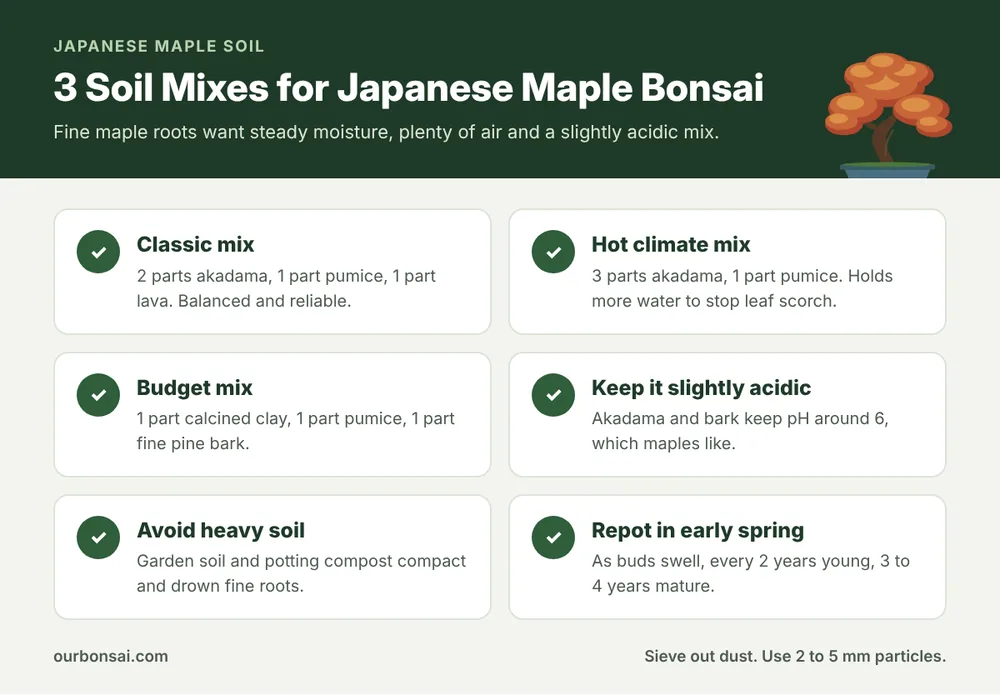
2 parts akadama, 1 part pumice, 1 part lava. The standard mix used by many maple growers. Drains well, holds moisture evenly and supports fine roots.
Recipe 2: Hot climate mix
3 parts akadama, 1 part pumice. In hot, dry summers, Japanese maples in small pots can dry out by midday. Dropping the lava and increasing akadama holds more water. Some growers in very hot regions also add a little pine bark.
Recipe 3: Budget mix
1 part calcined clay, 1 part pumice or perlite, 1 part fine pine bark. Uses easy-to-find materials and still drains well. Our guide to the best cat litter for bonsai soil explains which calcined clay products work.
If you would rather buy a ready-made mix, look for an akadama bonsai soil mix or a deciduous bonsai blend. Our premium bonsai soil review covers one popular option.
Soils to avoid for Japanese maple bonsai
- Garden soil. Compacts in the pot and drains poorly.
- Plain potting compost. Holds too much water, breaks down quickly and suffocates fine roots. See bonsai soil vs regular soil.
- All-lava or very coarse mixes. Drain so fast that the pot dries out and leaves scorch.
- Alkaline materials such as limestone grit, which push the pH up.
How to repot a Japanese maple bonsai into new soil
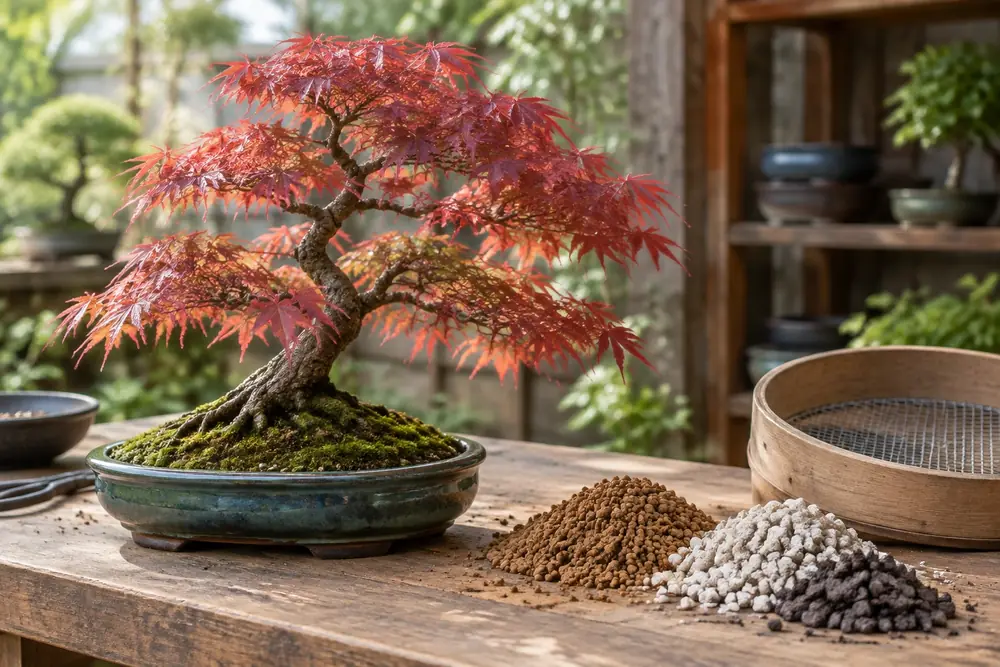
- Time it right. Early spring, as the buds swell and begin to show color, before the leaves open.
- Sieve each component to remove dust, then mix.
- Remove the tree and comb out the old soil from the outside and bottom of the root ball, about a third of the volume on a healthy tree.
- Trim roots. Cut back long, thick roots and any that circle the pot, keeping as many fine roots as possible. This also helps develop a good surface root spread (nebari).
- Repot. Add a base layer, set the tree, tie it in and work new soil in among the roots with a chopstick.
- Water thoroughly and keep the tree in light shade, out of wind and frost, for two to three weeks.
Young Japanese maples need repotting every one to two years; mature trees every three to four. Our guide to the best bonsai repotting tools covers what you need.
How soil affects watering
In an akadama-rich mix, water a Japanese maple when the top centimeter starts to dry. In summer that often means daily, sometimes twice in hot weather. The akadama changes from dark to light brown as it dries, which makes it easy to judge. In winter, a dormant maple outdoors needs much less water, but the roots must never dry out completely.
Soil, feeding and leaf size
A gritty bonsai mix holds very few nutrients, so feeding matters. Japanese maples respond well to organic fertilizer cakes or a balanced liquid feed from spring to late summer. Many growers feed lightly in spring, while the first leaves open, to keep those leaves small, and more generously after the spring flush has hardened. Strong feeding plus a rich, moist soil produces large leaves and long internodes, which is useful for a young tree you are growing bigger but not for a refined bonsai. Our guide to bonsai fertilizer pellets or liquid helps you choose a type.
FAQ: best soil for japanese maple bonsai
Is akadama necessary for Japanese maple bonsai?
Not essential, but it is the best single ingredient. Calcined clay plus pumice and a little bark is a good substitute.
Do Japanese maple bonsai need acidic soil?
Slightly acidic, around pH 5.5 to 6.5. Akadama and pine bark keep the mix in this range naturally.
Can I use the same soil for Japanese maple and trident maple?
Yes. Both do well in the classic akadama, pumice and lava mix.
Why does my maple’s soil dry out so fast?
The mix may be too coarse, or the pot too small or shallow for summer heat. Increase the akadama or add a little bark.
Final thoughts
The best soil for japanese maple bonsai is an akadama-rich mix that holds moisture evenly and drains freely: 2 parts akadama, 1 part pumice and 1 part lava is a great start, with more akadama in hot climates. Repot in early spring, keep particles fine but dust-free, and your maple will reward you with dense roots, fine branching and stunning autumn color. If you grow your maple indoors for part of the year, see our guide to Japanese maple bonsai indoors.