Bougainvillea Bonsai Yellow Leaves: Causes and Fixes

This post contains affiliate links. As an Amazon Associate, OurBonsai earns from qualifying purchases at no extra cost to you. Read our disclosure.
In this guide
Bougainvillea bonsai yellow leaves are one of the most common problems with this colorful tropical, and the cause is usually simple: too much water. Bougainvillea is naturally drought tolerant and likes its soil to dry out a little between waterings. When the soil stays wet, especially in a cool or dim room, the roots struggle and the leaves turn yellow and drop. Cold, low light and lack of nutrients are the other usual suspects.
This guide explains how to read the yellowing pattern, the main causes and how to fix each one so your bougainvillea gets back to growing and flowering.
Normal yellowing vs a problem
Bougainvillea replaces its leaves regularly. A few yellow older leaves near the base of shoots, dropping now and then, is normal. Bougainvillea also tends to shed more leaves in winter when light and temperatures fall. That is a resting response, not necessarily a problem.
It is a problem when:
- Many leaves turn yellow within a week or two
- Yellowing affects new leaves at the shoot tips
- Leaves turn yellow and drop while the soil is still wet
- Yellowing comes with wilting, black stems or a sour smell from the soil
6 causes of bougainvillea bonsai yellow leaves
1. Overwatering
By far the most common cause. Bougainvillea roots dislike sitting in wet soil. When they lack oxygen, they cannot take up water and nutrients properly, and the leaves turn an even yellow and fall. Left too long, the roots rot.
Fix: water only when the top 2 to 3 cm of soil is dry. Empty saucers after watering. If the soil is dense and stays wet for days, repot into a gritty mix in late spring. Our guide to the best soil for bougainvillea bonsai explains the right mix, and our guide to root rot in bonsai helps if roots are already damaged.
2. Cold
As a tropical plant, bougainvillea dislikes temperatures below about 50 °F (10 °C). A cold night outdoors in autumn, a cold windowsill in winter or a draft can trigger yellowing and leaf drop within days.
Fix: bring the tree indoors before nights get cool, and keep it away from cold glass and drafts. Ideal growing temperatures are 65 to 85 °F (18 to 29 °C).
3. Low light
Bougainvillea is a sun lover. In a dim room, it cannot support its leaves, which yellow and drop. Growth becomes weak and leggy, and flowering stops.
Fix: move it to the sunniest window you have, or outdoors in warm weather. In winter, add a grow light. Our guide on how much light a bonsai tree needs explains why light matters so much, and our list of the best indoor grow lights for bonsai helps you choose one.
4. Nutrient shortage
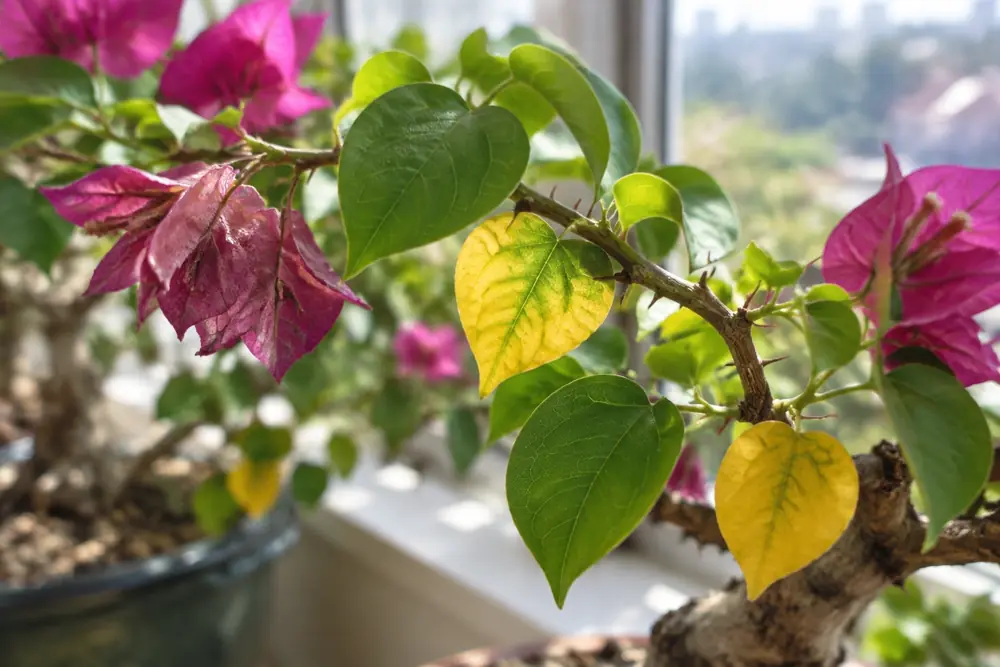
Bonsai soil holds few nutrients, and bougainvillea grows and flowers heavily in summer. A hungry tree turns pale yellow-green all over. Magnesium shortage shows as yellowing between the veins of older leaves, and iron shortage as yellowing between the veins of new leaves.
Fix: feed every two weeks during the growing season. Use a fertilizer that includes micronutrients, with lower nitrogen and higher phosphorus and potassium during flowering. A bougainvillea fertilizer formulated for blooms works well at half strength in a bonsai pot.
5. Root disturbance
Bougainvillea is sensitive to root work. After repotting, especially if many roots were cut, leaves often yellow and fall for several weeks.
Fix: keep the tree warm and in bright light, water carefully and do not fertilize until new shoots appear. Repot only every two to three years, in late spring or early summer.
6. Pests
Mealybugs, aphids and spider mites suck sap and cause yellowing. Look for white fluff in leaf joints, clusters of small insects on new shoots, or fine webbing and speckles.
Fix: rinse the tree and treat with insecticidal soap or neem oil. See our guide to tiny bugs on bonsai leaves to identify what you find.
How to diagnose step by step
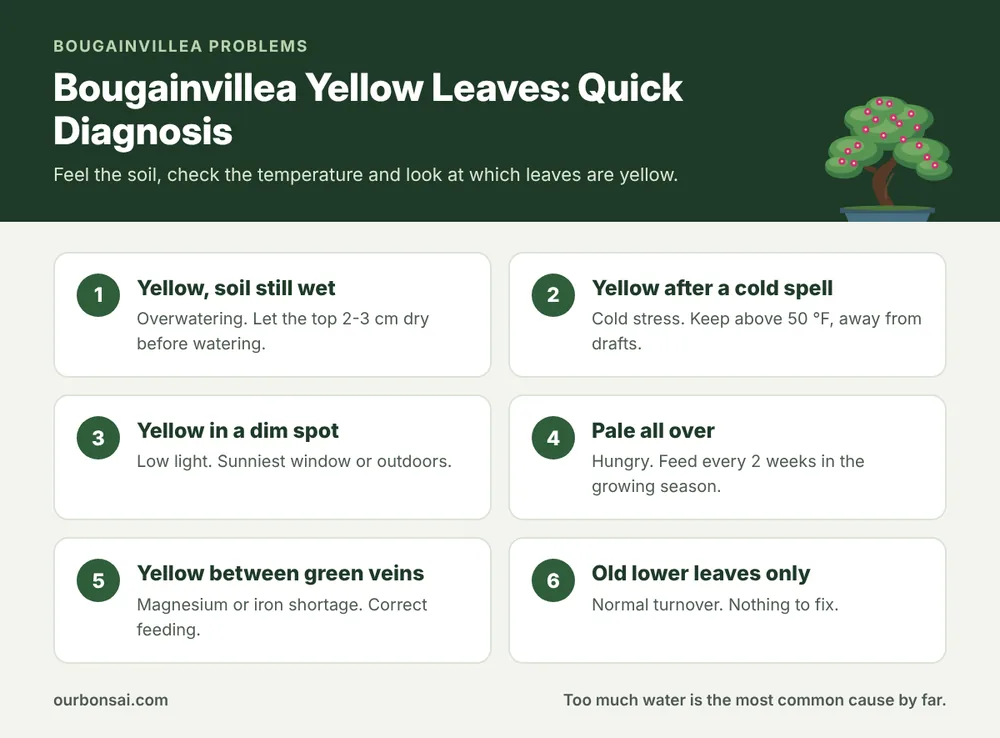
- Feel the soil. Still wet two days after watering? Overwatering is likely.
- Check the temperature. Has the tree been below 50 °F or near cold glass?
- Check the light. Less than six hours of direct sun? Too dim.
- Look at the leaf pattern. Old leaves only: normal or magnesium. New leaves with green veins: iron. Everything pale: nitrogen.
- Inspect for pests. Leaf joints, undersides and new shoots.
- Think about recent changes. Repotting or a move in the last month?
Quick reference
| What you see | Most likely cause | First step |
|---|---|---|
| Yellow leaves, wet soil | Overwatering | Let soil dry more between waterings |
| Sudden yellowing after a cold night | Cold stress | Move to a warm spot |
| Yellow leaves, weak growth, no flowers | Low light | More sun or a grow light |
| Pale green all over | Nitrogen shortage | Feed regularly |
| Yellow between veins of old leaves | Magnesium shortage | Fertilizer with micronutrients |
| Yellow after repotting | Root disturbance | Warm, bright, patient |
| Speckles, fluff, sticky leaves | Pests | Rinse and treat |
Bougainvillea yellow leaves in winter
Winter is when most bougainvillea yellowing happens indoors. Short days, cool rooms and the habit of watering as often as in summer all combine. In winter:
- Water much less often, only when the top few centimeters are dry
- Give it the sunniest window or a grow light for 12 to 14 hours a day
- Keep it above 50 °F, ideally 60 °F or more
- Stop fertilizing until spring growth begins
- Accept some leaf drop as the tree rests
When spring comes, increase watering gradually as growth returns, start feeding again and move the tree outdoors once nights are warm.
Moving a bougainvillea outdoors without yellow leaves
Many growers keep bougainvillea indoors in winter and outdoors in summer, which is ideal for flowering. The move itself, though, often causes a wave of yellow leaves if it is done too quickly. Leaves grown indoors are adapted to softer light and can bleach or scorch in full sun.
- Wait until nights stay above about 55 °F (13 °C).
- Start in bright shade for about a week.
- Move it to morning sun for another week.
- Then give it full sun for the rest of summer.
- Check the soil daily outdoors, because it dries much faster than indoors.
In autumn, reverse the process and bring it indoors before nights turn cold. A little yellowing after each move is normal and stops once the tree adjusts.
Yellow leaves and flowering
Bougainvillea grown with too much water and too much nitrogen often stays green and leafy but produces few bracts. When it is then moved to a dim spot, the leaves yellow. The healthiest, most colorful bougainvillea bonsai are kept slightly dry, in full sun, with a bloom fertilizer. Getting the yellowing under control often brings back the flowers too. Our guide to bougainvillea bonsai styles shows how a healthy, flowering tree should look. For more on this species in general, the Wikipedia article on Bougainvillea covers its natural growth habits.
FAQ: bougainvillea bonsai yellow leaves
Why are my bougainvillea bonsai leaves turning yellow and falling off?
Usually overwatering, cold or low light. Check the soil moisture first, then the temperature and light.
Can yellow bougainvillea leaves turn green again?
Rarely. Once fully yellow, they usually drop. New leaves will be green once you fix the cause.
Should I fertilize a bougainvillea with yellow leaves?
Only if hunger is the cause and the roots are healthy. Do not feed a tree with wet, rotting roots or one that was just repotted.
Does Epsom salt help yellow bougainvillea leaves?
Only if magnesium is lacking, shown by yellowing between the veins of older leaves. A complete fertilizer with micronutrients is usually a better long-term fix.
Final thoughts
Bougainvillea bonsai yellow leaves almost always come down to water, warmth, light or nutrients. Let the soil dry slightly between waterings, keep the tree warm and in full sun, and feed it through the growing season. Fix those basics, and the new leaves will come in green, followed by the bright bracts that make bougainvillea so popular.