How to Prune Pomegranate Bonsai for Shape and Flowers

If you want to know how to prune pomegranate bonsai, the key is understanding where the flowers come from. Pomegranates bloom at the tips of short shoots that grow in late spring and early summer. Cut those shoots at the wrong moment and you cut off the flowers. So the basic plan is: make structural cuts in late winter while the tree is leafless, let it grow and flower in spring and early summer, then trim long shoots back to two or three leaf pairs after flowering. Remove suckers from the base and trunk whenever they appear, and thin crossing branches to keep the canopy open.
In this guide
- How pomegranates grow
- When to prune pomegranate bonsai
- Tools you need
- How to prune pomegranate bonsai step by step
- Pruning for flowers vs pruning for shape
- Turning a nursery pomegranate into a bonsai
- Should you keep the fruit?
- Wiring pomegranate branches
- Common mistakes when pruning pomegranates
- FAQ: how to prune pomegranate bonsai
- Final thoughts
This guide covers timing, tools, the step-by-step method and how to balance a good shape with plenty of flowers and fruit.
How pomegranates grow
The pomegranate (Punica granatum) is a deciduous shrub or small tree with glossy leaves, twisting trunks and showy orange-red flowers. The Wikipedia article on pomegranate describes how it naturally forms a multi-stemmed shrub with many shoots from the base. Dwarf varieties such as ‘Nana’ are popular for bonsai because their leaves, flowers and fruit are naturally small.
Pomegranates are vigorous. They send out long, whippy shoots in summer and plenty of suckers from the roots and lower trunk. Those long shoots rarely flower. Flowers come from short spurs and shoot tips, which is why regular pruning that encourages short, compact growth also encourages flowering.
When to prune pomegranate bonsai
| Type of pruning | Best time | Why |
|---|---|---|
| Structural pruning | Late winter, before buds open | Tree is leafless and you can see the structure |
| Shoot trimming | After the main flowering, early to mid summer | Protects this year’s flowers, sets up next year’s |
| Sucker removal | Any time they appear | Stops them stealing energy |
| Light tidying | Late summer | Keeps the shape neat |
| Avoid | Late autumn, and heavy cuts during flowering | Slow healing, lost flowers |
Tools you need
- Sharp bonsai scissors for shoots. Our guide to the best bonsai pruning shears for beginners has good options.
- A concave cutter for removing branches close to the trunk. See our concave cutter review.
- Cut paste for larger wounds. Our guide to the best bonsai cut paste alternative explains the choices.
- A small pruning saw for thick trunks on older material.
How to prune pomegranate bonsai step by step
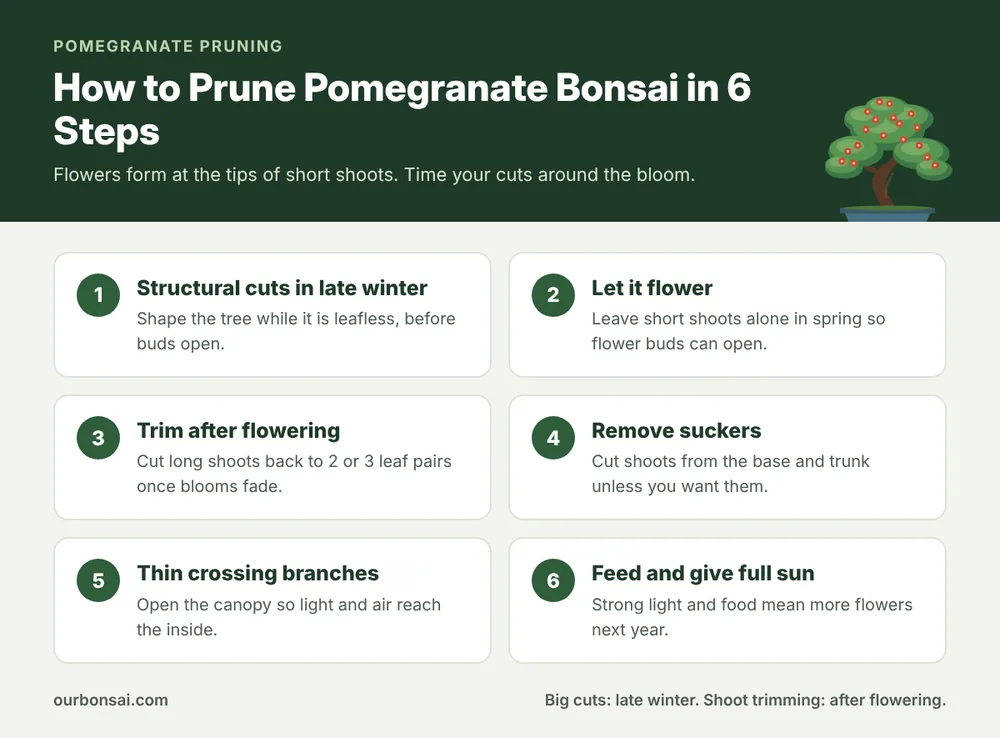
Step 1: Structural pruning in late winter
With the tree leafless, look at the trunk and main branches. Remove branches that cross, grow straight up from horizontal branches, point into the center or grow from the same point as another branch. Shorten branches that are far too long. Seal cuts larger than a pencil.
Pomegranates often have several trunks. Decide whether you want a single trunk or a clump, and remove extra stems at the base if they do not fit the design.
Step 2: Let it grow and flower
From spring, let new shoots grow. Short shoots that end in flower buds are what you want. Leave them alone until the flowers open and fade.
Step 3: Trim shoots after flowering
Once the main flush of flowers has faded, cut long, vigorous shoots back to two or three pairs of leaves. Choose a leaf pair with buds facing the direction you want new growth to go. Leave short shoots that carry developing fruit if you want to keep them.
Step 4: Remove suckers
Pomegranates produce suckers from the roots and lower trunk all season. Cut them off flush unless you want to grow one into a new trunk or branch.
Step 5: Thin the canopy
Remove some crowded and inward-growing shoots so light reaches inside the tree. Light inside the canopy keeps inner shoots alive and helps them flower.
Step 6: Aftercare
Keep the tree in full sun, water consistently and continue feeding. Our guide on bonsai fertilizer: pellets or liquid helps you choose. A feed slightly lower in nitrogen and higher in phosphorus and potassium after flowering supports next year’s flower buds.
Pruning for flowers vs pruning for shape
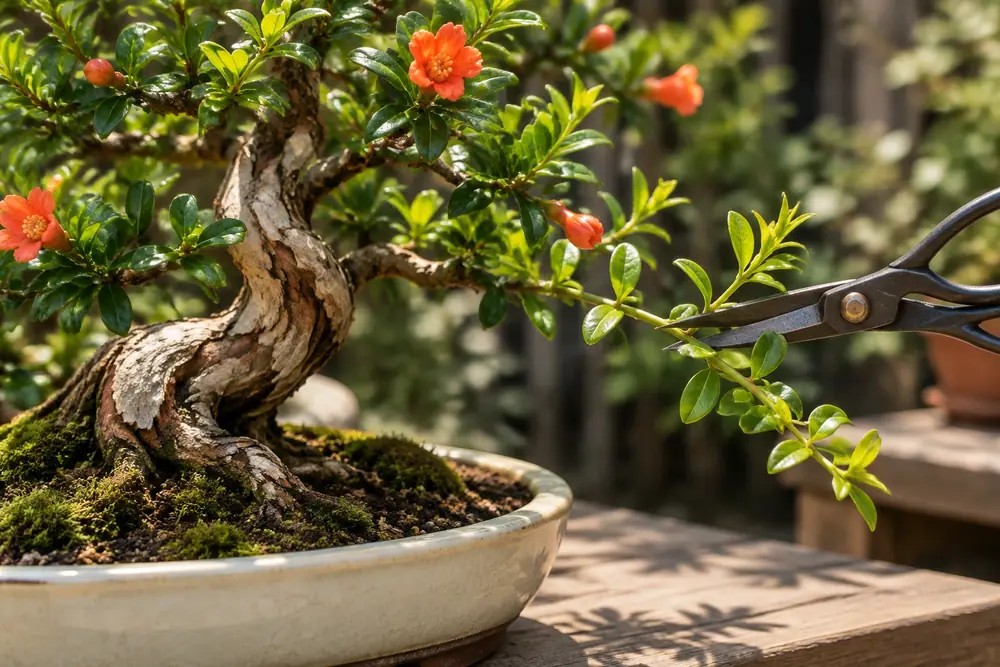
There is always a trade-off. Constant trimming gives a neat, dense shape but fewer flowers. Letting the tree grow freely gives more flowers but a messier outline. Most growers find a middle ground:
- Trees in development: focus on structure and thickening. Let shoots run long, then cut back hard in late winter. Flowers are a bonus.
- Refined trees: prune lightly after flowering, keep short flowering spurs and leave a few fruits if the tree is strong.
Turning a nursery pomegranate into a bonsai
Garden center pomegranates are usually bushy shrubs with many thin stems. To start a bonsai from one:
- In late winter, look at the base and pick the most interesting trunk or group of trunks. Remove the rest at soil level.
- Shorten the chosen trunk to the height you want, cutting just above a bud or side branch.
- Select three to five branches spaced around the trunk and remove the others.
- Let it grow freely for the rest of the year to recover and thicken. Remove suckers as they appear.
- Reduce the root ball gradually at spring repotting over the next two years, rather than all at once.
Pomegranates are tough, and this kind of hard start is usually well tolerated by a healthy plant.
Should you keep the fruit?
Small pomegranates on a bonsai are a beautiful feature, but fruit uses a lot of energy. On young or weak trees, remove most flowers after they bloom so the tree does not set fruit. On strong, mature trees, keep one to three fruits and remove the rest.
Wiring pomegranate branches
Young pomegranate branches bend easily, but they thicken fast and wire can bite in within weeks in summer. Wire in late winter or spring, check every two weeks and remove the wire as soon as it starts to mark the bark. The bark of older pomegranates is thin and twisting, so avoid wiring mature trunks heavily.
Common mistakes when pruning pomegranates
- Trimming all shoots in spring. You remove the flower buds.
- Ignoring suckers. They pull energy away from the main tree.
- Heavy pruning in late autumn. Wounds heal slowly in the cold.
- Letting it fruit heavily while young. It weakens the tree.
- Keeping it in shade. Pomegranates need full sun to flower.
For winter protection after your late-winter cuts, see our pomegranate bonsai winter care guide, and for general timing advice, our guide on when to prune deciduous bonsai.
FAQ: how to prune pomegranate bonsai
When is the best time to prune a pomegranate bonsai?
Do structural pruning in late winter before buds open, and trim shoots after the main flowering in early to mid summer.
Why is my pomegranate bonsai not flowering?
The most common reasons are pruning off the flower buds in spring, too little sun or too much nitrogen fertilizer.
Can I cut a pomegranate bonsai back hard?
Yes, pomegranates are vigorous and bud back well. Do hard pruning in late winter on healthy trees.
Should I remove pomegranate suckers?
Yes, unless you want to use one as a new trunk. Suckers take energy from the main tree.
Final thoughts
Learning how to prune pomegranate bonsai is all about timing. Shape the tree in late winter, let it flower in spring, trim long shoots after the blooms fade and remove suckers whenever they appear. Give it full sun and balanced feeding, and your pomegranate will reward you with a strong shape, plenty of orange-red flowers and maybe a few tiny fruits.