How to Prune Schefflera Bonsai: Step-by-Step Guide

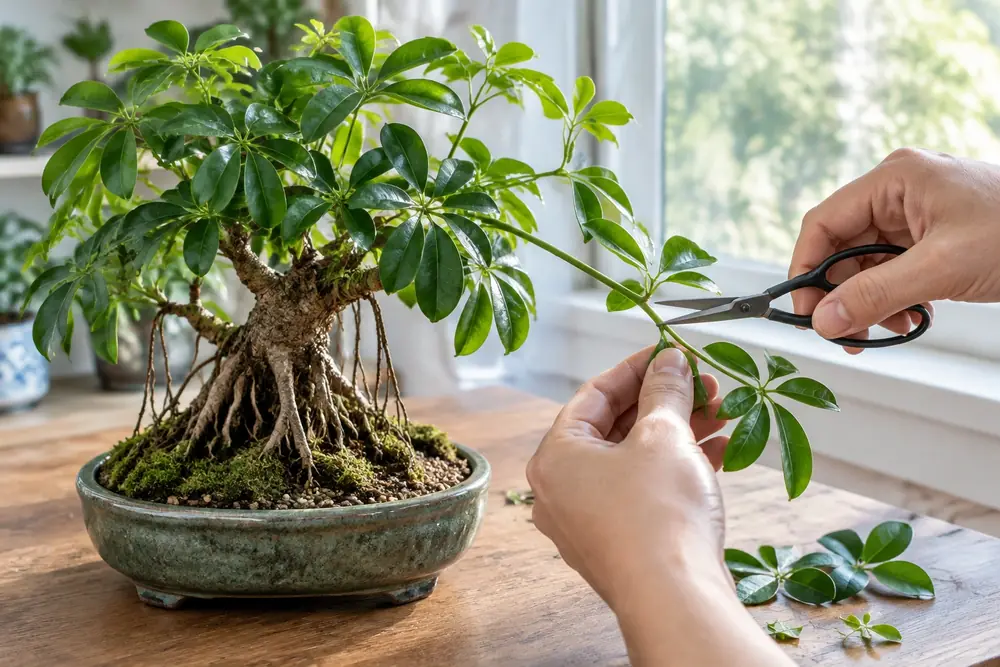
Learning how to prune schefflera bonsai is easy, because dwarf schefflera is one of the most forgiving trees to cut. It pushes new buds from almost anywhere, even old, bare wood. Prune in spring and summer while the tree is growing. Let shoots grow five or six leaves, then cut them back to one or two, just above a leaf node. Remove oversized leaves at the stalk, and cut leggy, bare stems back hard to force new growth lower down. Give the tree plenty of light afterward so the new buds grow short and compact.
In this guide
This guide walks you through when, where and how to cut.
Why schefflera needs pruning
Dwarf schefflera (Schefflera arboricola) grows long, straight stems topped with clusters of umbrella-shaped leaves. Left alone, it becomes tall and leggy, with bare stems and leaves only at the tips. The Wikipedia article on Schefflera arboricola notes it can reach several meters in the wild. Regular pruning:
- keeps the tree compact and in proportion to its pot,
- forces branching, so the canopy fills in,
- reduces leaf size over time,
- lets light reach inner and lower branches.
Our main dwarf schefflera bonsai care guide explains how pruning fits with light, watering and feeding.
When to prune schefflera bonsai
| Type of pruning | Best time |
|---|---|
| Maintenance trimming of shoots | Spring to late summer, whenever shoots grow long |
| Hard pruning of leggy stems | Late spring to early summer |
| Leaf pruning (removing large leaves) | Early to mid summer |
| Root pruning | Late spring to early summer, when repotting |
| Light tidying | Any time, if needed |
Avoid heavy pruning in late autumn and winter indoors. With low light, the tree grows slowly, and new shoots come out weak and stretched. Our guide on when to start pruning bonsai explains general timing.
Tools you need
- Sharp bonsai scissors for shoots and leaves.
- Concave or knob cutters for thicker stems, leaving a cut that heals flatter.
- Cut paste for cuts wider than a pencil.
Our guide to the best bonsai pruning shears for beginners helps you choose. Clean blades with rubbing alcohol before and after pruning.
How to prune schefflera bonsai step by step
1. Look at the whole tree first
Decide on the shape you want, usually an umbrella-like or broom-like canopy, or a multi-trunk banyan style with aerial roots. Note which stems are too tall, which areas are bare and which branches cross or crowd each other.
2. Trim long shoots
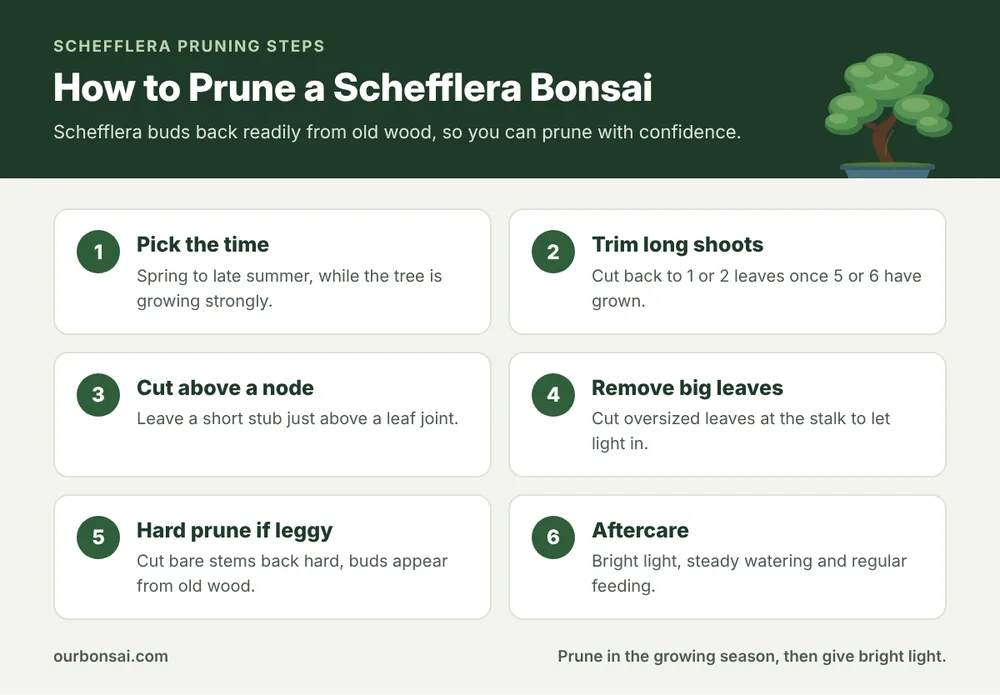
Let each new shoot grow five or six leaves. Then cut it back to one or two leaves. New buds will appear at the remaining leaf joints, creating two or more branches where there was one.
3. Cut just above a node
A node is the point where a leaf stalk joins the stem. Cut about 5 mm above it. Schefflera often pushes new buds from that node and from dormant buds lower down the stem.
4. Remove oversized leaves
Cut large leaves off at the base of the leaf stalk, leaving the bud at the joint. This opens the canopy, lets light reach inner growth and encourages smaller new leaves. Do not remove more than about half the leaves at once.
5. Thin crowded areas
Remove stems that cross, grow straight up or down, or crowd the center of the tree. Keep a balance between top and lower branches. The top usually grows strongest, so prune it a little harder.
6. Seal larger cuts
Seal cuts wider than a pencil with cut paste. Our guide to the best bonsai cut paste alternative lists options.
How to fix a leggy schefflera
A tall schefflera with bare stems and leaves only at the top is very common, especially indoors. The fix is a hard prune in late spring or early summer:
- Cut each bare stem back to the height you want, even if no leaves remain below the cut.
- Place the tree in the brightest spot you have, outdoors in partial sun if the weather allows.
- Keep watering steadily and feed every two weeks.
- New buds usually appear along the trunk within three to six weeks.
- Once new shoots grow five or six leaves, trim them back to one or two.
Only hard prune a healthy, well-rooted tree. A weak tree may not have the energy to bud back. Lack of light is the main cause of leggy growth, so our guides on how much light a bonsai tree needs and grow lights for bonsai help prevent it coming back.
Reducing leaf size
Schefflera leaves are naturally large for a bonsai. You can reduce them over time by:
- keeping the tree in strong light,
- pinching or trimming shoots regularly so energy spreads over many buds,
- removing the largest leaves in early summer,
- feeding moderately, not heavily, with a balanced fertilizer.
Expect leaf size to shrink over a few seasons, not weeks.
Pruning aerial roots
Schefflera can grow aerial roots from the trunk and branches in humid conditions. They can be trained down into the soil to form pillar roots in a banyan style. If you want them:
- keep humidity high,
- guide them down with a straw or tube filled with soil,
- let them root into the pot.
If you do not want them, simply cut them off close to the trunk. Our guide to Brussel’s Hawaiian umbrella bonsai shows a popular nursery tree with aerial roots.
Wiring schefflera
Schefflera stems are soft and do not hold wire shapes well. Most growers shape it mainly by pruning. Light wiring of young branches is possible, but check often and remove wire before it marks the bark.
Aftercare
- Light: as much as possible, ideally outdoors in summer.
- Water: steady, checking the soil daily.
- Feeding: every two weeks in the growing season. See bonsai fertilizer: pellets or liquid.
- Patience: new buds take three to six weeks to appear after a hard prune.
Common mistakes
- Only trimming the very tips. Cut back to one or two leaves so the tree branches.
- Pruning heavily in winter indoors. New growth comes out weak and leggy.
- Removing all leaves at once. Leave at least half the foliage.
- Hard pruning a weak tree. Fix watering, light and roots first.
- Keeping it in low light. Pruning cannot fix leggy growth without more light.
FAQ: how to prune schefflera bonsai
Can I cut my schefflera bonsai back hard?
Yes. Schefflera buds back from old, bare wood. Do it in late spring or early summer on a healthy tree with good light.
Where do I cut a schefflera to make it bushy?
Just above a leaf node, after letting each shoot grow five or six leaves and cutting back to one or two.
How often should I prune a schefflera bonsai?
Trim long shoots whenever they grow five or six leaves in the growing season. Hard prune only once a year at most.
Will schefflera grow back after pruning?
Yes. New buds usually appear within three to six weeks in the growing season.
Can I prune schefflera in winter?
Light tidying is fine. Save heavy pruning for spring and summer, when light and growth are strong.
Final thoughts
How to prune schefflera bonsai comes down to a few simple habits: prune in the growing season, cut shoots back to one or two leaves, remove oversized leaves and hard prune leggy stems when the tree is strong. Combine pruning with bright light and steady feeding, and your schefflera will become compact, bushy and full of small, glossy leaves.