Bonsai Apex Pruning: How to Prune and Build a Bonsai Top

This post contains affiliate links. As an Amazon Associate, OurBonsai earns from qualifying purchases at no extra cost to you. Read our disclosure.
In this guide
Bonsai apex pruning is about controlling the top of the tree, the part that grows strongest and catches the eye first. Almost every tree has strong apical dominance: the top and outer tips grow faster than the lower branches. Left alone, the apex of a bonsai becomes thick and bushy while the lower branches weaken and eventually die. Good apex pruning reverses that: you trim the top more often and harder than the rest of the tree, keep its branches finer than those below, and shape it into a soft, natural crown. On trees in development, apex pruning also means choosing and building a new top after a trunk chop.
This guide explains why the apex needs special treatment, how to prune an established apex, how to build a new one, and the timing for different trees.
Why the apex needs different pruning
Trees grow toward light, and the top shoot produces hormones that suppress buds lower down, a process called apical dominance. In nature this helps a tree outgrow its neighbors. In a bonsai, it causes three problems:
- A heavy top. The apex thickens and becomes coarse, spoiling the taper of the trunk.
- Weak lower branches. Energy flows to the top, so the lower branches, the most important ones for the design, grow less and can die.
- An unnatural shape. Old trees in nature have flat or rounded tops where growth has slowed, not a vigorous, pointed leader.
Apex pruning is how you keep the top small and fine while the lower branches stay strong.
How to prune an established apex
Trim more often
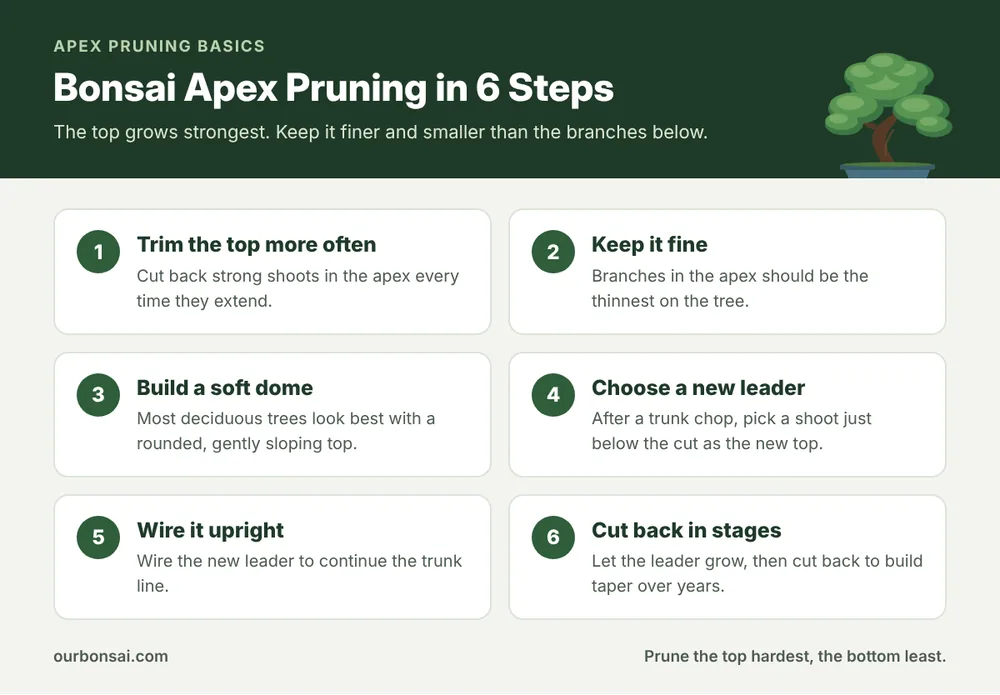
During the growing season, trim the apex every time new shoots extend, often every one to two weeks in spring. Lower branches can be left to grow longer before trimming. This simple difference in timing moves energy down the tree.
Cut back harder
In the apex, cut new shoots back to one leaf or one pair of leaves. On lower branches, leave two or three. Over a season, the top stays compact and the lower branches gain strength.
Keep apex branches thin
The branches in the top third of the tree should be the thinnest on the tree. If an apex branch is thickening, cut it back to a smaller side shoot, or remove it and let a finer shoot replace it.
Shape a soft crown
Most deciduous and broadleaf bonsai look best with a gently rounded, dome-shaped apex, like an old tree whose top has stopped climbing. Conifers often have a slightly flatter, rounded top made of small pads. Trim to this outline rather than letting a single leader shoot upward.
Partial leaf pruning
On strong deciduous trees, removing the leaves in the apex in early summer, while leaving the lower leaves, is a powerful way to weaken the top and let light into the lower canopy. Only do this on vigorous, healthy trees.
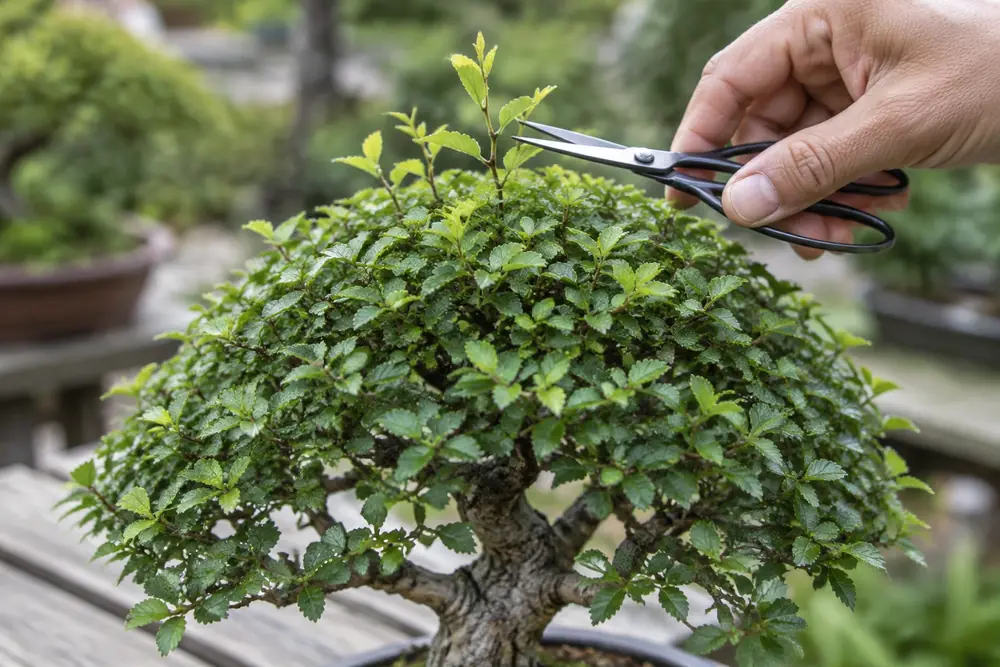
Building a new apex after a trunk chop
When you shorten a trunk to improve taper or reduce height, you need a new top. Here is the process:
- Make the chop in late winter for deciduous trees, at an angle, just above a bud or a small branch you want as the new leader.
- Choose the new leader. When shoots appear near the cut, pick the strongest one on the side that best continues the trunk line. Remove competing shoots at the top, or keep one as a backup until the leader is established.
- Wire it upright so it continues the line of the trunk rather than sticking out sideways. Our bonsai wire guide covers wire sizes.
- Let it grow freely for a season or more. The longer it grows, the thicker it becomes at the base, which smooths the transition from the old trunk.
- Cut it back to create the next section, and repeat. Each cycle adds taper and movement.
- Clean up the old cut once the new leader is well established, carving it at an angle so it heals smoothly.
Large chops heal slowly; seal them with cut paste. Our list of bonsai cut paste alternatives helps if you have none.
Apex pruning by tree type
| Tree type | Apex approach | Timing |
|---|---|---|
| Deciduous (maple, elm) | Frequent trimming, partial leaf pruning on top | Trim spring to summer; chops in late winter |
| Junipers | Pinch and thin the top harder than lower pads | Spring to summer; structural work in autumn |
| Pines | Pinch or decandle the top later and harder | Spring to early summer |
| Tropical (ficus) | Trim the top hard and often | Year round when growing; chops in early summer |
Our guides to when to prune deciduous bonsai and juniper bonsai styles for beginners give more species detail.
Reducing an apex that has grown too thick
On older trees, the apex has often been left to grow for years and is now a heavy knot of thick branches. Fixing it takes patience. In the dormant season, remove the thickest branch in the apex, or cut it back to a small side shoot. Leave the rest for now. The following year, remove or shorten the next thickest. Spreading the work over two or three seasons avoids shocking the tree and gives smaller shoots time to take over. Meanwhile, let the lower branches grow freely so they gain strength while the top is being reduced.
Tools you need
- Fine scissors for regular trimming.
- A concave cutter for removing thick apex branches.
- A pruning saw for trunk chops; see our pick of the top 5 best bonsai pruning saws.
- Wire for training a new leader.
You can also browse bonsai knob cutters for cleaning up old chop sites.
Common apex pruning mistakes
- Treating the top like the rest of the tree, so it keeps getting stronger.
- Letting apex branches thicken until they are as heavy as the lower branches.
- A pointed, upward leader on a deciduous tree that should have a rounded crown.
- Choosing a new leader on the wrong side, breaking the trunk line.
- Cutting a new leader back too soon, before it has thickened.
FAQ: bonsai apex pruning
Why does the top of my bonsai grow so fast?
Apical dominance: trees naturally send most energy to the top. Trim the apex more often and harder to balance it.
How do I make my bonsai top rounder?
Trim upward-growing shoots at the top back to sideways buds, and keep cutting to a dome outline through the season.
When should I do a trunk chop?
Late winter for deciduous trees, early summer for tropicals, and autumn for conifers, on a healthy tree.
How long does it take to build a new apex?
Usually two to five years of growing and cutting back, depending on the species and the size of the chop.
Final thoughts
Bonsai apex pruning is about restraint at the top: trim it more often, cut it back harder, keep its branches fine and shape it into a soft crown. When you need a new top, chop in the right season, choose a leader that continues the trunk line, and let it grow before cutting back. Do this consistently, and your tree will have strong lower branches, good taper and the mature crown of an old tree. For the full picture, see our bonsai care guide.