How to Prune Olive Bonsai: Step-by-Step Guide

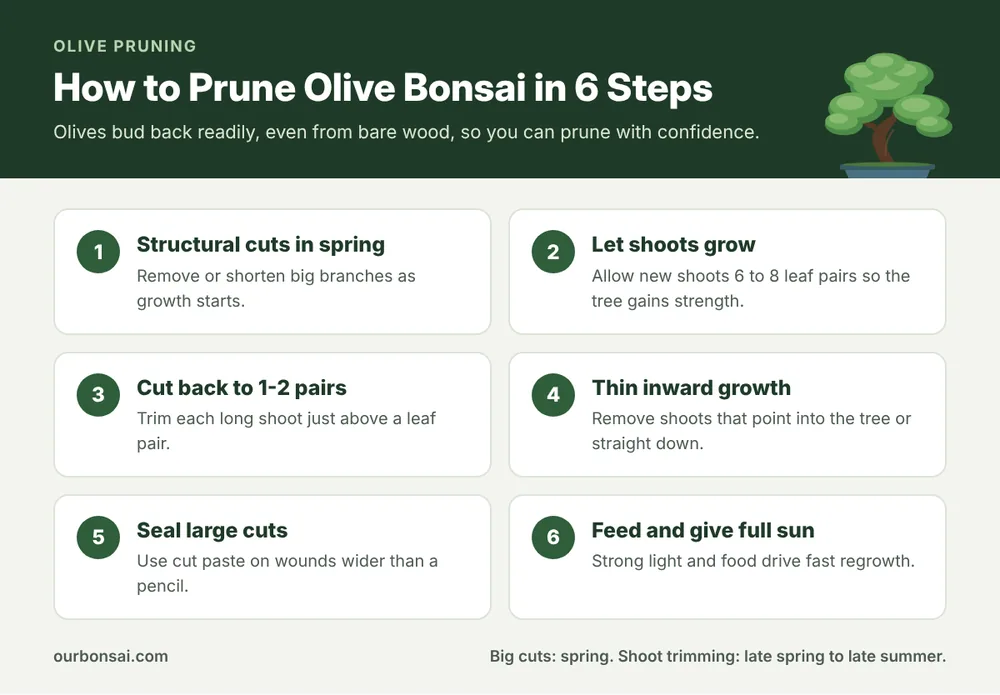
If you want to learn how to prune olive bonsai, the good news is that olives are among the most forgiving trees to cut. They are vigorous, they bud back readily from old and even bare wood, and they heal well. The basic approach: do structural cuts in spring as growth starts, let new shoots grow six to eight pairs of leaves through late spring and summer, then cut them back to one or two pairs. Thin out inward and downward growth, seal large cuts, and keep the tree in full sun with regular feeding so it regrows quickly.
In this guide
This guide explains timing, tools and the step-by-step method, plus a few olive-specific tips for building a gnarled, ancient-looking tree.
How olives respond to pruning
The European olive (Olea europaea) has been pruned by farmers for thousands of years to keep trees productive and manageable. Old orchard trees are often cut back hard to the trunk and regrow a whole new crown. The Wikipedia article on the olive notes that the tree can resprout even after being cut to the ground. That same toughness makes olives excellent bonsai.
Olive leaves grow in opposite pairs along the shoots. Each leaf pair has buds at its base, and when you cut a shoot, those buds below the cut wake up and branch. That is the mechanism you use to build dense foliage.
When to prune olive bonsai
| Type of pruning | Best time | Why |
|---|---|---|
| Structural (large branches) | Early to mid spring | Fast healing as growth starts |
| Shoot trimming | Late spring to late summer | Shoots have grown and the tree is strong |
| Light tidying | Early autumn | Neat shape before winter |
| Avoid | Winter and cold periods | Olive is resting and heals slowly |
If you keep your olive indoors in winter, do the main pruning after it goes back outside in spring and starts growing.
Tools for pruning olives
- Sharp bonsai scissors for shoots. Our guide to the best bonsai pruning shears for beginners compares good options.
- Concave cutter for removing branches flush with the trunk. See our concave cutter review.
- Pruning saw for thick trunks or branches on large olives. Our list of the best bonsai pruning saws has options.
- Cut paste for large wounds.
- Carving tools if you want to create deadwood. Our guide to the most essential bonsai carving tool covers the basics.
How to prune olive bonsai step by step
Step 1: Decide on the design
Look at the tree from all sides and choose the front. Olives look best when they suggest an old Mediterranean tree: a thick, twisting trunk, a few strong main branches and a broad, rounded crown. Decide which branches support that image.
Step 2: Make structural cuts in spring
Remove branches that compete with the main design, cross each other or grow from the same point as another branch. Shorten branches that are much too long. Olives bud back from old wood, so you can cut back to a short stub and expect new shoots near the cut. On large cuts, a concave cutter or saw gives a clean wound that heals flatter.
Step 3: Seal large wounds
Apply cut paste to wounds wider than about a pencil. It keeps moisture in the healing tissue and helps the wound roll over. Our guide to the best bonsai cut paste alternative has options.
Step 4: Let new shoots grow
Through late spring and early summer, let the tree grow freely. Strong shoots with six to eight pairs of leaves feed the roots and thicken the trunk and branches.
Step 5: Cut shoots back to one or two leaf pairs
Once shoots have extended and begun to firm up, cut them back to one or two pairs of leaves. Choose a leaf pair with buds pointing in the direction you want the next branch to go. Repeat this through summer and the tree will branch more densely each time.
Step 6: Thin and clean
Remove shoots growing straight down or into the center of the tree, and thin crowded areas so light reaches the inside. Olives in dense shade drop their inner leaves.
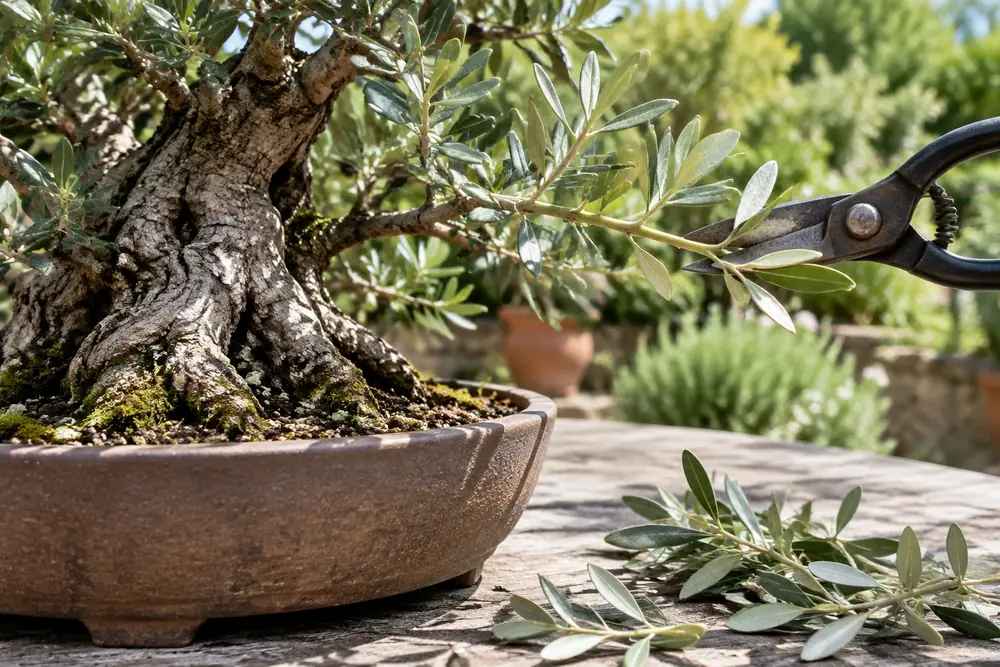
Hard pruning an overgrown olive
Nursery olives and garden olives are often tall, leggy trees with all the foliage at the top. Olives are one of the few species where you can cut back dramatically. In spring, a healthy olive can be cut back to a short trunk with a few stubs, and it will usually sprout new shoots along the trunk within a few weeks. Keep it in full sun, water well and feed as soon as new growth appears. Choose the best new shoots as future branches and remove the rest gradually.
Deadwood on olive bonsai
Ancient olives in the wild often have hollow trunks and dead sections. You can recreate this look by carving a large pruning wound into a hollow or by stripping bark from a branch stub to create a jin. Olive wood is hard, so power tools or sharp hand tools help. Treat exposed deadwood with lime sulfur to preserve it.
Aftercare after pruning
- Full sun. Olives regrow fastest in strong light. Our guide on how much light a bonsai tree needs explains why this matters.
- Water by need. Fewer leaves use less water, so check the soil before watering.
- Feed. Start or continue regular feeding during the growing season to fuel regrowth.
- Do not repot and hard prune in the same season unless the tree is very vigorous.
Common mistakes when pruning olive bonsai
- Trimming too often early in the season. Let shoots grow first so the tree gains strength.
- Pruning in winter. Wounds heal slowly in cold weather.
- Leaving big cuts unsealed. They dry back further than you want.
- Keeping the tree in shade. Weak light means weak, sparse regrowth.
- Shearing like a hedge. It creates a dense outer shell and a bare interior.
If the tree drops leaves after pruning, our guide on why a bonsai loses leaves suddenly helps you find the cause.
FAQ: how to prune olive bonsai
Can I cut an olive bonsai back hard?
Yes. Olives bud back from old wood, so a healthy tree can be cut back hard in spring and will regrow.
How often should I trim my olive bonsai?
Do structural pruning once a year in spring, then trim long shoots back two or three times during the growing season.
Should I remove olive flowers and fruit on a bonsai?
Many growers remove them, because flowering and fruiting use energy that would otherwise go into growth. On a mature tree you can leave a few for interest.
Can I reduce leaf size on an olive bonsai?
Yes. Regular shoot trimming, strong sunlight and a well-ramified canopy all lead to smaller leaves over time.
Can I wire an olive bonsai after pruning?
Yes. Young olive branches bend well, but the wood stiffens quickly as it matures. Wire in spring or summer, check every few weeks and remove the wire before it bites into the bark. Many olive growers rely mostly on pruning to shape the tree.
Final thoughts
Learning how to prune olive bonsai is rewarding because olives respond so well. Make the big cuts in spring, let shoots grow and then cut them back to one or two leaf pairs, thin the interior and give the tree full sun and food. Within a few seasons, you will have a dense, characterful olive that looks like a centuries-old tree in miniature.