Why Is My Jade Bonsai Dropping Leaves? Causes and Fixes

This post contains affiliate links. As an Amazon Associate, OurBonsai earns from qualifying purchases at no extra cost to you. Read our disclosure.
In this guide
Jade bonsai dropping leaves is a common worry because the leaves are so thick and solid that it seems strange for them to fall. But a jade (Crassula ovata) uses its leaves as water tanks, and when something goes wrong at the roots, with the temperature, or with the light, it sheds them to protect the rest of the plant. The good news: once you work out the cause, leaf drop usually stops quickly, and every fallen leaf can even grow into a new jade.
This guide covers the seven most common reasons a jade bonsai drops leaves, how to tell them apart, and what to do about each one.
First, look at the fallen leaves
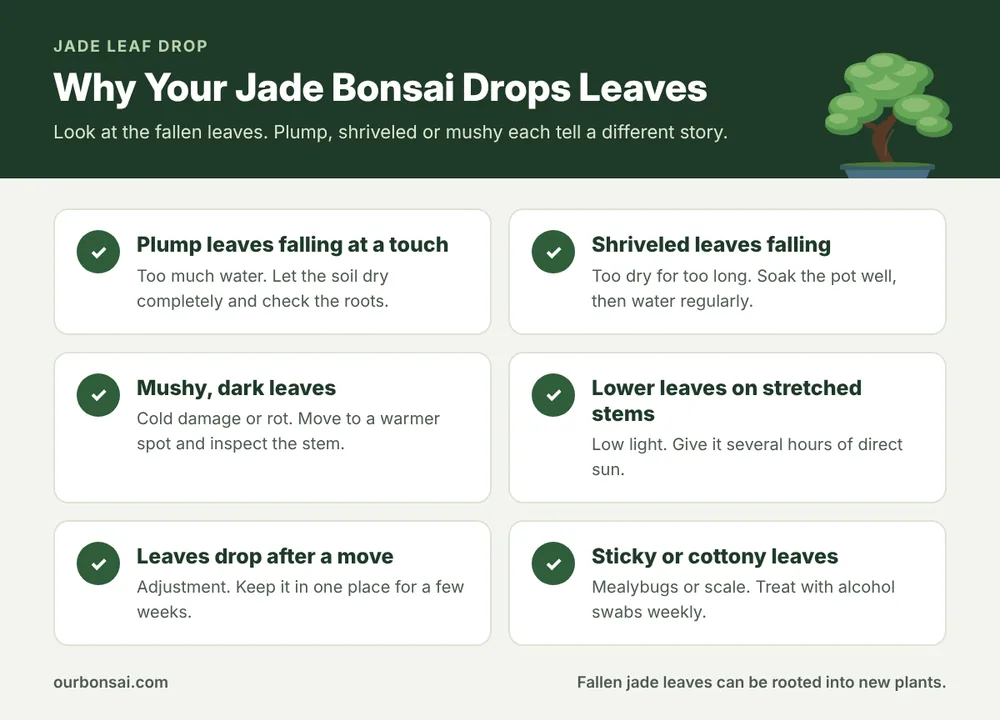
The condition of the leaves on the floor is your best clue:
| Fallen leaves are | Soil is | Most likely cause |
|---|---|---|
| Plump and green | Damp | Overwatering |
| Wrinkled and thin | Dry | Underwatering |
| Soft, dark or mushy | Damp or cold | Cold damage or rot |
| Yellow, from the bottom of long stems | Normal | Low light |
| Green, soon after a move | Normal | Adjustment shock |
| Sticky or with white fluff | Any | Pests |
7 causes of jade bonsai dropping leaves
1. Overwatering
The most common cause. When roots sit in wet soil, the leaves swell with too much water and drop off at the slightest touch, often while still green and plump. Leave it too long and the roots rot.
Fix: let the soil dry out completely. If it stays wet for more than a week, unpot the tree, cut away any black, mushy roots and repot into a gritty mix of pumice, lava and a little akadama. Our guide to root rot in bonsai explains the process. From then on, water only when the soil is dry right through.
2. Underwatering
A jade can go weeks without water, but not forever. When its stored water runs low, it sacrifices older leaves, which wrinkle, yellow and fall.
Fix: soak the pot until water runs from the drainage holes. Remaining leaves should plump up within a few days.
3. Cold and drafts
Jade tolerates cool rooms but not cold. Temperatures near freezing, cold window glass at night or an icy draft can turn leaves soft and dark, and they fall within days. Cold plus wet soil is the worst combination.
Fix: keep the tree above 45°F (7°C), and in winter pull it back a few inches from the window glass at night. Bring outdoor jades inside well before the first frost.
4. Low light
Jade wants bright light and some direct sun. In a dim spot it stretches toward the window, the stems grow long and thin, and the lower leaves fall because the tree cannot feed them all.
Fix: move it to a south- or west-facing window, or outdoors in summer with a gradual introduction to full sun. Our guide to how much light a bonsai tree needs explains why light matters so much, and a grow light for bonsai can fill the winter gap.
5. A sudden move or change
Moving a jade from a bright greenhouse to a living room, from outside to inside, or even from one window to another can cause some leaf drop as it adjusts. So can repotting.
Fix: pick a good spot and leave it there. Water carefully and wait two to three weeks for it to settle.
6. Pests
Mealybugs love the sheltered joints between jade leaves and stems. Scale insects settle on stems and undersides. Both drain sap and weaken leaves until they fall. Look for white cotton, sticky residue or small brown bumps.
Fix: dab each pest with a cotton swab dipped in rubbing alcohol, then check weekly. Our guide to mealybugs on bonsai trees covers treatment in more detail, or you can use an insecticidal soap spray.
7. Natural leaf turnover
Older leaves at the base of branches age and fall now and then. If it is only a few, and new leaves are appearing at the tips, it is normal.
When leaf drop becomes serious
Most leaf drop is a warning, not an emergency. It becomes urgent when it comes with any of these:
- A soft or wrinkled trunk at the soil line. Press gently; it should feel as firm as a carrot. Softness means rot is moving up from the roots.
- Black or brown streaks inside a broken stem. Rot has entered the wood.
- A sour or rotten smell from the soil.
- Leaf drop that continues for more than three weeks after you have fixed watering and light.
In any of these cases, unpot the tree the same day, cut back to clean, firm tissue, let it dry for two or three days, and repot in fresh gritty soil. Take a few healthy tip cuttings at the same time as insurance. Our guide to a bonsai losing leaves suddenly covers more general causes if your jade does not fit any of the patterns above.
What to do with fallen jade leaves
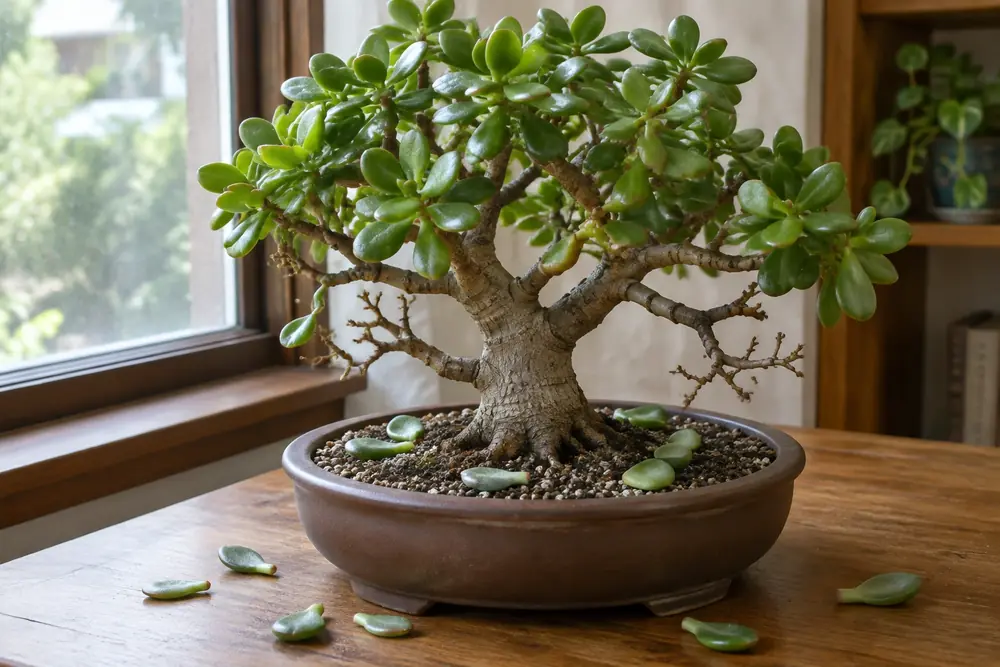
Healthy, plump fallen leaves can be turned into new plants. Let them dry for a few days until the broken end calluses, then lay them on top of dry, gritty soil in a bright spot out of direct sun. Mist the soil lightly every week or so. Within a few weeks, tiny roots and a small rosette of leaves will grow from the base. The Wikipedia page on Crassula ovata notes how easily it propagates from leaves and stem pieces, which is why it is such a common houseplant. Soft, mushy or rotting leaves should be thrown away.
How to prevent leaf drop on a jade bonsai
- Use gritty, fast-draining soil and a pot with good drainage holes.
- Soak thoroughly, then let the soil dry out completely before watering again.
- Water less in winter, often only every two to four weeks.
- Give it as much light as you can, including summer outdoors.
- Keep it above 45°F (7°C) and away from drafts.
- Check leaf joints for pests every few weeks.
- Avoid moving it around once it has a good spot.
Shaping a jade by pruning also helps it stay compact and full, so fewer leaves drop from long, weak stems; our guide to traditional jade bonsai styles has ideas.
FAQ: jade bonsai dropping leaves
Why are healthy-looking leaves falling off my jade?
Plump, green leaves dropping at a touch is the classic sign of overwatering. Let the soil dry out fully and check the roots.
Is it normal for a jade bonsai to lose leaves in winter?
A few, yes, because light is lower. Heavy leaf drop in winter usually means it is too cold, too wet or too dark.
Will my jade grow new leaves?
Yes. As long as the stems are firm and green, new leaves will grow from the branch tips and nodes once the cause is fixed.
Can I plant the leaves that fell off?
Yes, healthy plump ones. Let them callus for a few days, then set them on dry, gritty soil.
Final thoughts
Jade bonsai dropping leaves is a sign of stress, most often from too much water, cold or low light. Read the fallen leaves, check the soil, and fix the one thing that is wrong. Your jade will soon fill out again, and the fallen leaves can become your next bonsai.