Is My Fukien Tea Bonsai Dying? Signs and How to Save It


This post contains affiliate links. As an Amazon Associate, OurBonsai earns from qualifying purchases at no extra cost to you. Read our disclosure.
In this guide
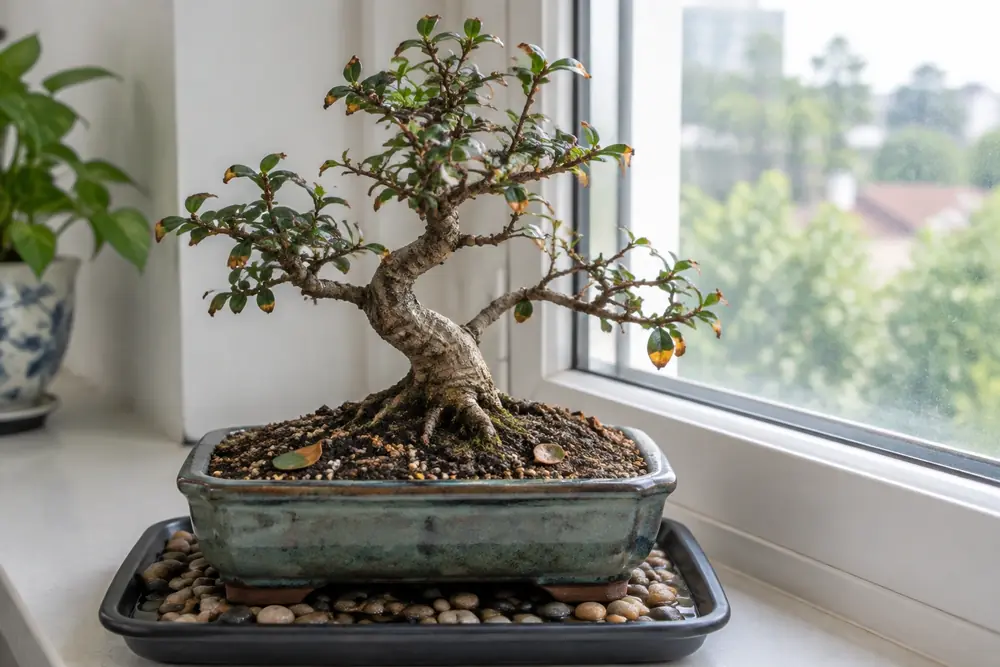
A Fukien tea bonsai dying is one of the most common problems with indoor bonsai, and one of the most frustrating, because the tree can go from glossy and flowering to bare within a couple of weeks. Fukien tea (Carmona microphylla) is famous for reacting to any change, whether in light, temperature, watering or humidity, by dropping leaves. Often that is stress, not death, and the tree recovers once conditions are stable again. But if the roots have rotted or dried out badly, you need to act quickly.
This guide helps you tell stress from real decline, check whether the tree is still alive, understand the usual causes, and follow a clear rescue plan.
Stress or dying? The warning signs
| Sign | Usually means |
|---|---|
| Leaves dropping after a move or temperature change | Stress. Often recovers in weeks |
| Brown, crispy leaf tips | Dry soil or dry air |
| Leaves yellowing and dropping slowly | Overwatering or low light |
| Black spots on leaves | Fungal leaf spot, often from wet foliage and poor air |
| White specks on leaves and webbing | Spider mites |
| Twigs that snap dry | Dieback on those branches |
| Soft, dark roots and sour soil | Root rot. Serious |
| No buds and no growth for over a month in warm light | Serious decline |
Fukien tea leaves naturally have tiny white dots on the upper surface. These are normal hairs, not pests or disease, so do not confuse them with mites or mildew.
Is my Fukien tea still alive?
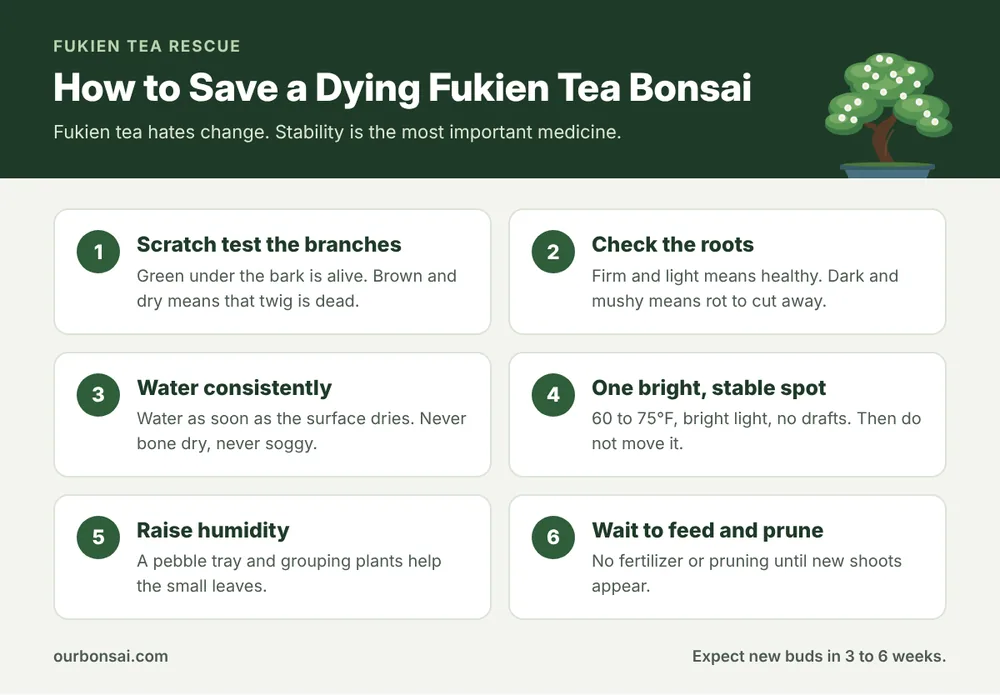
Scratch test: scratch a tiny patch of bark on a thin branch with your fingernail. Green underneath means alive; brown and dry means dead. Work toward the trunk until you find green.
Bend test: living twigs flex, dead ones snap.
Root check: ease the tree out of its pot. Healthy roots are firm and light brown with pale tips. Rotten roots are dark, slimy and fall apart.
If the trunk is green under the bark and some roots are firm, the tree can usually be saved.
Why Fukien tea bonsai decline
Inconsistent watering
Fukien tea has fine roots that dislike both extremes. A single day bone dry in a small pot can kill root tips and trigger heavy leaf drop. Soil that stays wet for days causes rot. The answer is checking daily and watering as soon as the surface begins to dry.
Low light
Indoors, especially in winter, light can fall below what Fukien tea needs. The tree drops leaves it cannot feed and stops flowering. Our guide to how much light a bonsai tree needs explains why a bright window, or a grow light, makes such a difference.
Cold, drafts and sudden changes
Fukien tea is subtropical and dislikes temperatures below about 55°F (13°C). Drafts from doors, cold glass and heating vents all cause leaf drop. So does moving the tree, even to a better spot. The Wikipedia page on Ehretia microphylla describes its warm native range in southern China and Southeast Asia.
Dry air
Heated rooms in winter are very dry. The small leaves lose water quickly and brown at the tips. A humidity tray helps a lot.
Pests and leaf spot
Spider mites thrive in warm, dry air and are common on Fukien tea. Whiteflies and scale also appear. Fungal leaf spot shows as black or brown dots, often after misting in poor air movement. Our guides to spider mites on bonsai trees and bonsai leaf spot disease cover treatment.
How to save a dying Fukien tea bonsai
Step 1: Check and treat the roots
If the soil smells sour and roots are dark and mushy, cut away all rotten roots with clean scissors and repot into a fresh, free-draining mix in a pot that fits the remaining roots. Our list of the top 10 best soil for Fukien tea bonsai has good options. If the roots look healthy, do not repot; it adds stress.
Step 2: Water consistently
Check the surface every day. Water thoroughly as soon as it starts to feel dry, then let it drain. With fewer leaves the tree uses less water, so do not water on a schedule.
Step 3: Choose one bright, warm spot and leave it there
A bright window with some morning or late afternoon sun, 60 to 75°F (15 to 24°C), away from vents and doors. Add a grow light in winter if your windows are dim; our guide to the best indoor grow lights for bonsai compares several. Then resist the urge to move it.
Step 4: Raise humidity
Use a humidity tray, or browse bonsai humidity trays. Grouping plants together also helps.
Step 5: Treat pests if present
Rinse leaves gently with lukewarm water to knock off mites, then spray with insecticidal soap weekly until clear.
Step 6: Wait
Do not fertilize, prune or wire until new shoots appear. Then cut dead twigs back to live wood and start feeding lightly.
How long does recovery take?
In good conditions, new buds usually appear in three to six weeks. A full canopy may take a growing season. Fukien tea often re-buds along bare branches once it is stable, so do not give up on a leafless tree that still passes the scratch test.
Recovery is usually fastest in late spring and summer, when light is strong and days are long. A tree that crashes in midwinter may sit quietly with few leaves until spring, then suddenly push a flush of new shoots. Keep the soil evenly moist and the tree warm through that waiting period, and resist the urge to repot or fertilize just to “do something”. The roots are rebuilding quietly, and disturbing them sets the clock back.
How to keep it healthy afterwards
- Check the soil every day and keep it evenly moist.
- Keep the tree in the same bright spot, turning it a little every week or two.
- Use a humidity tray all year indoors.
- Feed every two weeks in the growing season with a balanced fertilizer; our best fertilizer for Fukien tea bonsai list helps.
- Inspect leaves weekly for mites.
- Avoid big changes: no repotting, heavy pruning and moving all at once.
FAQ: fukien tea bonsai dying
Why is my Fukien tea losing all its leaves?
Usually a sudden change: a move, cold, a dry spell or low light. Stabilize the conditions and it will often re-bud.
Can a Fukien tea with no leaves recover?
Yes, if the branches are green under the bark and the roots are healthy. Give it light, warmth, humidity and consistent water.
Why are my Fukien tea leaves getting black spots?
Usually fungal leaf spot. Improve air flow, avoid wetting the leaves late in the day, and remove badly spotted leaves.
Is Fukien tea a good beginner bonsai?
It is beautiful but less forgiving than ficus. With daily soil checks and a stable spot, beginners can grow it well.
Final thoughts
A Fukien tea bonsai dying is usually reacting to inconsistent water, low light, cold or dry air. Check what is alive, fix the roots if needed, and then give the tree what it craves most: stability. Most trees push new leaves within weeks, and with steady care, the white flowers soon return. For styling ideas once it recovers, see our Fukien tea bonsai styles.