How to Revive Dying Bonsai Trees: Step-by-Step Rescue Plan

This post contains affiliate links. As an Amazon Associate, OurBonsai earns from qualifying purchases at no extra cost to you. Read our disclosure.
In this guide
If you want to revive dying bonsai trees, the first thing to know is that many trees that look dead are not. Bonsai often drop all their leaves or turn brown as a survival response, while the roots and trunk are still alive. With the right steps, a surprising number of these trees can be brought back. The process is simple: confirm the tree is alive, find the cause, fix it, then give the tree stable conditions and time.
This guide walks you through a complete rescue plan, from the first check to the first new leaves, and explains the mistakes that kill struggling trees during recovery.
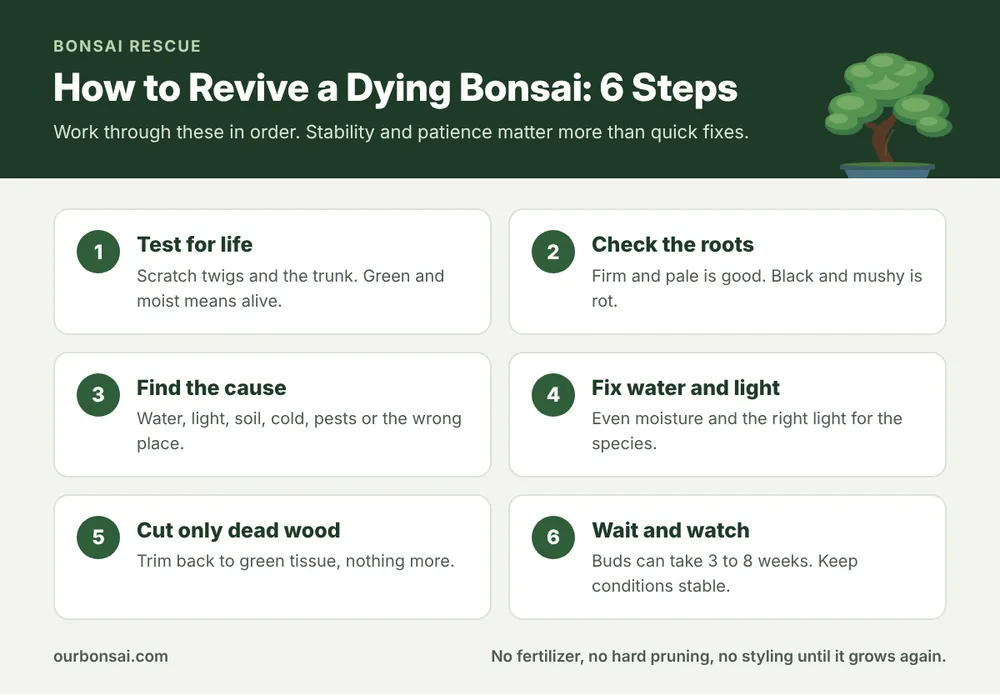
Step 1: is your bonsai still alive?
Before doing anything else, find out whether there is still life in the tree.
The scratch test
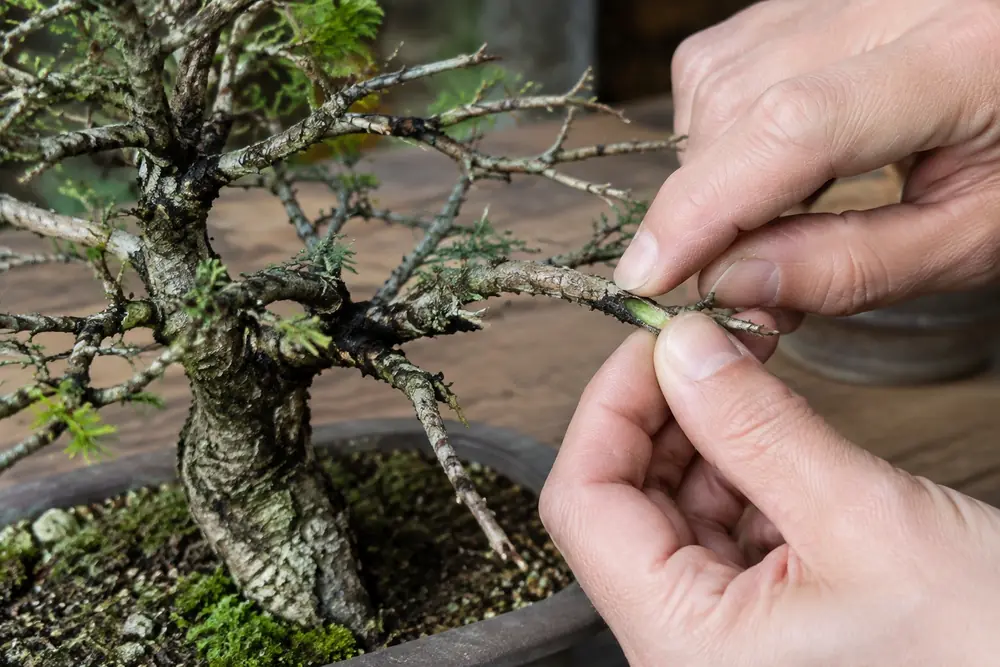
Use your fingernail or a small knife to scratch a tiny patch of bark on a thin twig. Bright green, moist tissue underneath means that twig is alive. Brown and dry means it is dead. Work back toward the trunk, testing every few centimeters, until you find green. If the trunk is green, the tree has a real chance.
The bend test
Live twigs are flexible. Dead twigs snap with a dry crack.
Evergreens and conifers
Junipers and pines can stay green for weeks after they have died, especially in cool weather. For these, check the roots and look for foliage that has lost its shine, feels dry or turns grayish. A juniper that is dull gray-green and brittle is in serious trouble.
Step 2: check the roots
Gently slide the tree out of its pot. If the soil is very compact, run a knife around the inside edge of the pot first.
| What you find | What it means |
|---|---|
| Firm, pale or light brown roots with white tips | Healthy roots, the cause is elsewhere |
| Dry, brittle, hollow roots | Drought or freeze damage |
| Black, mushy roots that pull apart, sour smell | Root rot from overwatering or poor drainage |
| A solid mat of circling roots, little soil | Root-bound, water cannot soak in |
| Grubs or insects in the soil | Root pests |
The roots tell you more about the tree’s chances than the leaves do. A tree with some healthy roots can almost always recover.
Step 3: find the cause
Most dying bonsai suffer from one of a handful of problems:
- Underwatering: dry, crispy leaves, soil pulling away from the pot.
- Overwatering or root rot: yellow, soft leaves, wet soil, sour smell. See our guide to root rot in bonsai.
- Too little light: pale, leggy growth, gradual leaf drop, common indoors.
- Wrong place: an outdoor tree like a juniper kept indoors, or a tropical tree left out in the cold.
- Pests: sticky leaves, webbing, white fluff or small bumps on stems. Our overview of bonsai pests and diseases helps you identify them.
- Winter damage: outdoor trees whose roots froze hard in a small pot.
- Too much at once: repotting, hard pruning and moving the tree in the same month.
If branches are dying one by one rather than the whole tree, our guide to why bonsai branches are dying covers that specific problem.
Step 4: fix the cause
For a dried-out tree
Soak the whole pot in a basin of water for 10 to 15 minutes, until bubbles stop rising. Let it drain fully. From now on, check the soil every day and water when the top is just dry.
For root rot
Remove as much of the wet, old soil as you can. Cut away black, mushy roots with clean scissors, back to firm tissue. Repot into fresh, gritty bonsai soil in a pot with good drainage. Water once, then let the top dry slightly before watering again. Our comparison of bonsai soil vs regular soil explains why the right soil matters so much here. This is the only situation where you should repot a struggling tree outside the normal season.
For low light
Move indoor tropical trees right next to the brightest window, and add a grow light for 12 to 14 hours a day if needed. Our guide on how much light a bonsai tree needs explains the details. Move outdoor species outside, introducing full sun gradually.
For the wrong place
Outdoor trees go outside, with protection from hard frost in winter. Tropical trees stay above about 50 to 60 °F (10 to 15 °C), away from drafts.
For pests
Rinse the tree with water and treat with insecticidal soap or neem oil, following the label. Repeat weekly until no new pests appear.
Step 5: cut back only dead wood
Once you are sure which branches are dead (no green under the bark anywhere), cut them back to living tissue with clean, sharp scissors. Leave everything else alone, even if it is bare. Bare but living branches often bud again.
Step 6: recovery care
A recovering tree needs stability more than anything.
- Keep it in one spot. Do not move it around looking for the perfect place.
- Water carefully. A tree with few leaves and damaged roots uses less water. Check daily, water when the top is just dry.
- Raise humidity for indoor trees. A humidity tray helps tropicals recover.
- No fertilizer. Damaged roots cannot use it and can be burned by it. Wait until new leaves have formed and hardened, then feed at half strength.
- No pruning, wiring or styling. All of that can wait until next season.
A pack of plant labels can help you note the date you started the rescue and what you changed, so you do not lose track.
How long does it take to revive a dying bonsai?
| Stage | Typical timing |
|---|---|
| Leaf drop slows or stops | 1 to 2 weeks |
| Buds swell on branches or trunk | 3 to 8 weeks |
| New leaves open | 4 to 10 weeks |
| Normal vigor returns | Next growing season |
Outdoor deciduous trees rescued in autumn or winter will not show buds until spring. Do not give up on them until late spring.
Mistakes that kill recovering bonsai
- Fertilizing a weak tree to “give it energy”
- Repotting a tree that does not have root rot
- Watering a little every day regardless of the soil
- Moving the tree every few days
- Pruning live but bare branches
- Bringing an outdoor tree into a warm house
FAQ: revive dying bonsai
Can a bonsai with no leaves be revived?
Often yes. If the scratch test shows green under the bark and some roots are healthy, the tree can push new buds.
Should I repot a dying bonsai?
Only if the roots are rotting or the soil is waterlogged. Otherwise, repotting adds stress at the worst possible time.
How do I know if my bonsai is completely dead?
No green under the bark anywhere, including the base of the trunk, and dry or completely rotten roots. For deciduous trees, wait until late spring before deciding.
Does sugar water or vitamin B1 help a dying bonsai?
No. Neither has been shown to help. Correct watering, light and patience are what work.
Final thoughts
To revive dying bonsai trees, start with the scratch test and the roots, then find and fix the cause. After that, keep conditions stable, water carefully and wait without feeding, pruning or repotting. Many trees that look lost come back within a few weeks. Once yours recovers, our main bonsai care guide will help you keep it healthy. For background on the stress response you are helping the tree through, see the Wikipedia article on transplant shock.