How Often to Water Cherry Blossom Bonsai (Indoor & Outdoor)

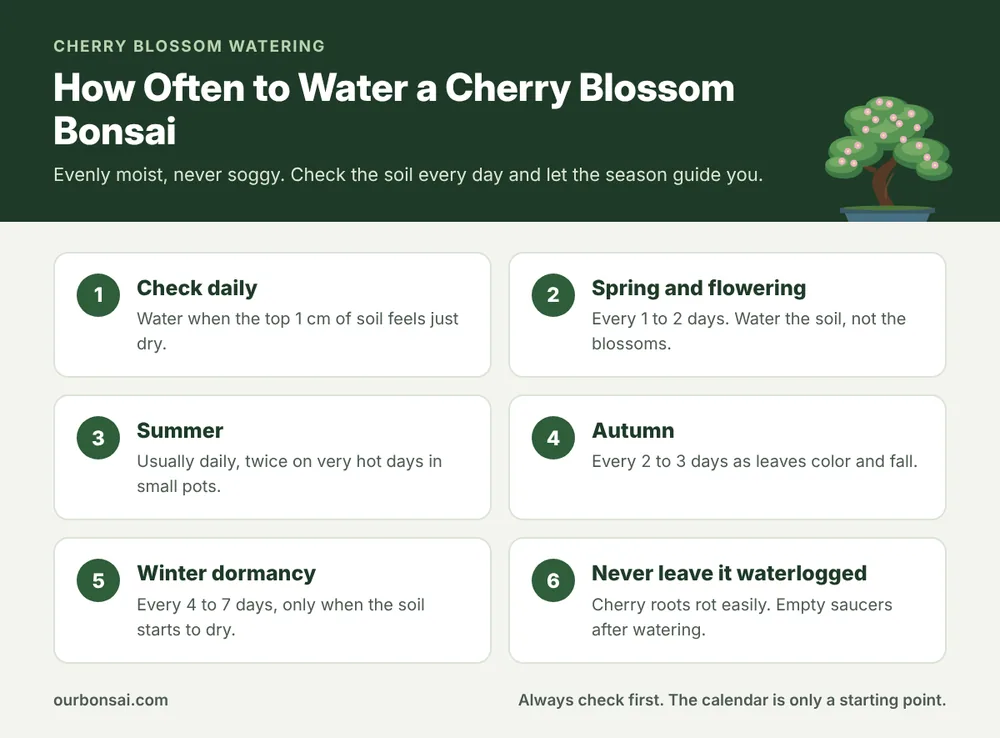
If you are wondering how often to water cherry blossom bonsai, the short answer is: check the soil every day and water whenever the top centimeter is just starting to dry. For an outdoor tree in spring and summer that usually means every one to two days, and daily in hot weather. In autumn the need drops, and in winter dormancy the tree may only need water once every week or so. Flowering cherries like evenly moist soil, but their roots are prone to rot if the soil stays soggy, so the aim is moist, airy soil, not wet soil.
In this guide
- Why watering matters so much for cherry bonsai
- How often to water cherry blossom bonsai by season
- How to tell when your cherry bonsai needs water
- How to water a cherry blossom bonsai
- Indoors or outdoors?
- Winter watering
- Watering after repotting
- Does water quality matter?
- Signs of overwatering and underwatering
- Common watering mistakes with cherry bonsai
- FAQ: how often to water cherry blossom bonsai
- Final thoughts
Cherry blossom bonsai are usually Japanese flowering cherry (Prunus serrulata) or similar ornamental Prunus species. They are outdoor trees that need sun, seasons and a cold winter rest to flower. This guide explains how to water them through the year, how to handle the flowering period and the signs that tell you something is off.
Why watering matters so much for cherry bonsai
Cherries combine two traits that make watering important. They grow a lot of leaves and flowers in spring, which takes a lot of water. And they have fleshy roots that are more vulnerable to root rot than many bonsai species. That means both extremes, bone dry and constantly wet, can do serious damage.
Drying out during flowering makes blossoms wilt and drop early. Drying out in summer, when the tree is forming next year’s flower buds, can mean fewer flowers the following spring. Soggy soil at any time invites root rot and branch dieback.
How often to water cherry blossom bonsai by season
| Season | How often (outdoor, typical pot) | What is happening |
|---|---|---|
| Early spring | Every 2 to 3 days | Buds swelling, water use rising |
| Flowering | Every 1 to 2 days | Flowers and new leaves use a lot of water |
| Late spring | Daily or every other day | Leaves expanding fast |
| Summer | Daily, sometimes twice | Heat and next year’s flower buds forming |
| Autumn | Every 2 to 3 days | Leaves color and drop, growth slows |
| Winter | Every 4 to 7 days | Dormant, roots must not dry out or freeze dry |
These are starting points. A tree in a tiny pot on a windy balcony may need water twice a day in summer, while a larger tree in a sheltered spot may need it every other day.
How to tell when your cherry bonsai needs water
- Finger test: push a finger 1 cm into the soil near the edge of the pot. Just dry means water. Still damp means wait.
- Chopstick test: leave a wooden chopstick in the soil for ten minutes. A dark, damp chopstick means there is still moisture in the root zone.
- Pot weight: lift the pot after watering and again later. A light pot needs water.
- Leaves: soft, drooping leaves on a warm afternoon mean the tree is thirsty. Water right away.
A simple soil moisture meter helps while you get to know your tree.
How to water a cherry blossom bonsai
- Use a watering can with a fine rose so you do not wash out the soil. Our guide to the best Japanese watering can for bonsai covers good choices.
- Water slowly over the whole surface until water runs from the drainage holes.
- Wait a minute, then water again so the soil absorbs it fully.
- Let the pot drain. Do not leave it standing in a saucer of water.
- Water in the morning when possible, so foliage dries before evening and fungal problems are less likely.
Watering during flowering
While the tree is in bloom:
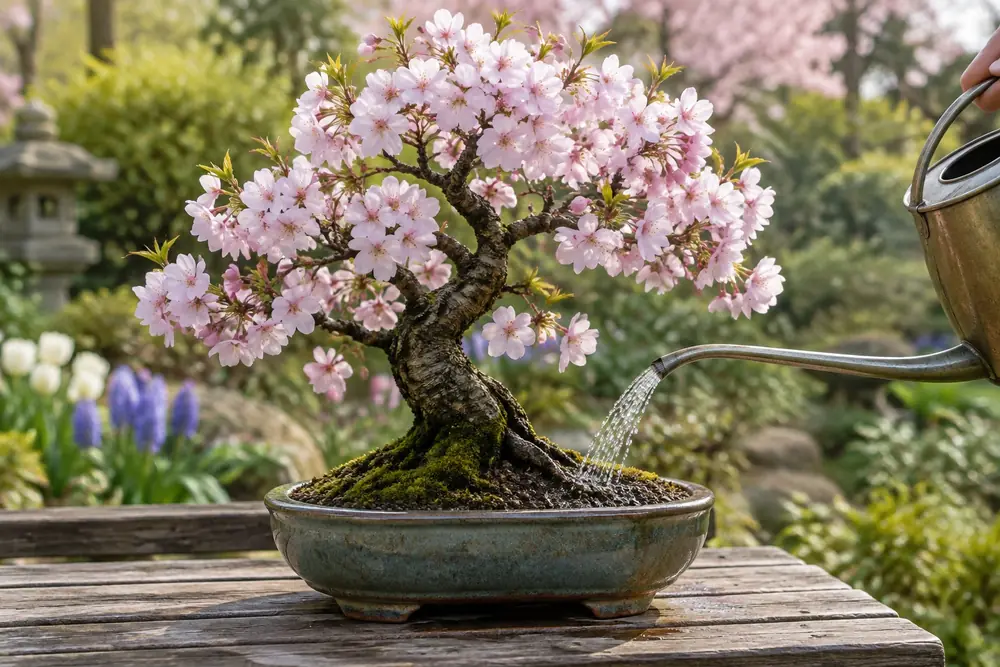
- Aim the water at the soil, not the flowers. Wet petals bruise, spot and drop faster.
- Check the soil every day, because flowering increases water use sharply.
- Keep the tree out of strong midday sun and wind to make the flowers last longer.
- Do not let the soil dry out at all during this time.
Indoors or outdoors?
Cherry blossom bonsai are outdoor trees. They need full sun to grow and set flower buds, and a period of winter cold to bloom. Kept indoors all year, they weaken and rarely flower. You can bring a tree in flower indoors for a few days to enjoy it, placed in a cool, bright spot, but check the soil daily and return it outside promptly. Our guide to types of outdoor bonsai trees explains why the seasons matter so much for species like this.
Winter watering
In winter, the tree is bare and dormant, and uses little water. But the roots still need some moisture.
- Keep the tree outdoors in a sheltered spot, protected from strong wind.
- Protect the pot from hard frost by placing it on the ground, mulching around it, or moving it into an unheated shed or garage with some light.
- Water only when the soil starts to dry, preferably on mild days.
- Never let a frozen pot dry out completely.
Watering after repotting
Cherries are repotted every two to three years, in early spring as buds swell or right after flowering. A freshly repotted tree has fewer roots, so it needs a slightly different approach for a few weeks:
- Water thoroughly right after repotting until the water runs clear.
- Keep the tree in a sheltered, lightly shaded spot for two to three weeks.
- Check the soil daily, but expect it to dry a little more slowly at first, because there are fewer roots drinking.
- Do not let it dry out, but do not keep it soggy either. Damaged roots are especially prone to rot.
- Wait about a month before you start feeding again.
Does water quality matter?
For most cherry bonsai, normal tap water is fine. Very hard water, though, slowly leaves minerals in the soil. Over time you may see a white crust on the soil surface or pot rim, and the soil pH may creep up. If that happens, use rain water when you can and flush the pot thoroughly every month or two. Avoid water from a softener, which contains sodium that harms roots. Cold water straight from the tap is fine for outdoor cherries, as they are hardy trees, but avoid watering in the evening during cold spells so the soil does not freeze while wet.
Signs of overwatering and underwatering
| Sign | Likely cause | What to do |
|---|---|---|
| Drooping leaves that recover after watering | Underwatering | Check more often, water thoroughly |
| Flowers wilting and dropping early | Soil dried out during bloom | Check daily while flowering |
| Crispy brown leaf edges in summer | Dry roots, heat | Water more often, afternoon shade |
| Yellow leaves, soil wet for days | Overwatering, poor drainage | Water less, improve soil |
| Branch dieback, sour smell from soil | Root rot | Check roots, repot into gritty soil |
If the soil drains slowly or stays wet, the soil itself may be the problem. Our bonsai soil mix ratio guide explains how to build a faster-draining mix, and our guide to root rot in bonsai covers rescue steps. For extra hot spells, our article on watering bonsai in summer has practical tips.
Common watering mistakes with cherry bonsai
- Watering on a fixed schedule. Check daily instead.
- Watering the flowers. Aim at the soil during bloom.
- Letting it dry out in summer. This can cost you next year’s flowers.
- Using dense potting soil. It stays wet and leads to root rot.
- Keeping it indoors. Low light and no winter rest weaken the tree.
FAQ: how often to water cherry blossom bonsai
Should I water my cherry blossom bonsai every day?
In summer and during flowering, often yes. In autumn and winter, much less. Always check the soil first.
Can I water my cherry bonsai with tap water?
Yes, in most areas. If your water is very hard and leaves white crust on the soil, use rain water when you can.
How do I keep the flowers on my cherry bonsai longer?
Keep the soil evenly moist, water the soil rather than the flowers, and keep the tree out of strong midday sun and wind while it blooms.
Is my cherry bonsai overwatered?
If the soil stays wet for days, leaves turn yellow and the soil smells sour, yes. Water less often and check the drainage.
Final thoughts
So, how often to water cherry blossom bonsai? Check daily, water thoroughly when the topsoil is just dry, and expect daily watering in summer and during bloom, with much less in autumn and winter. Keep the soil airy so the roots never sit in water, and you will be rewarded with healthy growth and a full show of blossoms each spring. For more on flowering trees, see our guide to flowering indoor bonsai tree care.