Trident Maple Bonsai Dying? Causes and How to Save It

This post contains affiliate links. As an Amazon Associate, OurBonsai earns from qualifying purchases at no extra cost to you. Read our disclosure.
In this guide
- Signs your trident maple bonsai is in trouble
- How to tell if your trident maple is still alive
- 6 common causes of a dying trident maple
- How to save a dying trident maple bonsai
- Branches dying one at a time
- How to keep a trident maple healthy
- Recovery timeline: what to expect
- FAQ: trident maple bonsai dying
- Final thoughts
A trident maple bonsai dying is unusual, because Acer buergerianum is one of the toughest and most vigorous bonsai species. When one does start to decline, there is almost always a clear reason: it dried out, its roots are rotting, it was overworked, or it picked up a disease. The sooner you find the cause, the better its chances.
This guide walks you through the warning signs, the six most common causes, and a step-by-step plan to save the tree.
Signs your trident maple bonsai is in trouble
Some changes are normal. Trident maples turn red, orange and yellow in autumn and drop all their leaves for winter. A bare tree in December is resting, not dying. Watch for these signs instead:
| Sign | Season | What it may mean |
|---|---|---|
| Crispy brown leaf edges | Summer | Drought or leaf scorch |
| Whole leaves wilt suddenly | Spring or summer | Dry roots or root damage |
| Yellow leaves, wet soil | Any growing season | Overwatering, root rot |
| Branches die one by one | Summer | Possible verticillium wilt |
| No buds open in spring | Spring | Root freeze or dry roots in winter |
| Sticky leaves, curled shoots | Spring | Aphids |
How to tell if your trident maple is still alive
Use the scratch test. Gently scrape a tiny patch of bark on a twig with your fingernail. Bright green underneath means that part is alive. Brown and dry means it is dead. Start at the tips and work toward the trunk. Many trees that look dead still have living tissue lower down and will recover.
In winter or early spring, also look at the buds. Plump, firm buds are a good sign. Shriveled buds that crumble when pressed suggest the branch has died.
6 common causes of a dying trident maple
1. Drying out
The number one cause. Trident maples drink a lot. In summer, a root-bound tree in a small pot can dry out in a few hours, and one bad day can kill many fine roots. The leaves scorch and drop, and branches may die back. See our guide to watering bonsai in summer.
2. Root rot from soggy soil
Old, broken-down soil that stays wet suffocates roots. Leaves yellow and the tree weakens slowly. Our guide to bonsai root rot explains how to check and treat it.
3. Root damage in winter
Trident maples are hardy in the ground, but roots in a shallow pot can freeze solid and die in a hard winter. The tree may look fine until spring, when it fails to bud or leafs out weakly and collapses. Protect pots in deep freezes.
4. Too much work at once
Heavy root pruning, full defoliation and hard top pruning in the same year can exhaust even a strong trident. Weak trees need rest between big jobs.
5. Verticillium wilt
Maples are prone to verticillium wilt, a soil-borne fungus that blocks the water-carrying tissue. Typical signs are leaves wilting and drying on one branch or one side of the tree in summer, often with dark streaks in the wood when a branch is cut. There is no cure, but removing affected branches and keeping the tree vigorous can help it survive.
6. Pests
Aphids cluster on new shoots in spring and can weaken young growth. Scale and spider mites also appear. Our guide to aphids on bonsai trees shows how to deal with them.
How to save a dying trident maple bonsai
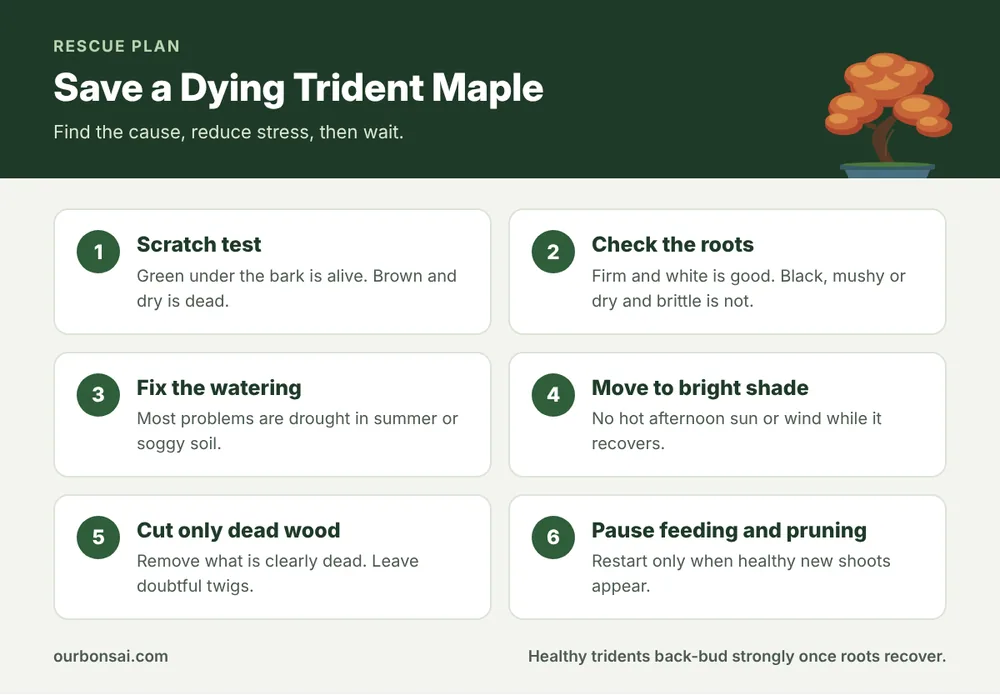
Step 1: Find the living parts
Do the scratch test across the whole tree. Mark which branches are alive.
Step 2: Check the roots
Slide the tree out of its pot. Healthy roots are firm and light colored. Black, mushy, sour-smelling roots mean rot. Dry, brittle roots mean drought damage. If the soil is old, compacted and soggy, gently remove what you can, trim rotten roots, and repot into fresh, free-draining soil. Do this carefully; a weak tree cannot handle heavy root pruning.
Step 3: Fix the watering
Water thoroughly when the surface starts to dry, never on a fixed schedule. In hot weather check twice a day. A soil moisture meter helps if you are unsure.
Step 4: Reduce stress
Move the tree into bright shade, out of wind and afternoon sun, for several weeks. If many leaves are scorched, you can remove the worst ones so the tree loses less water.
Step 5: Remove only dead wood
Cut back branches that are clearly dead to living tissue. Leave anything that might still be alive until you see new buds.
Step 6: No fertilizer or styling until it recovers
Damaged roots burn easily. Wait until you see healthy new growth, then feed at half strength. Hold off on wiring and pruning.
Branches dying one at a time
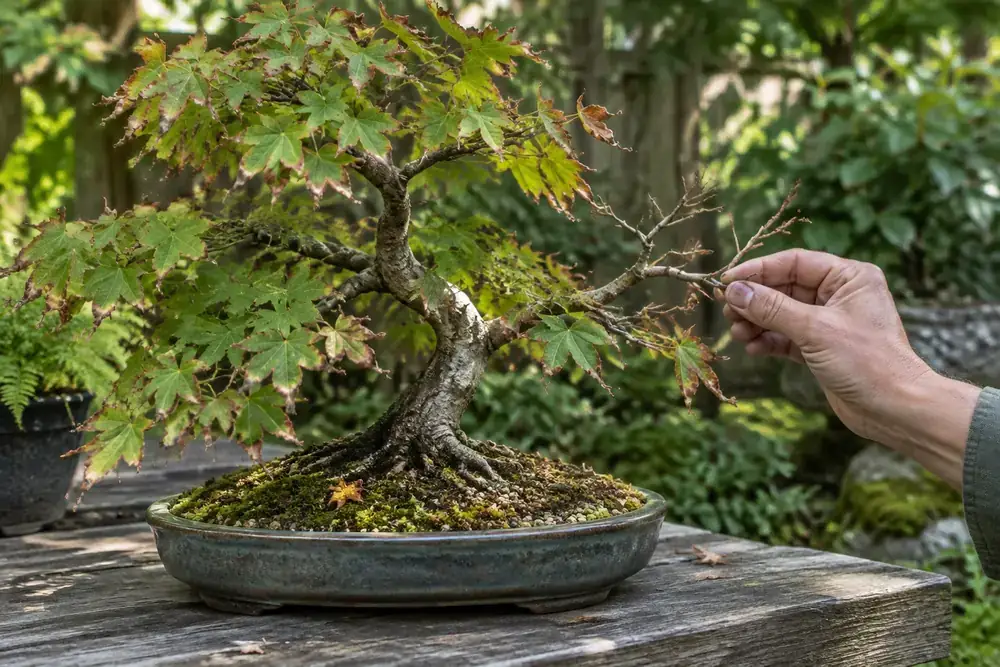
If your tree loses branches one by one while the rest stays healthy, look at:
- Shading: Inner and lower branches die when the top gets too dense. Thin the top to let light in.
- Verticillium wilt: Wilting on one side in summer, with dark streaks in the wood.
- Old wire damage or bark wounds that girdle the branch.
Our article on why bonsai branches die goes deeper into this pattern.
How to keep a trident maple healthy
- Repot every one to three years in early spring into a free-draining akadama-based mix.
- Water generously in the growing season, and give some afternoon shade in very hot climates.
- Feed regularly from spring to late summer.
- Protect the roots in hard winters by placing the pot on the ground with mulch or in a cold frame.
- Space out big jobs: do not repot, defoliate and prune hard all in the same year.
If you need a moisture meter or other basics, you can find bonsai soil moisture meters on Amazon. For general care, our bonsai care guide covers the essentials.
Recovery timeline: what to expect
A trident maple that has been rescued does not recover overnight. Here is a realistic picture:
- First two weeks: Little visible change. Remaining leaves may still drop. This is the time for patience.
- Weeks three to six: New buds swell on living branches, often on old wood. Trident maples are excellent at back-budding.
- Rest of the season: Let new shoots grow freely without cutting them back. Their leaves feed the roots.
- Next year: If the tree is growing well by the following spring, you can return to normal pruning and repotting.
FAQ: trident maple bonsai dying
Can a trident maple recover after losing all its leaves in summer?
Often, yes. If the branches and roots are alive, tridents push new buds within a few weeks. Keep the soil evenly moist and the tree in bright shade.
Why did my trident maple not leaf out in spring?
Usually the roots were damaged by freezing or drying out during winter. Check the roots and the buds. If some buds are firm, give it time.
Is my trident maple dead if it has no leaves in winter?
No. Trident maples are deciduous and are bare from late autumn to spring. Check the buds and do a scratch test.
Can verticillium wilt be cured?
No, but affected trees sometimes recover if you remove dying branches, keep the tree vigorous and avoid wounding the roots.
Final thoughts
A trident maple bonsai dying is rarely a mystery. Check for drought, root rot, winter root damage, overwork, disease and pests. Find what is alive, fix the roots and the watering, give the tree shade and rest, and let it grow freely for a season. Trident maples are among the best trees at bouncing back, and with patience most will recover. For more on this species’ needs, see the Wikipedia page on Acer buergerianum and our Brussel’s trident maple bonsai review.