Is My Bonsai Root Bound? Signs and How to Fix It

This post contains affiliate links. As an Amazon Associate, OurBonsai earns from qualifying purchases at no extra cost to you. Read our disclosure.
In this guide
- What does root bound mean?
- Signs your bonsai is root bound
- Why a root-bound bonsai struggles
- Is root bound ever good for bonsai?
- How often should a bonsai be repotted?
- When is the best time to repot a root-bound bonsai?
- How to fix a root-bound bonsai
- Aftercare after repotting a root-bound tree
- Should you move to a bigger pot?
- How roots grow in a bonsai pot
- Common mistakes with root-bound bonsai
- FAQ: bonsai root bound
- Final thoughts
A bonsai root bound in its pot is not unusual. Every healthy tree in a container keeps growing roots until they fill every bit of space. A little root-bound is even useful for some bonsai, because it slows growth and keeps leaves small. But when roots take over completely, water cannot soak in, the soil breaks down, and the tree starts to struggle. Knowing the signs and repotting at the right time keeps your tree healthy for decades.
This guide explains how to tell if your bonsai is root bound, why it matters, when to repot and how to fix it.
What does root bound mean?
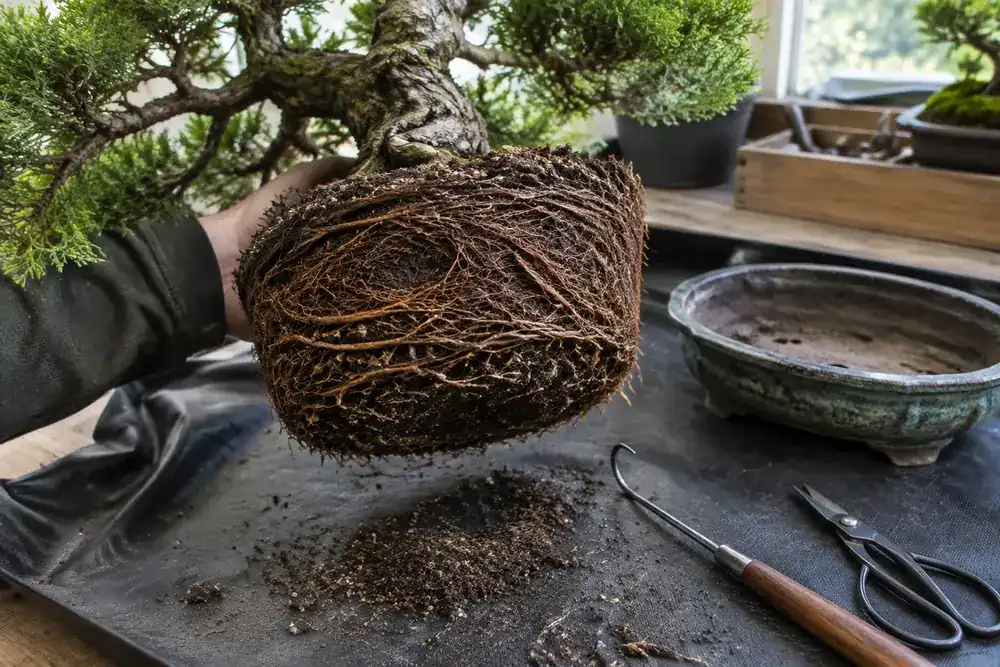
A plant is root bound (or pot bound) when its roots have filled the container so completely that there is little soil left. The roots begin circling around the inside of the pot, forming a dense mat. In bonsai pots, which are shallow, this can happen in one to three years for fast-growing trees.
Signs your bonsai is root bound
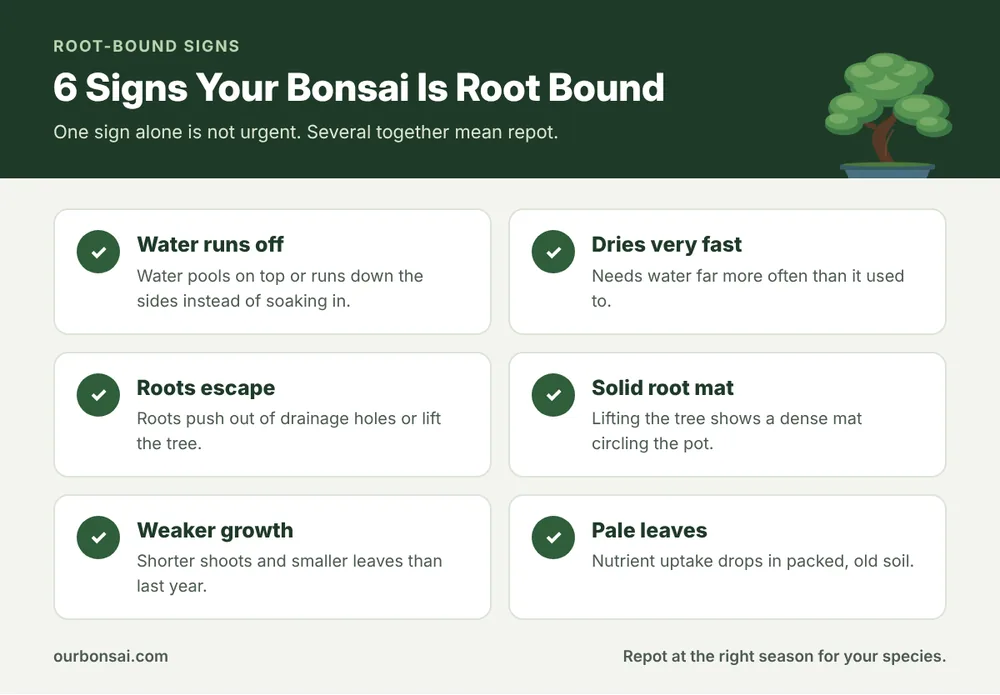
You can also check directly. In early spring, gently tip the tree and slide it partly out of the pot. If you see a solid wall of roots around the outside of the root ball with little visible soil, it is root bound.
Why a root-bound bonsai struggles
- Water cannot soak in. It runs off the surface or down the sides of the pot, leaving the center dry.
- The pot dries out very quickly, because there is more root than soil. Trees can wilt within hours in summer.
- Old soil breaks down into fine particles, reducing air around the roots.
- Nutrient uptake drops, leading to pale leaves and weak shoots.
- Roots can rot in the center where old soil stays wet while the outside dries.
Our bonsai care guide explains why fast-drying pots are risky in heat.
Is root bound ever good for bonsai?
Slightly, yes. Bonsai growers deliberately keep trees in small pots to restrict growth, shorten internodes and reduce leaf size. A tree that is just starting to fill its pot is often in its best phase for refinement. The problem is when it goes too far and the tree weakens.
How often should a bonsai be repotted?
| Tree type | Typical repotting interval |
|---|---|
| Young, fast-growing deciduous trees | Every 1 to 2 years |
| Mature deciduous trees | Every 2 to 4 years |
| Tropical trees (ficus, Fukien tea) | Every 2 to 3 years |
| Junipers and pines | Every 3 to 5 years |
| Very old, refined trees | Every 4 to 5 years or more |
These are guides. The tree’s condition matters more than the calendar.
When is the best time to repot a root-bound bonsai?
- Most temperate trees: early spring, as buds swell and before leaves open.
- Tropical trees: late spring to early summer, when it is warm and they grow strongly. See our guide on the best time to repot tropical bonsai.
- Some deciduous trees can also be repotted in autumn. Our guide on repotting bonsai in autumn covers which ones.
If the tree is badly root bound in midsummer and drying out several times a day, a careful slip-pot into a slightly larger container is safer than root pruning out of season.
How to fix a root-bound bonsai
- Prepare. Water the tree the day before. Gather your tools: root hook, root scissors, chopsticks, fresh soil, mesh and wire. Our guide to bonsai repotting tools covers what you need, and a repotting mat keeps the work area clean.
- Remove the tree. Cut the tie-in wires under the pot, then run a knife or root sickle around the inside edge to free the root ball.
- Untangle the outer roots. Work from the outside in with a root hook, combing out the circling roots. Start at the sides and bottom.
- Prune the roots. Cut back long, circling and thick downward roots. On a healthy tree, removing up to about a third of the root mass is usually safe.
- Remove old soil from the outer part of the root ball. Leave some around the trunk base on the first repotting of a very bound tree.
- Repot into fresh, sieved bonsai soil. Our guide to bonsai soil mix ratios helps you pick a mix.
- Work soil into the roots with a chopstick so there are no air pockets.
- Tie the tree in firmly and water thoroughly.
A bonsai root hook makes untangling much easier than using your fingers.
Aftercare after repotting a root-bound tree
- Keep it in bright shade and out of wind for two to three weeks.
- Water when the surface begins to dry; the new soil may dry differently.
- Do not feed for three to six weeks.
- Avoid heavy pruning until it is growing well again.
Should you move to a bigger pot?
Not always. For a refined bonsai, the goal is usually to stay in the same pot and root prune. For young trees still developing a thick trunk, moving to a larger training pot lets them grow faster. Our review of large deep bonsai pots shows suitable options.
How roots grow in a bonsai pot
Roots grow fastest at their tips and naturally head outward and downward until they meet the wall of the pot. There they turn and follow the edge, which is why a root-bound tree has a ring of roots around the outside. In the ground, these roots would keep spreading; in a pot, they double back on themselves. Regular root pruning cuts these long roots and forces the tree to produce many fine feeder roots closer to the trunk. Those fine roots are the ones that matter most for water and nutrient uptake, and they are what keeps a bonsai healthy in a small pot for years.
Common mistakes with root-bound bonsai
- Waiting until the tree is weak before repotting. Repot a strong tree, not a struggling one.
- Repotting in the wrong season, especially root pruning temperate trees in midsummer.
- Cutting off too much at once on a tree that has been bound for many years. Spread the work over two repottings.
- Leaving the old, compacted core untouched for decades, so the center stays soggy.
- Packing the new soil down hard instead of working it in gently with a chopstick.
- Skipping the tie-in wires, so the tree rocks and breaks new roots.
FAQ: bonsai root bound
Can a root-bound bonsai die?
It can weaken and eventually die if left for many years, mostly from drought stress and root rot in the center. Repotting in time prevents this.
Can I repot a root-bound bonsai in summer?
Avoid root pruning temperate trees in summer. If urgent, slip-pot into a larger container without disturbing the roots.
How much root can I remove?
On a healthy tree, up to about a third. Weak trees and conifers need lighter root work.
Do I need a new pot?
Not necessarily. You can clean the old pot and replant the tree in it with fresh soil after root pruning.
Final thoughts
A bonsai root bound in its pot is a normal part of its life cycle, and repotting is the cure. Watch for water running off, very fast drying, roots escaping the holes and weaker growth. Repot at the right season, comb out and prune circling roots, use fresh soil and give the tree a few weeks of gentle aftercare. Your tree will reward you with stronger growth and easier watering.