How to Prune Chinese Elm Bonsai: Step-by-Step Guide

This post contains affiliate links. As an Amazon Associate, OurBonsai earns from qualifying purchases at no extra cost to you. Read our disclosure.
In this guide
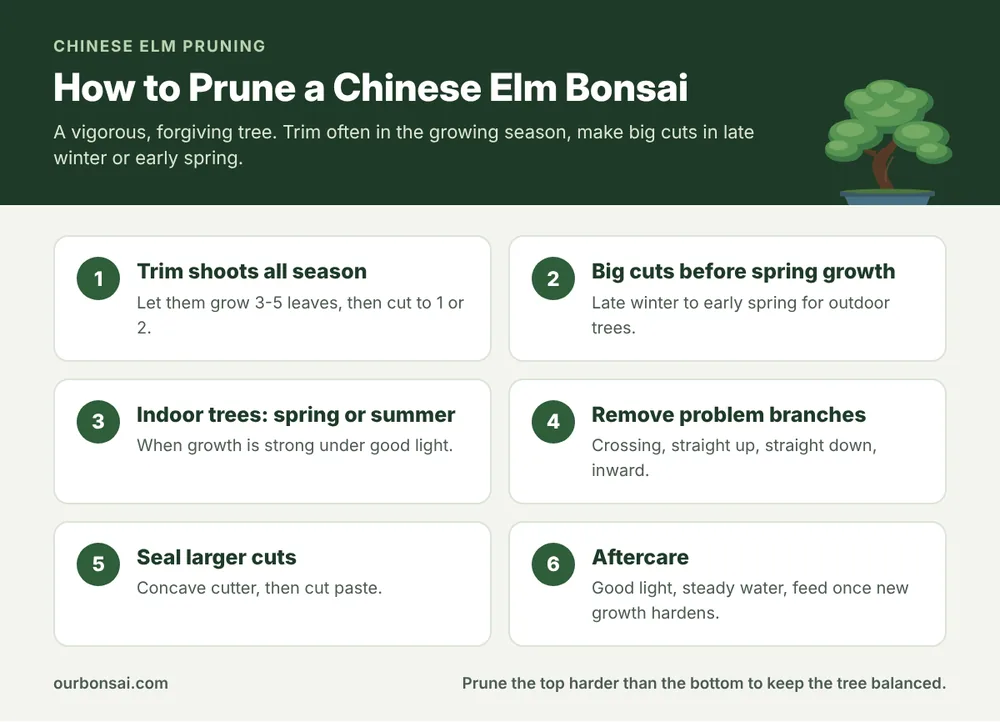
Learning how to prune chinese elm bonsai is a great way to start with bonsai pruning, because this tree is vigorous and forgiving. The basic method is simple: during the growing season, let new shoots grow three to five leaves, then cut them back to one or two. Do bigger structural cuts in late winter or early spring for outdoor trees, or in spring and summer for indoor trees. Chinese elm buds back readily, even from older wood, so you can shape it with confidence.
The Chinese elm (Ulmus parvifolia) has small, glossy, serrated leaves, fine twigs and attractive mottled bark. These traits make it ideal for building a dense, tree-like canopy through regular pruning. This guide covers timing, maintenance trimming, structural pruning and aftercare.
When to prune a Chinese elm bonsai
| Type of pruning | Outdoor tree | Indoor tree |
|---|---|---|
| Structural pruning | Late winter to early spring | Spring or early summer |
| Shoot trimming | Spring to early autumn | Whenever shoots extend, mostly spring to autumn |
| Defoliation (optional) | Early summer, healthy trees only | Rarely needed indoors |
| Avoid heavy cuts | Late autumn | When growth is weak in dim winter light |
Outdoor Chinese elms often drop many leaves in winter, so late winter is a good time to see the branch structure clearly. Our general guide on when to prune deciduous bonsai explains the reasoning.
Tools you will need
- Sharp bonsai scissors for shoots and small twigs
- A concave cutter for branch removal
- A knob cutter for stubs (optional)
- Cut paste for larger wounds
Our guide to the best bonsai pruning shears for beginners is a good place to start, and a basic bonsai tool set covers the rest.
How to prune chinese elm bonsai: maintenance trimming
Maintenance trimming builds fine branching, called ramification, and keeps the canopy compact.
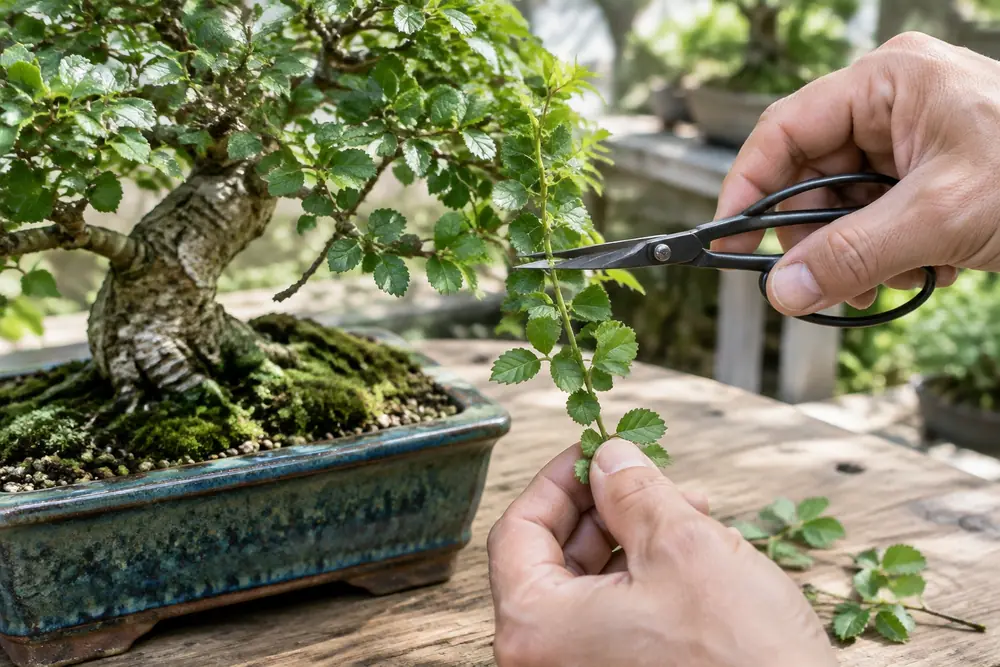
- Let the shoot grow. Wait until a new shoot has three to five leaves.
- Cut back to one or two leaves. Cut just above the leaf you want to keep. New buds will form at the base of those leaves.
- Cut in the direction you want growth. Choose a leaf on the side where you want the next shoot to grow, usually outward or sideways.
- Trim the top more often. The top of the tree is strongest. Trim it more frequently and harder than the lower branches.
- Repeat through the season. Chinese elm may push several flushes of growth from spring to autumn.
Over a few seasons, this cycle of growth and cutting turns long, single shoots into dense pads of fine twigs.
Structural pruning
Structural pruning shapes the tree’s main branches. For outdoor elms, do it in late winter or early spring before the buds open. For indoor elms, do it in spring or early summer when growth is strongest.
- Study the tree. Decide on the front and the overall shape. Chinese elm is often styled as a broom or an informal upright tree.
- Remove problem branches. Crossing branches, branches growing straight up from the top of other branches, branches pointing down, and branches growing back toward the trunk.
- Thin crowded areas. Where several branches grow from one point, keep one or two.
- Shorten long branches back to a side shoot or bud pointing in the right direction.
- Cut cleanly with a concave cutter so the wound heals flat, then seal larger cuts. Our guide to the best bonsai cut paste alternatives has options.
The broom style
Chinese elm is a classic choice for the broom style, where many branches fan out evenly from the top of a straight trunk, like an upside-down broom. To build it, the trunk is cut at the desired height and the many new shoots that appear are trimmed regularly to develop a rounded, even crown.
Pruning an indoor Chinese elm
Many Chinese elms are sold as indoor bonsai. Indoors, the tree grows more slowly and with weaker light, so adjust your pruning:
- Trim less often. Wait until shoots have grown four or five leaves before cutting, so the tree keeps enough leaves to make energy.
- Avoid heavy cuts in winter. Indoor light in winter is weak, and the tree recovers slowly.
- Improve the light first. If new shoots are long and thin with big gaps between leaves, the tree needs more light, not more pruning. A grow light makes a big difference.
- Consider a summer outdoors. Many indoor elms benefit from spending the warm months outside, where they grow stronger and respond better to pruning.
Defoliation
On strong, healthy outdoor trees, removing most of the leaves in early summer can produce a second flush of smaller leaves and more buds. It is an advanced technique. Only do it on vigorous trees in good light, never on weak or indoor trees, and not every year.
Wiring Chinese elm
Young Chinese elm branches are flexible and wire well. Wire in spring or summer and check every two weeks. Chinese elm thickens quickly in the growing season, so remove the wire before it bites into the bark. Many growers prefer the “clip and grow” method, shaping mostly by pruning, which suits elms well.
Aftercare
- Light: outdoors in full sun or bright light, indoors right next to the brightest window. Our guide on how much light a bonsai tree needs explains why it matters for regrowth.
- Water: with fewer leaves, the tree uses less water for a while. Check the soil daily and water when the top is just dry.
- Feeding: feed every two to four weeks in the growing season. See our guide to the best Chinese elm bonsai fertilizer.
Common pruning mistakes
- Never pruning. Elms grow fast and lose their shape within a season.
- Pruning only the bottom. The top keeps getting stronger and lower branches weaken.
- Cutting all shoots back too early. Let them reach three to five leaves first so the tree keeps its strength.
- Heavy cuts in late autumn. Leave big cuts for late winter or spring.
- Leaving wire on too long. Elms thicken fast and scar easily.
Pruning roots
Chinese elm also responds well to root pruning. Repot every two years for young trees and every three to four for older ones, in early spring for outdoor trees. Remove up to about a third of the roots, focusing on thick, long roots, and use a gritty soil like those in our guide to the best soil for Chinese elm bonsai.
FAQ: how to prune chinese elm bonsai
How often should I prune my Chinese elm bonsai?
Trim shoots every few weeks in the growing season. Structural pruning once a year in late winter or spring.
Can I cut my Chinese elm back hard?
Yes. Chinese elm buds back well from older wood. Do hard cuts in late winter or early spring on healthy trees.
Should I prune my indoor Chinese elm in winter?
Light trimming is fine if it is growing. Save heavy pruning for spring and summer, when light is stronger.
Why is my Chinese elm growing long shoots after pruning?
That is normal vigor. Keep trimming them back to one or two leaves once they have three to five.
Final thoughts
Knowing how to prune chinese elm bonsai comes down to regular shoot trimming in the growing season and structural cuts at the right time of year. This forgiving tree rewards consistent pruning with fine twigs, small leaves and a dense, mature-looking canopy. For full care beyond pruning, see our Chinese elm bonsai care guide, and for background on the species, the Wikipedia article on Ulmus parvifolia.