Should You Rotate Bonsai? Why and How Often to Turn Your Tree

This post contains affiliate links. As an Amazon Associate, OurBonsai earns from qualifying purchases at no extra cost to you. Read our disclosure.
In this guide
Should you rotate bonsai trees? In most cases, yes. Every tree grows toward the light, a response called phototropism. A bonsai that always has the same side facing the window or the sun will slowly lean, develop stronger branches on the bright side and weaker, sparser branches on the shaded side. Turning the tree regularly, usually a quarter turn every week or two indoors and every few weeks outdoors, spreads the light around so the whole tree grows evenly. It is one of the simplest habits in bonsai care, and one of the most effective.
This guide explains why rotation matters, how often to turn your bonsai indoors and outdoors, how to use rotation to balance a tree, and the times when you should leave it alone.
Why bonsai grow unevenly
Plants bend and grow toward their main light source. The shaded side of the stem grows a little faster than the lit side, so the shoot curves toward the light. The Wikipedia article on phototropism explains the plant hormone, auxin, that drives this. In a bonsai, the effects add up over weeks:
- Leaning apex. The top of the tree tilts toward the window.
- One-sided canopy. Branches on the bright side grow long and dense; branches on the dark side thin out.
- Dying back branches. Shaded inner and back branches can weaken and die if they never get light.
- Uneven trunk and roots. Over years, the side that gets the most light develops more vigorously, including the roots below it.
Indoor bonsai are the most affected, because a window gives light from one direction only. Outdoor trees get light from overhead and around them, so the effect is smaller, but still real on a bench against a wall or fence.
How often to rotate bonsai
| Situation | How often to turn | Notes |
|---|---|---|
| Indoors on a windowsill | A quarter turn every 1 to 2 weeks | Strongest one-sided light |
| Indoors under a grow light | Every 2 to 4 weeks | Light from above is more even |
| Outdoors in open full sun | Every 3 to 4 weeks, or as needed | Light comes from many directions |
| Outdoors against a wall or fence | Every 1 to 2 weeks | One side is always shaded |
| Training a weak side | Face the weak side to the light longer | Use rotation to balance strength |
Indoor trees benefit the most. If you only do one thing, give your indoor bonsai a quarter turn every time you water once a week.
Signs your bonsai needs rotating
If you are not sure whether your tree has been turned enough, look for these signs:
- The apex leans toward the window or the brightest side of the garden.
- New shoots on one side are long and strong, while the other side barely grows.
- Leaves are bigger and darker on one side and smaller or paler on the other.
- Branches at the back are thinning or dropping leaves, especially low down.
- The soil dries unevenly, faster on the sunny side of the pot.
None of these is serious if you catch it early. A few months of regular rotation, with a little extra light on the weak side, usually brings the tree back into balance. A leaning apex can also be corrected with wire once the tree is growing evenly again.
How to rotate a bonsai
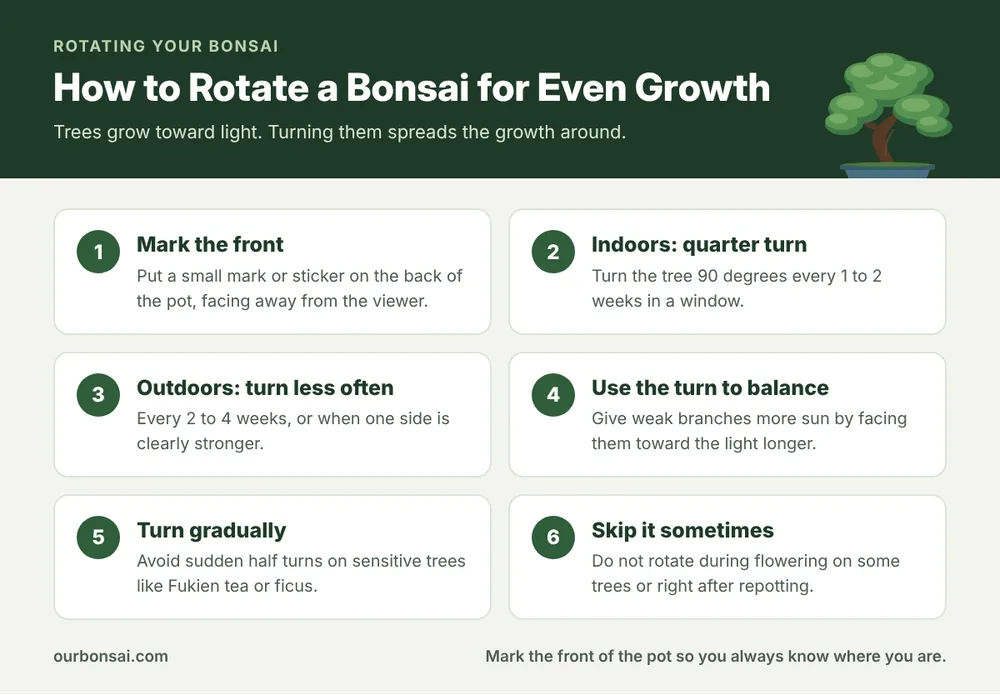
- Mark the front. Every bonsai has a front, the side you show. Put a small sticker or pencil mark on the back of the pot, so you always know which way the tree is facing.
- Turn a quarter at a time. Rotate the pot 90 degrees in the same direction each time. After four turns the tree is back to its starting position.
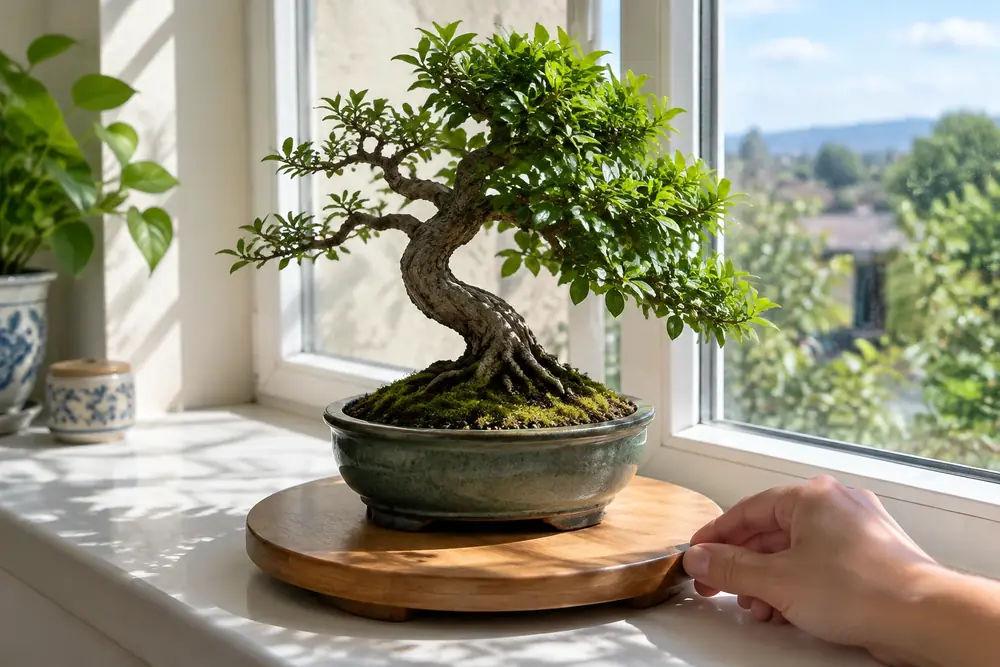
- Use a turntable for larger or heavy trees. It makes small turns easy and protects the surface underneath. Our Mighty Mini bonsai turntable review covers one option, or browse bonsai turntables.
- Keep it consistent. Linking the turn to a regular task, such as watering day or the weekly check for pests, makes it easy to remember.
Using rotation to balance a tree
Rotation is not only about even growth; it is also a styling tool. If one side of your bonsai is weaker, let that side face the light for longer, for example two weeks instead of one, before turning. The weak branches get more energy and catch up. The same trick helps a lower branch that is losing out to a strong top.
On outdoor trees, many growers display the front toward the sun for most of the season, so the most important branches get the best light, and turn the tree only now and then to stop the back from dying out.
When not to rotate your bonsai
There are a few times when it is better not to turn the tree:
- Some flowering trees in bud. Trees such as azaleas and some flowering indoor bonsai can drop buds or open them unevenly if moved during flowering. Keep them still until the flowers fade. Our guide to flowering indoor bonsai tree care explains more.
- Sensitive indoor species. Ficus and Fukien tea can drop leaves after a big change in light. Small quarter turns are fine; avoid sudden half turns or moving the tree to a different window.
- Right after repotting. Let the tree settle in one spot for a couple of weeks.
- In deep winter dormancy outdoors. A dormant deciduous tree does not need turning until spring.
Rotation and placement go together
Rotation evens out the light a tree gets, but it cannot fix a spot that is simply too dark. If your indoor tree is leaning hard and losing leaves on all sides, it probably needs a brighter window or a grow light, not just more turning. Our guides on how much light a bonsai tree needs and the best place for a bonsai tree help you choose the right spot first.
FAQ: rotate bonsai
How often should I rotate my indoor bonsai?
A quarter turn every one to two weeks is a good routine for a bonsai on a windowsill.
Do outdoor bonsai need to be rotated?
Less often, but yes, especially if they sit against a wall or fence. Every few weeks is usually enough.
Will rotating my bonsai stress it?
Small quarter turns rarely cause stress. Sensitive species may react to sudden big changes, so turn gradually.
Which way should I turn my bonsai?
It does not matter, as long as you turn in the same direction each time so the tree gets light evenly on all sides.
Final thoughts
Rotating your bonsai is a small habit with a big payoff: a straighter trunk, a fuller, balanced canopy and fewer dead branches at the back. Mark the front of the pot, give indoor trees a quarter turn every week or two, turn outdoor trees every few weeks, and use longer light exposure to strengthen weak sides. Combine it with good placement and the basics in our bonsai care guide, and your tree will grow evenly year after year.