No Growth After Repotting Bonsai? Why It Happens and What to Do

This post contains affiliate links. As an Amazon Associate, OurBonsai earns from qualifying purchases at no extra cost to you. Read our disclosure.
In this guide
- Is it normal for a bonsai not to grow after repotting?
- How long does it take?
- Common causes of no growth after repotting
- How to help a repotted bonsai start growing
- When should you worry?
- How to repot so the tree recovers faster next time
- What happens below the soil while you wait
- Species notes: what to expect
- FAQ: no growth after repotting bonsai
- Final thoughts
Seeing no growth after repotting bonsai can be worrying, especially when the rest of your collection is already pushing fresh leaves. In most cases, the tree is simply busy below the soil. Repotting removes a share of the roots, and the tree rebuilds those before it puts energy into new shoots. A few weeks of stillness is normal. But if nothing happens for months, something may be holding it back.
This guide explains what is normal, how long recovery usually takes, the most common causes of a stalled tree, and how to get it growing again.
Is it normal for a bonsai not to grow after repotting?
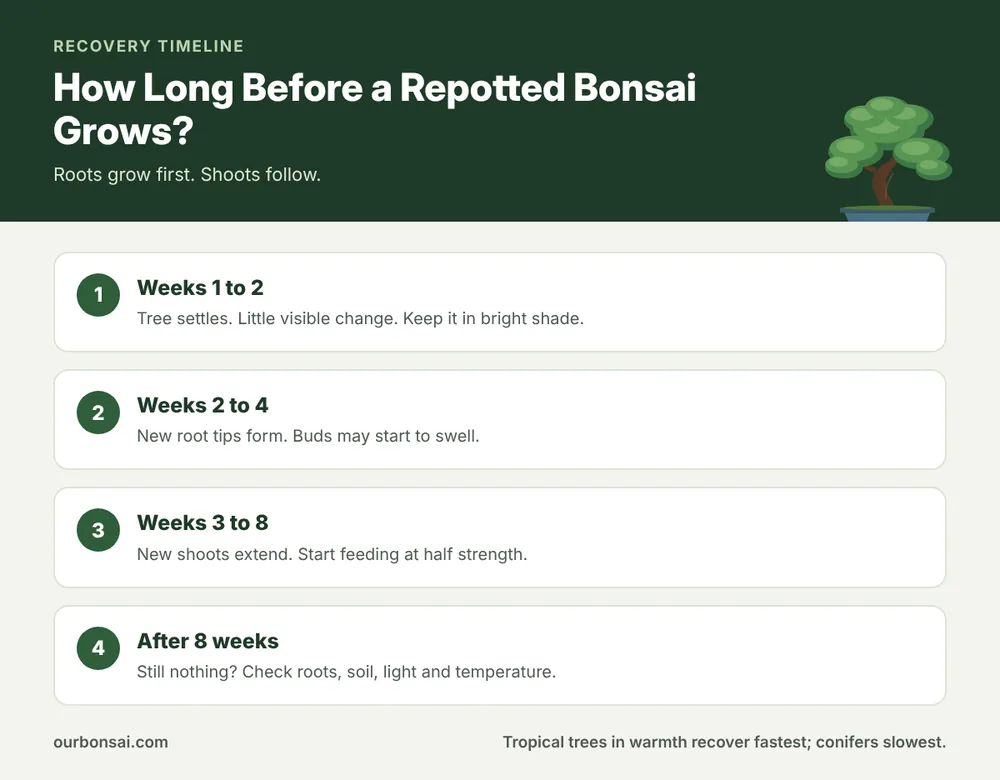
Yes, for a while. After repotting, the tree has fewer roots to take up water and nutrients. Its first priority is to grow new root tips. Only when those are working does it have the resources to push new shoots.
Signs that the tree is fine, just slow:
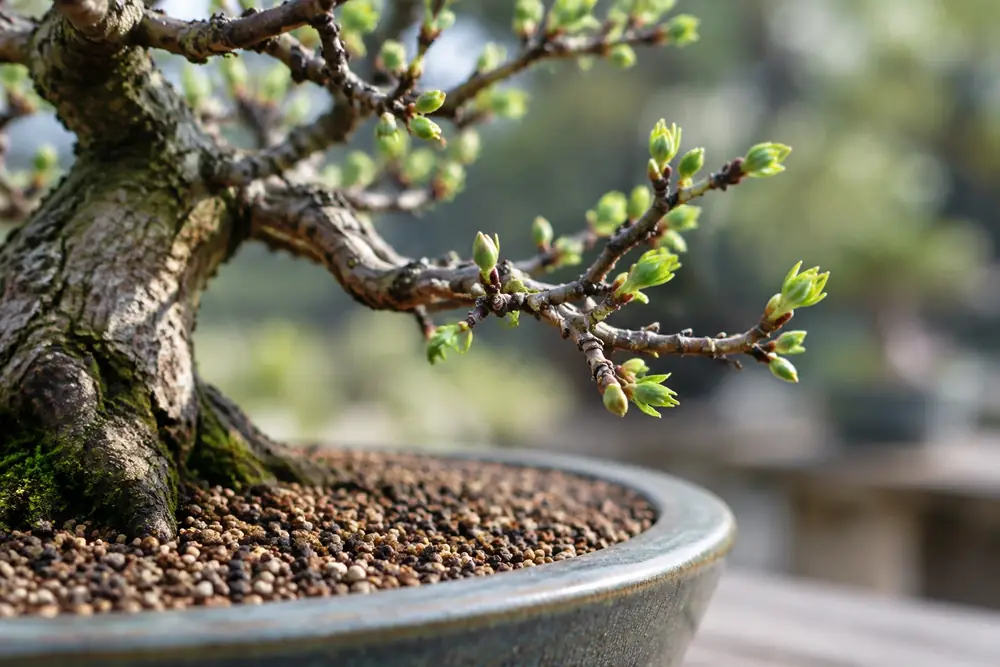
- Buds are firm and plump, not shriveled.
- Twigs are green under the bark when scratched.
- Existing leaves stay green and do not wilt badly.
- The soil dries out at a steady rate, a sign roots are drinking.
How long does it take?
| Tree type | Typical wait before new growth |
|---|---|
| Tropical trees in warmth (ficus, Fukien tea) | 2 to 4 weeks |
| Deciduous trees repotted at bud swell | Often no pause; buds open on schedule |
| Deciduous trees repotted late | 3 to 6 weeks |
| Junipers | 4 to 8 weeks |
| Pines | 6 to 10 weeks, sometimes longer |
| Collected or very weak trees | A full season |
Temperature matters a lot. Roots grow slowly in cool soil, so a tree repotted in a cold early spring will take longer than one repotted as the weather warms.
Common causes of no growth after repotting
1. Repotted at the wrong time
Repotting a deciduous tree after its leaves have opened, or a tropical tree in cold weather, slows recovery a lot. Our guides on the best time to repot tropical bonsai and repotting bonsai in autumn cover timing.
2. Too many roots removed
Removing more than about a third of the roots on a tree that was not very vigorous can stall it for a season. Conifers in particular dislike heavy root pruning.
3. Cold soil
Roots need warmth to grow. A tropical tree on a cold windowsill, or an outdoor tree during a cold spring, may sit still for weeks.
4. Soil that stays wet
If the new soil is too fine or the drainage is blocked, the fresh root tips can rot. Signs include yellow leaves and a sour smell. Our guide to bonsai root rot explains what to look for.
5. A loose tree
A tree that rocks in its pot keeps breaking the delicate new root tips every time the wind blows or you touch it. Tie it in firmly with bonsai wire.
6. Not enough light
Trees put back in deep shade, or indoor trees far from a window, have little energy to grow. After the first two weeks in bright shade, give the tree the light its species needs. See how much light a bonsai tree needs.
7. Fertilizer too soon
Feeding straight after repotting can burn the fresh root cuts. Always wait several weeks.
How to help a repotted bonsai start growing
- Check that it is alive. Scratch-test twigs and look at the buds.
- Make sure it is stable in the pot. Tighten tie-in wires if needed.
- Check the soil moisture. Water when the surface begins to dry; never let it stay soggy.
- Give the right warmth. For tropical trees, a warm spot above about 18°C (64°F). A seedling heat mat under the pot can help in cool rooms.
- Increase light after the first couple of weeks.
- Start feeding at half strength once you see the first new shoots.
- Do not prune, wire or repot again until it is growing well.
When should you worry?
Be concerned if, after about eight weeks in the growing season:
- Buds have shriveled or turned brown.
- Branches feel dry and brittle, with brown tissue under the bark.
- The soil stays wet for a week or more.
- Leaves have yellowed and dropped with no sign of new buds.
At that point, gently check the roots. Healthy new root tips are white and firm. If you find rot, trim the damaged roots and move the tree into fresh, free-draining soil. Our guide to bonsai soil mix ratios helps you choose a mix.
How to repot so the tree recovers faster next time
- Repot at the right moment: as buds swell for most temperate trees, when it is warm for tropicals.
- Prepare the tree: water the day before, and only repot trees that grew well the previous year.
- Remove only what you need: focus on long, circling and dead roots.
- Use good soil: sieved, free-draining and suitable for the species.
- Tie it in firmly and work soil into the roots with a chopstick.
- Use sharp tools. Clean cuts heal faster. See our pick of bonsai repotting tools.
What happens below the soil while you wait
It helps to picture what the tree is doing. After repotting, the cut ends of the roots first seal over. Then new root tips form, usually just behind the cuts and along the remaining fine roots. These white tips are the parts that actually absorb water and nutrients. In warm conditions they can appear within a week or two; in cool soil it takes longer. Only when enough of them are working does the tree send hormones up to the buds to open. On many species you can gently lift the tree after three or four weeks and see new white roots at the edge of the root ball, a sure sign that top growth will soon follow.
Species notes: what to expect
- Trident maple and Chinese elm: Very quick to recover. If repotted at bud swell, they often show no pause at all.
- Japanese maple: Recovers well but dislikes very heavy root pruning. Expect a short pause if many roots were removed.
- Juniper: Often sits still for a month or more. Keep the foliage misted lightly in dry weather and wait.
- Pine: The slowest. A pine may not extend its candles strongly until the following year after heavy root work.
- Ficus: Fast in warmth, very slow in a cool room. Warmth is the key.
- Azalea: Fine roots dry out quickly. Keep the soil evenly moist and expect flowering to be lighter that year.
FAQ: no growth after repotting bonsai
How long after repotting will my bonsai grow?
Usually two to eight weeks, depending on species, season and temperature. Some conifers and collected trees take a full season.
Should I fertilize a repotted bonsai that is not growing?
No. Wait for new growth, then start at half strength. Fertilizer cannot replace missing roots.
Can I move my repotted bonsai into full sun to wake it up?
After the first two weeks, gradually increase light to what the species needs. Do not jump straight into hot sun.
My bonsai has leaves but no new growth. Is that okay?
Yes, as long as the leaves stay healthy. The tree is building roots. New shoots will follow. The Wikipedia article on transplant shock describes this pause in general.
Final thoughts
No growth after repotting bonsai is usually a sign of a tree focusing on its roots, not a dying tree. Keep it stable, evenly moist, warm enough and in good light, hold off on feeding and further work, and give it time. If nothing happens after about two months in the growing season, check the roots and soil. For more on everyday care, see our bonsai care guide.