How Often to Water Pomegranate Bonsai (Indoor & Outdoor Guide)

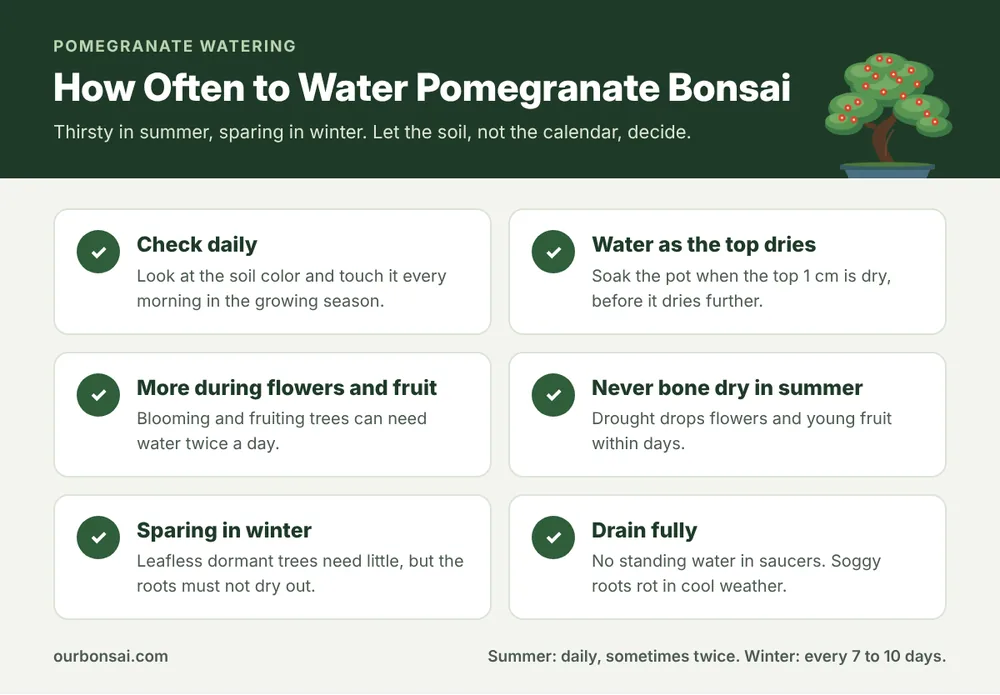
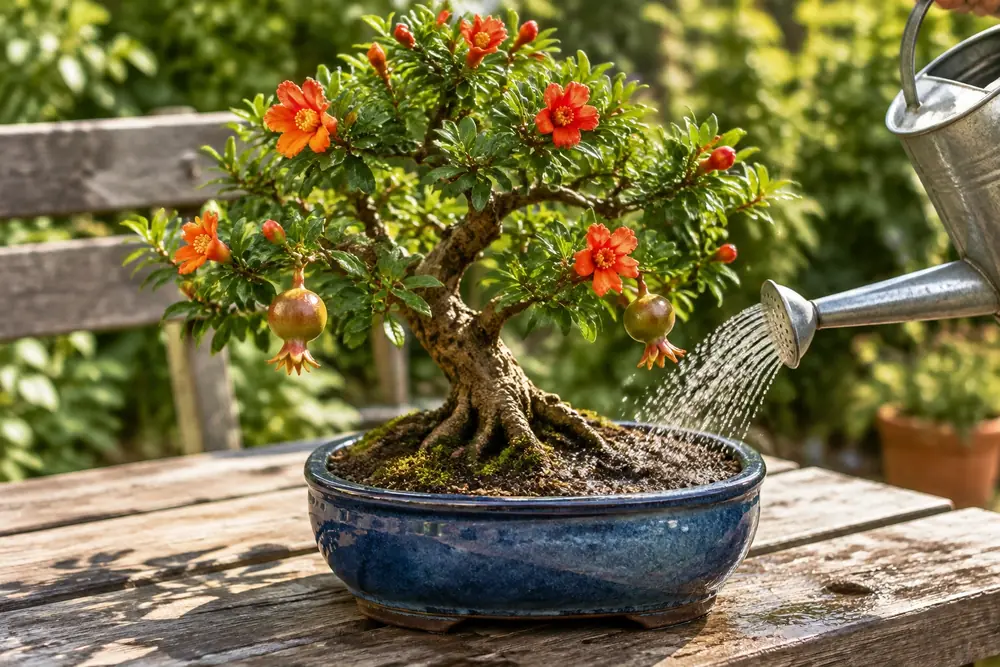
If you are wondering how often to water pomegranate bonsai, the answer changes a lot with the season. In summer, when the tree is in leaf, flowering and carrying fruit, it often needs water every day and sometimes twice on hot days. In spring and autumn it is usually every two to three days. In winter, when an outdoor pomegranate is dormant and leafless, it may only need water every week to ten days. The rule that ties it together: check the soil daily and water thoroughly when the top centimeter starts to dry.
In this guide
- Why pomegranates need more water in summer
- How often to water pomegranate bonsai by season
- How to tell when your pomegranate needs water
- How to water a pomegranate bonsai
- Watering pomegranate bonsai indoors
- Signs of over and underwatering
- Summer heat tips
- Watering after repotting and pruning
- Winter care and watering
- Common mistakes
- FAQ: how often to water pomegranate bonsai
- Final thoughts
This guide explains why pomegranates are so thirsty in summer, how to judge when they need water and how the routine changes through the year.
Why pomegranates need more water in summer
The pomegranate (Punica granatum) is drought tolerant in the ground, with deep roots that reach moisture far below the surface. The Wikipedia article on pomegranate notes it grows well in hot, dry regions. But a bonsai has no deep roots to rely on. Everything comes from a small pot.
In summer, a pomegranate bonsai uses water for three things at once: a full canopy of leaves, bright flowers and swelling fruit. Flowers and young fruit are the first things the tree drops when it runs short. One dry afternoon can cost you a season’s blooms. That is why summer watering matters so much with this species.
In winter, the story flips. Most pomegranate varieties are deciduous, and once the leaves fall, water use drops sharply. Wet soil plus cold temperatures is a recipe for root rot.
How often to water pomegranate bonsai by season
| Season | Outdoors | Indoors | What is happening |
|---|---|---|---|
| Spring | Every 2 to 3 days | Every 3 to 4 days | Leaves open, growth speeds up |
| Early summer (flowering) | Daily | Every 2 days | Flowers use a lot of water |
| Mid to late summer (fruit) | Daily, often twice | Every 1 to 2 days | Fruit swells, peak heat |
| Autumn | Every 2 to 4 days | Every 3 to 5 days | Leaves turn yellow and fall |
| Winter (dormant) | Every 7 to 10 days | Every 5 to 7 days | Leafless, very little water use |
Treat this as a guide to how often to check carefully, not as a fixed schedule.
How to tell when your pomegranate needs water
Finger test
Push a finger about 1 cm into the soil. If it feels dry at that depth, water. If it feels damp, wait and check again later in the day in summer, or the next day in cooler weather.
Soil color
Akadama-based soil turns from dark brown to light tan as it dries. When most of the surface looks light, water. Our guide to the bonsai soil mix ratio explains why this kind of mix helps.
Pot weight
A freshly watered pot feels noticeably heavier. With practice, you can lift a pomegranate bonsai and know at once whether it needs water.
Leaf signals
Soft, slightly drooping new shoots are an early sign of thirst. Water immediately. Do not let it reach the point where flowers and fruit start to drop.
How to water a pomegranate bonsai
- Use a watering can with a fine rose, such as those in our guide to the best Japanese watering can for bonsai.
- Water the whole soil surface slowly until water runs from the drainage holes.
- Wait a minute and water again, so dry pockets soak through.
- During flowering, aim at the soil rather than the flowers so they last longer.
- Let the pot drain completely. Do not leave it in a saucer of water.
Pomegranates tolerate hard tap water, so you do not need special water for them.
Watering pomegranate bonsai indoors
Pomegranates grow best outdoors in full sun, with a cool winter rest. Dwarf varieties such as ‘Nana’ are sometimes kept indoors, especially in cold climates.
- Indoors in summer: place the tree in the sunniest window, check daily and water when the top dries. Indoor trees dry more slowly than outdoor trees but still need frequent water when flowering.
- Indoors in winter: dwarf pomegranates may keep some leaves in a warm room. Water when the top dries, which is usually every five to seven days. A cool, bright spot gives a better rest than a warm living room.
Our guide on watering indoor bonsai in winter covers the cold-season routine.
Signs of over and underwatering
| Sign | Likely cause | What to do |
|---|---|---|
| Flowers or young fruit dropping in summer | Soil dried out | Check twice a day, water thoroughly |
| Drooping shoots that recover after watering | Underwatering | Water earlier in the day |
| Crispy leaf edges | Repeated drying out or heat | Shade the pot, water more consistently |
| Yellow leaves in spring or summer, wet soil | Overwatering | Let the soil dry more, check drainage |
| Dark, mushy roots, sour smell | Root rot | Repot into gritty soil, trim dead roots |
Yellow leaves in autumn are normal leaf fall for a deciduous tree, not a watering problem. If you suspect rot, see our guide to root rot in bonsai.
Summer heat tips
- Water early in the morning, then check again in the late afternoon.
- Move the tree into light afternoon shade during heat waves.
- Shade the pot itself, since hot pots cook roots.
- Group trees together to raise humidity around them.
Our guide to watering bonsai in summer has more heat wave advice.
Watering after repotting and pruning
After repotting in spring, water thoroughly once to settle the new soil, then let the top start to dry before watering again. With fewer roots and leaves only just opening, the tree uses little water for the first two or three weeks.
After pruning, a tree with fewer leaves uses less water. Pomegranates are often pruned in early summer after the first flush of flowers, so cut back on watering a little until new shoots appear.
While fruit ripens in late summer and early autumn, keep the soil evenly moist. Large swings between wet and dry can cause the small fruits to split, just as they do on full-size pomegranate trees.
Winter care and watering
Protect the roots from hard frost and keep the soil just slightly moist. Do not water frozen soil. For full details on overwintering, see our pomegranate bonsai winter care guide.
Common mistakes
- Letting it dry out while flowering. You will lose flowers and fruit.
- Keeping the summer routine in winter. Dormant trees need much less water.
- Using dense potting soil. It stays wet in cool weather.
- Watering over the flowers. Aim at the soil.
FAQ: how often to water pomegranate bonsai
Should I water my pomegranate bonsai every day?
In summer, usually yes, especially while it is flowering or fruiting. In spring and autumn, every few days. In winter, much less.
Why is my pomegranate bonsai dropping flowers?
The most common reason is the soil drying out, even briefly. Check twice a day in hot weather.
How often should I water a pomegranate bonsai in winter?
Outdoors and dormant, roughly every seven to ten days. Check the soil and water only when it starts to dry.
Can pomegranate bonsai handle hard water?
Yes. Pomegranates tolerate hard, alkaline tap water well.
Final thoughts
So, how often to water pomegranate bonsai? Daily in summer, every few days in spring and autumn, and sparingly in winter. Check the soil every day, water thoroughly when the top dries, and never let a flowering or fruiting tree dry out. Get the rhythm right and your pomegranate will reward you with a summer full of bright flowers and tiny fruit.