How to Reduce Bonsai Leaf Size: 7 Proven Techniques


If you want to reduce bonsai leaf size, the most reliable path is to build fine branching (ramification), grow the tree in strong light and regularly cut back new shoots. Over a few seasons, those three habits alone shrink leaves noticeably. For faster results on healthy deciduous trees, partial or full defoliation in early summer produces a second set of smaller leaves. Feeding less nitrogen once the tree is refined and keeping fine roots in a smaller pot help too. Some species, like trident maple, elm and ficus, respond well. Others, like many fruiting trees, barely change.
In this guide
This guide explains why leaves shrink, seven techniques that work and which trees respond best.
Why leaf size matters on a bonsai
A bonsai is meant to look like a full-size tree in miniature. When leaves are huge compared to the trunk and branches, the illusion breaks. Reducing leaf size brings the foliage into proportion, lets light into the canopy and shows off fine branch structure, especially on deciduous trees in winter.
It helps to know that leaf size is partly genetic. A species with large leaves will never have needle-sized foliage. The goal is to get the smallest healthy leaves that your species can produce.
Why leaves get smaller
A tree has a certain amount of energy to put into new growth. When that energy goes into a few long, strong shoots, each leaf is large. When it is shared among many short shoots, each leaf is smaller. Strong light also keeps leaves compact, because leaves grown in shade expand to catch more light. Those two facts drive every technique below.
7 techniques to reduce bonsai leaf size
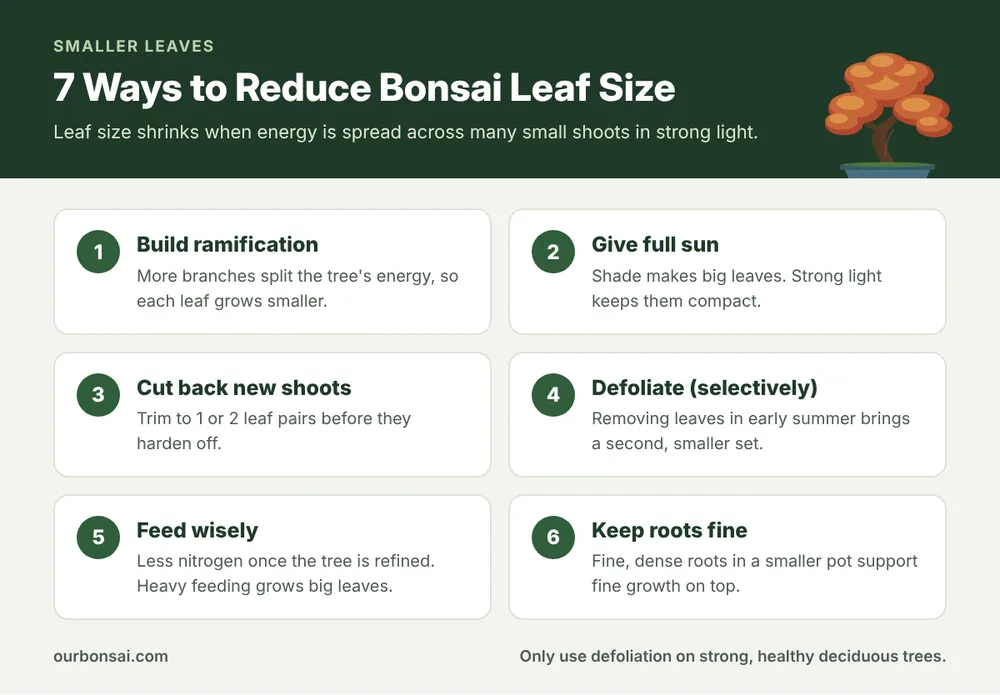
1. Build ramification
Ramification means repeated branching: each branch splits into two, then four, then eight finer twigs. More growing tips share the same energy, so each produces smaller leaves. Build it by cutting shoots back to one or two leaf pairs throughout the growing season. Our guide on when to start pruning bonsai explains timing.
2. Give full sun
Trees in shade grow larger, thinner leaves to capture more light. Outdoor species in full sun, at least where your climate allows, keep leaves smaller and tougher. Indoors, strong light from a good window plus a grow light makes a difference. See our guide on how much light a bonsai tree needs.
3. Cut back new shoots before they harden
When a new shoot has grown four to six leaves, cut it back to one or two. The next shoots that grow from those buds are shorter with smaller leaves. On species with opposite leaves like maples, many growers pinch or cut out the central bud of the new shoot as it emerges, which stops the shoot from lengthening.
4. Defoliation
Defoliation means removing all or some of the leaves in early summer. A healthy deciduous tree responds by pushing a second set of leaves, which are smaller and denser than the first. Full defoliation is a strong technique and only suits vigorous trees such as trident maple, Japanese maple, Chinese elm and some ficus.
- Full defoliation: cut every leaf off at the leaf stalk, leaving the stalk on the tree. Do it in early summer, once spring growth has hardened.
- Partial defoliation: remove only the largest leaves, or leaves on the strongest parts of the tree. This is gentler and balances vigor across the tree.
Do not defoliate weak trees, conifers, newly repotted trees or trees in the same year as heavy pruning. Never defoliate twice in one year on most species.
5. Feed wisely
Heavy nitrogen feeding produces lush growth with big leaves. That is useful when you are thickening a trunk, but not once the tree is in refinement. Switch to a balanced or lower-nitrogen fertilizer for refined trees. Our guide on bonsai fertilizer NPK explains what the numbers mean.
6. Keep roots fine and the pot appropriate
Fine, well-branched roots support fine, well-branched growth on top. Regular repotting with root pruning and a bonsai pot that is not oversized keeps vigor in check. Trees in large training pots or in the ground grow big leaves because they have unlimited roots. Our bonsai soil mix ratio guide helps you choose a mix that encourages fine roots.
7. Be patient
Leaf reduction builds over years. Each season of ramification, sun and careful feeding takes the leaves a little smaller. Expect visible change in the second and third year of consistent work.
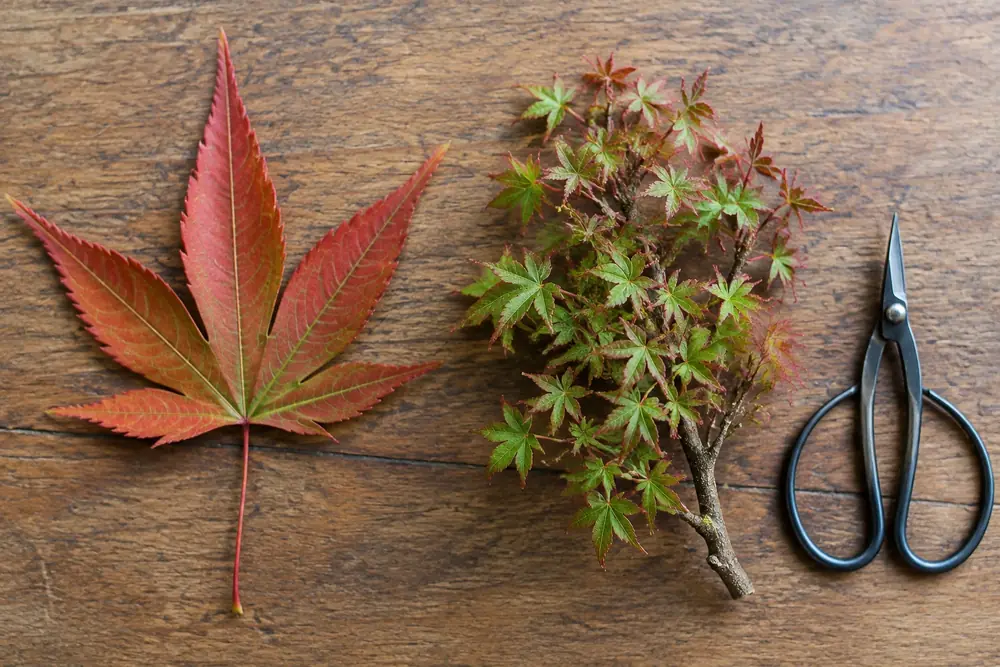
How to defoliate a trident or Japanese maple step by step
- Check the timing. Early summer, once the first flush of spring leaves has fully hardened and the tree is growing strongly.
- Check the tree. Only healthy, vigorous trees that were not repotted this year.
- Cut, do not pull. Use sharp scissors to cut each leaf at the base of the leaf blade, leaving the leaf stalk attached. The stalk protects the bud and drops off on its own.
- Start with the strong areas. On a partially defoliated tree, remove leaves from the top and outer branches, which are naturally the most vigorous.
- Aftercare. Keep the tree in good light but out of scorching afternoon sun for a week or two. Water less, since there are no leaves to use the water.
- Watch for new buds. A new set of smaller leaves usually opens within three to five weeks.
Which bonsai respond best to leaf reduction
| Species | Response | Best techniques |
|---|---|---|
| Trident maple | Excellent | Ramification, defoliation, sun |
| Japanese maple | Very good | Pinching, partial defoliation |
| Chinese elm | Excellent | Constant shoot trimming, sun |
| Ficus | Good | Defoliation, strong light |
| Zelkova, hornbeam | Good | Ramification, partial defoliation |
| Azalea | Moderate | Shoot trimming after flowering |
| Pomegranate, crab apple | Limited | Ramification only, leaves stay larger |
| Pines and junipers | Different process | Needle reduction via candle pruning |
When not to try to reduce leaf size
- On young trees still growing a thick trunk. Let them grow freely first.
- On weak, recently repotted or stressed trees.
- In the same season as heavy root pruning.
- On fruiting trees when you want flowers and fruit.
Common mistakes
- Defoliating a weak tree. It may not produce a second set of leaves.
- Keeping the tree in shade. Leaves stay big no matter how you prune.
- Feeding heavy nitrogen to refined trees. It fuels big leaves.
- Expecting results in one season. Leaf reduction is a long-term process.
For more on shaping and styling, see our guide to bonsai cutting tool reviews, and for keeping trees healthy while you work on them, our main bonsai care guide.
FAQ: reduce bonsai leaf size
What is the fastest way to reduce bonsai leaf size?
Defoliation in early summer gives the quickest result on vigorous deciduous trees. Combine it with full sun and regular shoot trimming for lasting change.
Does defoliation hurt a bonsai?
It stresses the tree, so only do it on strong, healthy trees and not every year on most species.
Can I reduce leaf size on an indoor bonsai?
Yes, on species like ficus, but strong light is essential. Use a grow light if your window is not bright enough.
Why are my bonsai leaves getting bigger?
Usually too much shade, too much nitrogen, or long unpruned shoots. Move it into more light and cut back new growth.
Can I reduce needle size on pines and junipers?
Yes, but with different methods. Pines use candle pruning and needle plucking, and junipers rely on thinning and strong light. Defoliation is not used on conifers.
Final thoughts
To reduce bonsai leaf size, focus on ramification, strong light and regular shoot trimming, then add defoliation for vigorous deciduous trees when you want faster results. Feed refined trees lightly and keep roots fine. Over a few seasons, your tree’s leaves will shrink into proportion and it will look much more like an old tree in miniature. For background on the proportions bonsai artists aim for, see the Wikipedia article on bonsai aesthetics.