How Often to Water Ginkgo Bonsai (Indoor & Outdoor Guide)

This post contains affiliate links. As an Amazon Associate, OurBonsai earns from qualifying purchases at no extra cost to you. Read our disclosure.
In this guide
- Why ginkgo watering needs a balance
- How often to water ginkgo bonsai by season
- How to check if your ginkgo needs water
- How to water a ginkgo bonsai
- What changes how often your ginkgo needs water
- Watering after repotting
- Summer watering and leaf scorch
- Winter watering
- Signs of overwatering and underwatering
- FAQ: how often to water ginkgo bonsai
- Final thoughts
If you are wondering how often to water ginkgo bonsai, check it every day during the growing season and water when the top centimeter of soil starts to dry. For an outdoor ginkgo in summer that usually means once a day; in spring and autumn, every two to three days; and in winter, when the tree is leafless and dormant, every one to two weeks, just enough to keep the roots from drying out. Ginkgo (Ginkgo biloba) has thick, fleshy roots that dislike both soggy soil and complete dryness, so a steady, moderate rhythm works best.
This guide covers seasonal watering, how to check the soil, how to water, and how to recognize watering problems before they hurt the tree.
Why ginkgo watering needs a balance
Ginkgo is a tough tree in the ground, famous for surviving city streets and even the atomic bomb in Hiroshima. The Wikipedia page on Ginkgo biloba describes its remarkable resilience. In a bonsai pot, though, it has two sensitive points:
- Fleshy roots. Ginkgo roots are thicker and softer than most bonsai roots. In wet, airless soil they rot more easily.
- Thin, fan-shaped leaves. The leaves lose water fast on hot, windy days and scorch at the edges if the soil dries out.
That is why the soil should be kept evenly moist, never soggy and never dusty. A free-draining mix makes this easy; our guide to the bonsai soil mix ratio explains how to build one with akadama, pumice and lava.
How often to water ginkgo bonsai by season
| Season | Typical frequency | Notes |
|---|---|---|
| Spring (leaves opening) | Every 2 to 3 days | Increase as leaves expand |
| Summer | Daily, sometimes twice | Small pots in full sun dry fast |
| Autumn (leaves turning gold) | Every 2 to 4 days | Water use drops as leaves age |
| Winter (leafless) | Every 1 to 2 weeks | Only to keep roots from drying out |
These are typical figures for an outdoor ginkgo in a temperate climate. Ginkgo is an outdoor tree and needs a cold winter rest; it does not thrive indoors. Always check the soil before watering, because pot size, soil and weather make a big difference.
How to check if your ginkgo needs water
- Finger test. Push a finger about 1 cm into the soil. If it feels dry at that depth, water. If it is still cool and damp, wait.
- Look at the akadama. If your mix contains akadama, it turns from dark brown to light tan as it dries.
- Lift the pot. A dry pot feels clearly lighter than a freshly watered one.
- Watch the leaves. Slight drooping or curling on a hot afternoon means the tree needs water now. Do not wait for this sign routinely; by then the roots are stressed.
How to water a ginkgo bonsai
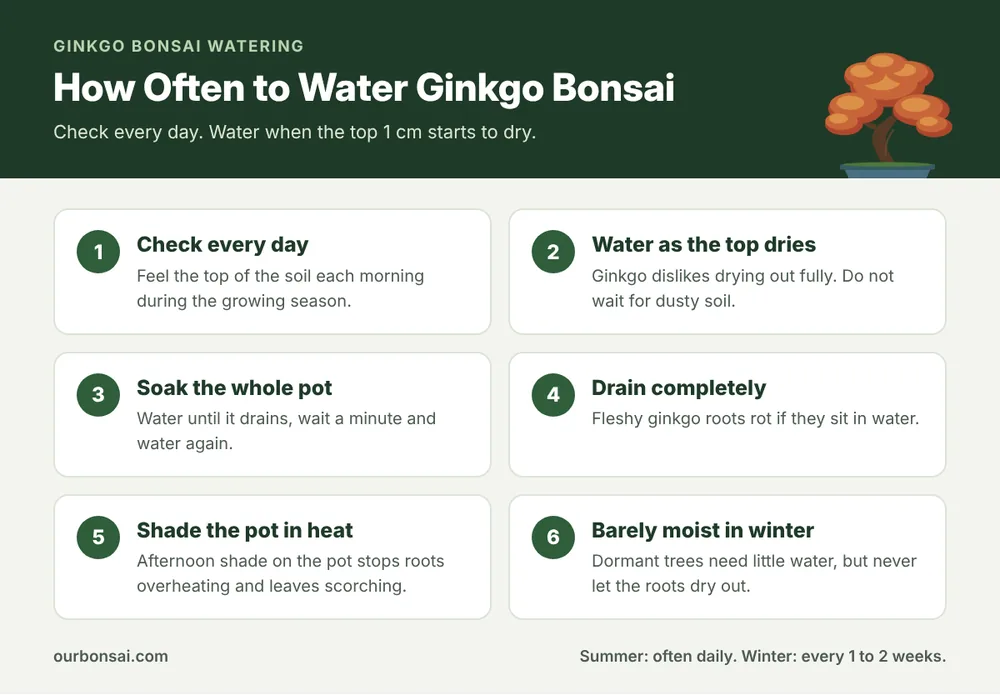
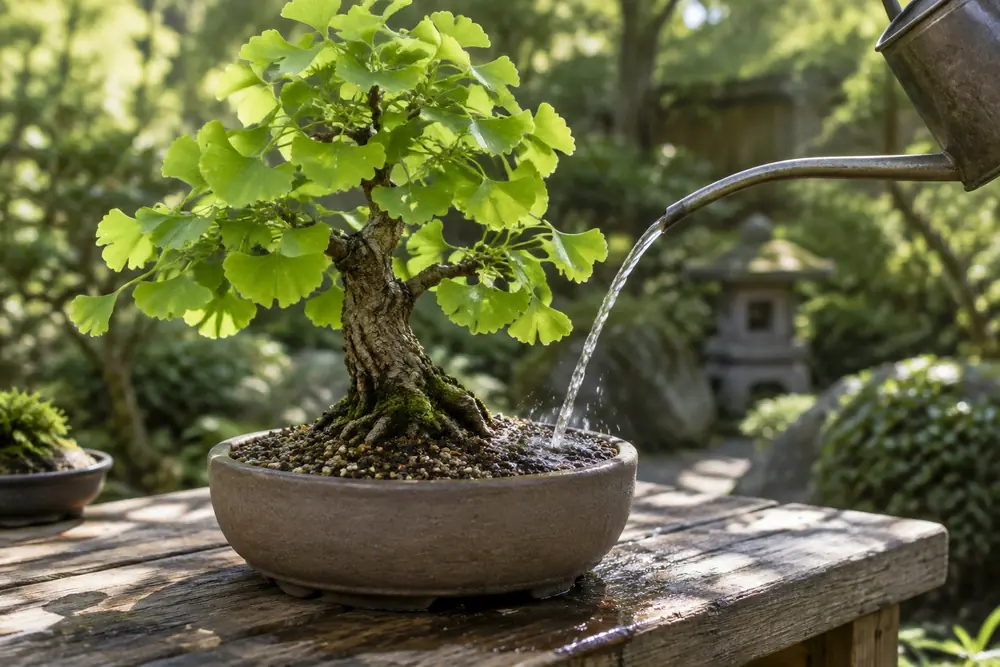
- Water evenly over the whole soil surface with a fine-rose watering can or a gentle hose nozzle, so soil is not washed away. Our guide to the best Japanese watering can for bonsai covers some good choices, or browse bonsai watering cans with a fine rose.
- Keep going until water runs from the drainage holes.
- Wait a minute, then water again. The second pass soaks any dry pockets.
- Let it drain completely. Never leave the pot standing in a saucer.
- Water in the morning in summer, so the tree has water through the hottest part of the day. On very hot days, check again in the late afternoon.
What changes how often your ginkgo needs water
- Pot size and depth. Young ginkgo are often kept in deeper training pots, which hold water longer. Refined trees in shallow display pots dry much faster.
- Soil mix. A mix heavy in akadama holds more water than one heavy in lava or pumice. Dense, peaty soil holds far too much.
- Sun and wind. A tree on an exposed, sunny bench can use twice as much water as one in a sheltered spot.
- Leaf stage. Fresh spring leaves and full summer canopy use the most water; golden autumn leaves use much less.
- Root mass. A pot full of roots dries quickly and may be due for repotting in early spring.
Watering after repotting
After repotting in early spring, water thoroughly once to settle the soil, then keep it evenly moist but never soggy while new roots grow. Cut, fleshy ginkgo roots are especially vulnerable to rot in the weeks after repotting, so let the surface start to dry before each watering. Keep the tree out of strong wind and hot sun for two to three weeks.
Summer watering and leaf scorch
Ginkgo leaves are prone to brown, crispy edges in summer, especially in small pots in full afternoon sun. The cause is usually the roots overheating or drying out for a few hours, not the sun on the leaves alone. To prevent it:
- Check the soil every morning and again in the afternoon during heat waves.
- Shade the pot from strong afternoon sun, or place the tree where it gets morning sun and light afternoon shade.
- Group pots together or stand them on gravel to keep the roots cooler.
Our article on watering bonsai in summer has more tips for hot weather.
Winter watering
Ginkgo drops its leaves in autumn after turning a brilliant gold, and needs a cold, dormant winter outdoors. A leafless tree uses very little water, but the roots must not dry out completely. Check every week or so and water lightly when the soil is dry and not frozen, ideally in the morning. Protect the pot from hard freezes by sheltering it or sinking it in mulch; frozen, wet soil can damage the fleshy roots.
Signs of overwatering and underwatering
| Too much water | Too little water |
|---|---|
| Leaves yellowing and dropping in summer | Leaf edges brown and crispy |
| Soil stays dark and damp for days | Leaves curl or droop in the afternoon |
| Weak, small spring growth | Soil pulling away from the pot edge |
| Soft, dark roots with a sour smell | Early leaf drop in late summer |
If you suspect overwatering, let the soil dry a little more between waterings and check that the pot drains freely. Our guide to root rot in bonsai explains what to do if the roots are damaged.
FAQ: how often to water ginkgo bonsai
Should I water my ginkgo bonsai every day?
In summer, often yes. In spring and autumn, every two to three days is typical. Always check the soil first.
Can I keep a ginkgo bonsai indoors?
Not long term. Ginkgo needs outdoor light and a cold winter dormancy to stay healthy.
Why are my ginkgo leaves turning brown at the edges?
Usually the soil dried out or the roots overheated in strong afternoon sun. Water more consistently and shade the pot.
Should I mist my ginkgo?
Not necessary. Focus on watering the soil properly.
Final thoughts
Now you know how often to water ginkgo bonsai: check daily during the growing season, water when the top centimeter starts to dry, soak the pot fully, drain well and keep the roots just moist through winter. Give ginkgo that steady rhythm and its fan-shaped leaves will stay fresh all summer before turning gold in autumn. If you are buying your first tree, our Brussels ginkgo bonsai review looks at what a typical young ginkgo arrives in and how to care for it.