How to Prune Boxwood Bonsai: Step-by-Step Guide

This post contains affiliate links. As an Amazon Associate, OurBonsai earns from qualifying purchases at no extra cost to you. Read our disclosure.
In this guide
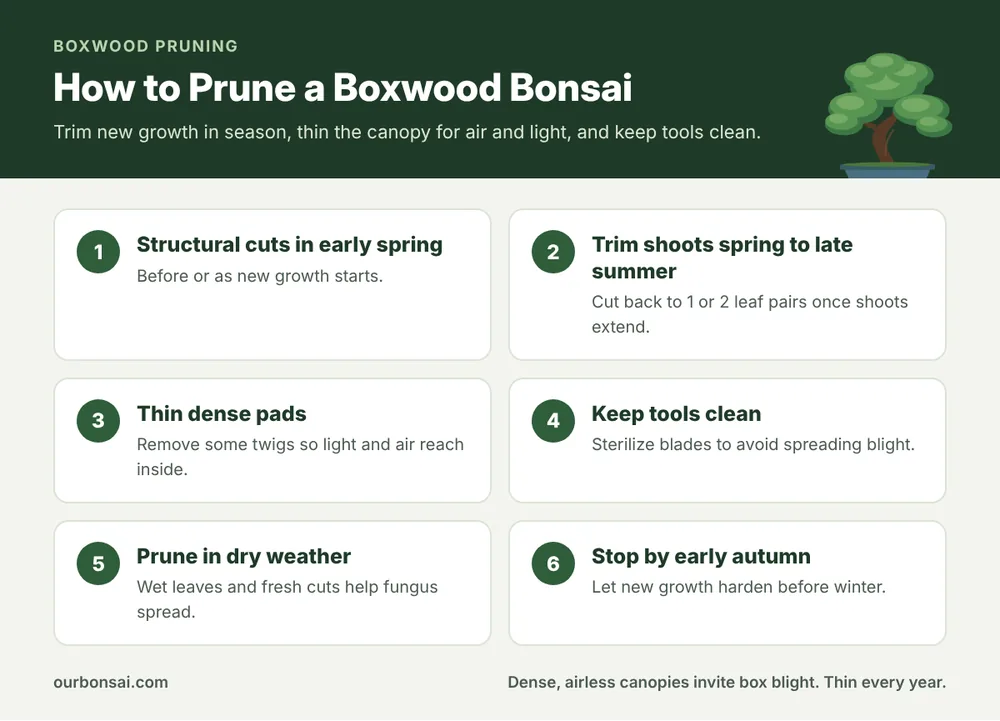
Learning how to prune boxwood bonsai is mostly about two things: trimming new growth during the growing season to keep the shape compact, and thinning the canopy so light and air can reach the inside. Boxwood takes pruning very well and buds back readily, even from old wood. Make structural cuts in early spring, trim shoots back to one or two pairs of leaves from spring to late summer, and stop by early autumn so new growth can harden before winter.
Boxwood (Buxus) is a popular bonsai species thanks to its small, glossy leaves, fine twigs and tolerance of hard pruning. Common choices are Japanese and Korean boxwood, common boxwood and Harland boxwood. Because it grows so densely, boxwood also needs regular thinning to stay healthy. This guide covers timing, techniques and disease prevention.
When to prune a boxwood bonsai
| Type of pruning | Best time | Notes |
|---|---|---|
| Structural pruning | Early spring | As buds begin to swell |
| Shoot trimming | Late spring to late summer | Whenever new shoots extend |
| Thinning | Spring or early summer | Opens the canopy before humid weather |
| Light tidy | Early autumn | Last trim of the year |
| Avoid | Late autumn and winter | New growth can be damaged by frost |
Indoor Harland boxwood can be trimmed whenever it grows, but heavy cuts are still best in spring and early summer. For general timing principles, see our guide on when to start pruning bonsai.
Tools you will need
- Small, pointed bonsai scissors for twigs and shoots
- A concave cutter for branch removal
- Cut paste for larger wounds
- Rubbing alcohol or disinfectant to clean blades
Clean tools are especially important for boxwood because box blight and other fungal diseases can spread on dirty blades. Our guide to the best bonsai pruning shears for beginners can help you choose. Keep a small bottle of isopropyl alcohol with your tools for wiping blades between trees.
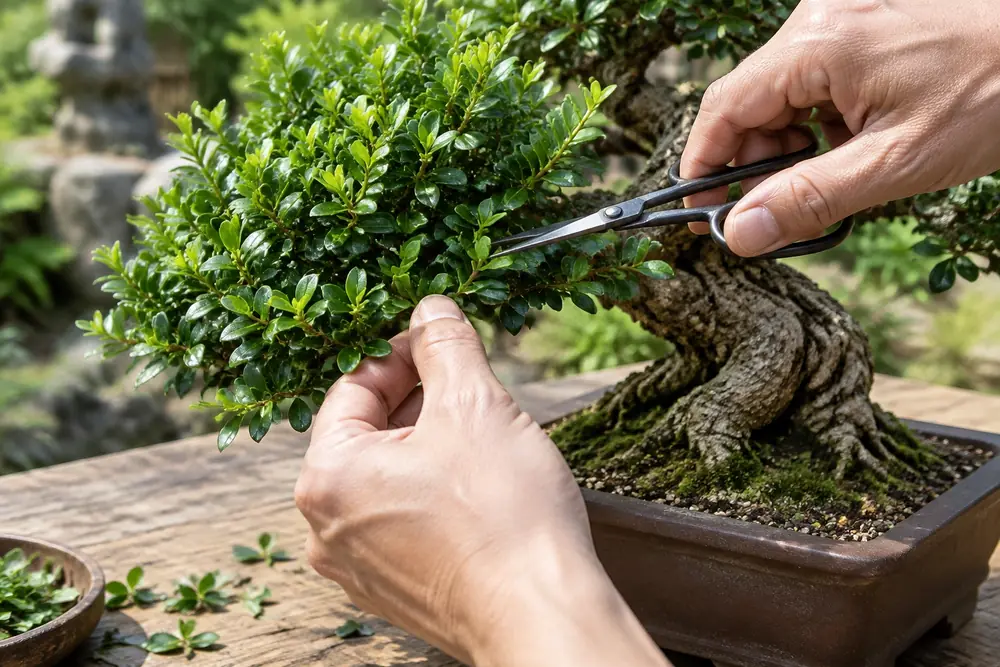
How to prune boxwood bonsai: shoot trimming
- Let new shoots extend. In spring, boxwood pushes soft new shoots with several pairs of leaves.
- Cut back to one or two leaf pairs. Once shoots have three to five pairs, cut back to one or two. New buds will grow from the leaf joints you keep.
- Trim the top and outer edges more. These areas grow fastest. Trimming them harder keeps the tree balanced.
- Keep the silhouette. Trim to the outline of each foliage pad, but avoid shearing it like a hedge, which creates a dense outer shell and bare insides.
- Repeat through summer whenever new growth extends.
Thinning the canopy
Boxwood naturally grows into a very dense ball. Inside, light and air are blocked, so inner leaves yellow and drop and the risk of fungal disease rises. Thinning solves this.
- Look into each foliage pad from above and below.
- Where twigs are crowded, remove some of them completely, especially those growing straight up, straight down or crossing.
- Remove twigs where two or more grow from the same point, keeping the best one.
- Clear dead twigs and old, yellow leaves from inside the canopy.
- Aim for a pad where you can see light through it and branches are visible.
Thinning once or twice a year, ideally in spring and early summer, keeps boxwood healthy and helps it develop fine, well-spaced branches. Our boxwood bonsai styles guide shows the open, layered pads you are aiming for.
Structural pruning
Structural pruning shapes the trunk and main branches. Do it in early spring.
- Decide on the front of the tree and the shape you want.
- Remove branches that cross, grow toward the front from the trunk at eye level, or come from the same height on opposite sides.
- Shorten long branches back to a side shoot facing the direction you want.
- Use a concave cutter for clean, flat wounds, and seal larger cuts. Our guide to the best bonsai cut paste alternatives has options.
- Boxwood buds well from older wood, so you can cut back into bare branches on a healthy tree, but take no more than about a third of the foliage in one session.
Boxwood wood is hard and branches thicken slowly. Wiring is possible on young shoots, but much of the shaping on boxwood is done by careful pruning over several years.
Pruning a nursery boxwood into a bonsai
Many boxwood bonsai start as garden-center shrubs, which are cheap and often have thick, interesting trunks hidden under a ball of foliage. Turning one into a bonsai is a great project:
- Start in early spring. Remove the shrub from its nursery pot and look at the base to find the best trunk line and front.
- Clear the trunk. Remove the lower branches and suckers that hide the trunk, keeping the branches you want to build on.
- Reduce the height to a branch or bud at the height you want the tree to be.
- Cut back the remaining branches to roughly the outline you want, leaving some foliage on each one, because boxwood branches without leaves can die back.
- Leave the roots alone this year if you removed a lot of top growth. Reduce the roots gradually over the next two springs while moving it toward a bonsai pot.
- Let it recover in a training pot for a full season, trimming new shoots lightly.
Within two or three years, a nursery shrub can become an attractive young bonsai.
Preventing box blight while pruning
Box blight is a fungal disease that causes dark leaf spots, black streaks on stems and rapid leaf drop in warm, humid weather. The RHS box blight guide explains how it spreads. To lower the risk:
- Prune in dry weather, not when leaves are wet
- Clean tools before and between trees
- Thin the canopy for airflow
- Collect clippings and fallen leaves
- Water the soil, not the foliage
If you see signs of blight, isolate the tree and cut out affected shoots well into healthy wood.
Aftercare
- Light: outdoor boxwood in bright light or sun with some afternoon shade in hot climates. Indoor Harland boxwood in the brightest window.
- Water: check the soil daily and water when the top is just dry.
- Feeding: feed every two to four weeks in the growing season to support regrowth. Our guide to the best liquid fertilizer for bonsai trees has good options.
- Winter: shelter outdoor trees from cold, drying wind to prevent winter bronzing.
Common pruning mistakes
- Shearing like a hedge. Creates a dense shell and a bare, dying interior.
- Never thinning. Inner branches weaken and fungal disease risk rises.
- Pruning in wet weather. Helps fungal spores spread.
- Dirty tools. Can carry blight from one plant to another.
- Pruning late in autumn. Soft new growth may be damaged by frost.
FAQ: how to prune boxwood bonsai
How often should I prune my boxwood bonsai?
Trim new shoots every few weeks from late spring to late summer, thin once or twice a year, and do structural work in early spring.
Can I cut a boxwood bonsai back hard?
Yes. Healthy boxwood buds back from old wood. Do it in early spring and avoid removing more than about a third of the foliage at once.
Why is the inside of my boxwood bonsai bare?
Too little light and air inside a dense canopy. Thin the pads so light reaches inner branches, and new buds will follow.
Should I prune my boxwood in winter?
Avoid it. Wait until early spring so cuts heal quickly and new growth is not damaged by frost.
Final thoughts
Knowing how to prune boxwood bonsai comes down to regular trimming, yearly thinning and good hygiene. Trim shoots back in the growing season, thin dense pads so light and air reach inside, make structural cuts in early spring and keep your tools clean. Done consistently, this builds a healthy boxwood with fine branches and neat foliage pads. For tips on the best tree to start with, see our Brussel’s Harland boxwood bonsai review.