Japanese Maple Bonsai Yellow Leaves: Causes and How to Fix It

This post contains affiliate links. As an Amazon Associate, OurBonsai earns from qualifying purchases at no extra cost to you. Read our disclosure.
In this guide
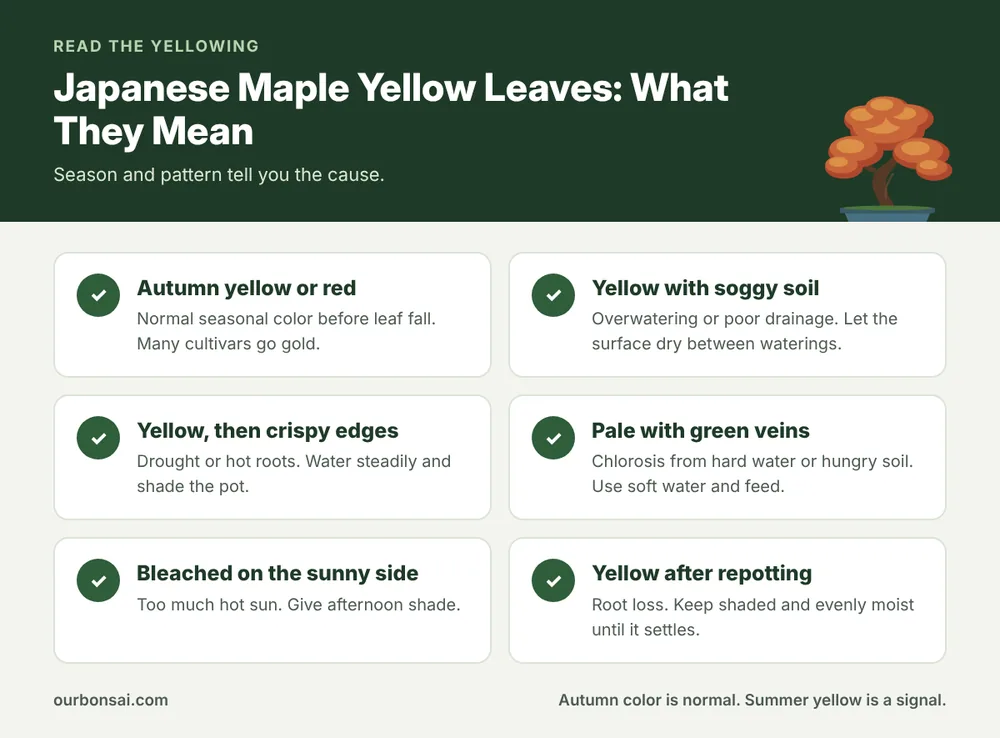
Japanese maple bonsai yellow leaves can mean two very different things. In autumn, many Japanese maples (Acer palmatum) turn brilliant yellow, orange or red before dropping their leaves, which is completely normal. In spring and summer, though, yellowing leaves are a signal that something is off with water, roots, nutrition or light. The pattern of the yellowing, whether it is even, between the veins, on one side, or with crispy edges, is your best clue to the cause.
This guide explains how to tell normal autumn color from a problem, the six most common causes of summer yellowing, and how to fix each one.
Autumn color: normal
Japanese maples are deciduous. In autumn, as days shorten and nights cool, the green chlorophyll breaks down and the leaves show their autumn colors before falling. Depending on the cultivar, that can be yellow, gold, orange, red or purple. The Wikipedia page on Acer palmatum describes the huge range of cultivars and their autumn colors.
If the yellowing happens in autumn, across the whole tree, and the buds for next year are plump and firm, there is nothing to worry about.
When yellow leaves are a problem
| What you see | Most likely cause |
|---|---|
| Soft yellow leaves, soil always wet | Overwatering, poor drainage |
| Yellow then brown, crispy edges | Drought or hot roots |
| Pale yellow leaves with green veins | Chlorosis: iron or nutrient shortage, often hard water |
| Pale, bleached patches on the sunny side | Too much hot sun |
| Small, pale leaves all over | Hungry soil or weak roots |
| Yellowing a few weeks after repotting | Root disturbance |
6 causes of Japanese maple bonsai yellow leaves
1. Overwatering and poor drainage
Fine maple roots need air. In dense soil or a pot that does not drain, they suffocate, and leaves turn a soft, dull yellow and drop. The soil stays dark and may grow algae.
Fix: water when the top centimeter starts to dry rather than on a schedule, remove any saucer, and repot into an akadama-rich mix in early spring. Our guide to root rot in bonsai explains how to check the roots.
2. Drought and hot roots
If a small pot dries out on a hot day, leaves yellow and then scorch at the edges. Repeated dry spells weaken the tree.
Fix: check the soil morning and afternoon in summer, water as soon as the surface dries, and shade the pot. Our article on watering bonsai in summer has more tips.
3. Chlorosis from hard water or hungry soil
Japanese maples prefer slightly acidic conditions. Hard, alkaline tap water slowly raises the soil pH, which locks up iron and manganese. New leaves come out pale yellow with darker green veins. The Wikipedia article on chlorosis describes this classic pattern. A tree that has not been fed for a long time can also turn pale.
Fix: use rain water when possible, feed regularly with a balanced or acid-loving plant fertilizer, and consider a product with chelated iron; browse chelated iron for plants. Repot into fresh akadama-based soil every two to three years. Our kanuma bonsai soil review covers an acidic component that can help in hard water areas.
4. Too much sun
Japanese maples evolved in forest shade. In hot climates, full afternoon sun can bleach leaves pale yellow or white on the sunny side, then scorch them brown. Variegated and light-colored cultivars are especially sensitive.
Fix: give morning sun and afternoon shade in summer, for example under a 30 to 50 percent shade cloth.
5. Weak roots or root damage
Roots damaged by frost over winter, rot or a heavy root prune cannot supply enough water and nutrients, so leaves open small and pale or yellow during the season.
Fix: protect pots from hard freezes in winter, use a free-draining soil, and avoid heavy pruning and repotting in the same season.
6. Repotting stress
Some yellowing for a few weeks after spring repotting is normal. Keep the tree out of strong sun and wind and the soil evenly moist, and hold off fertilizing for a month.
Yellow leaves in spring
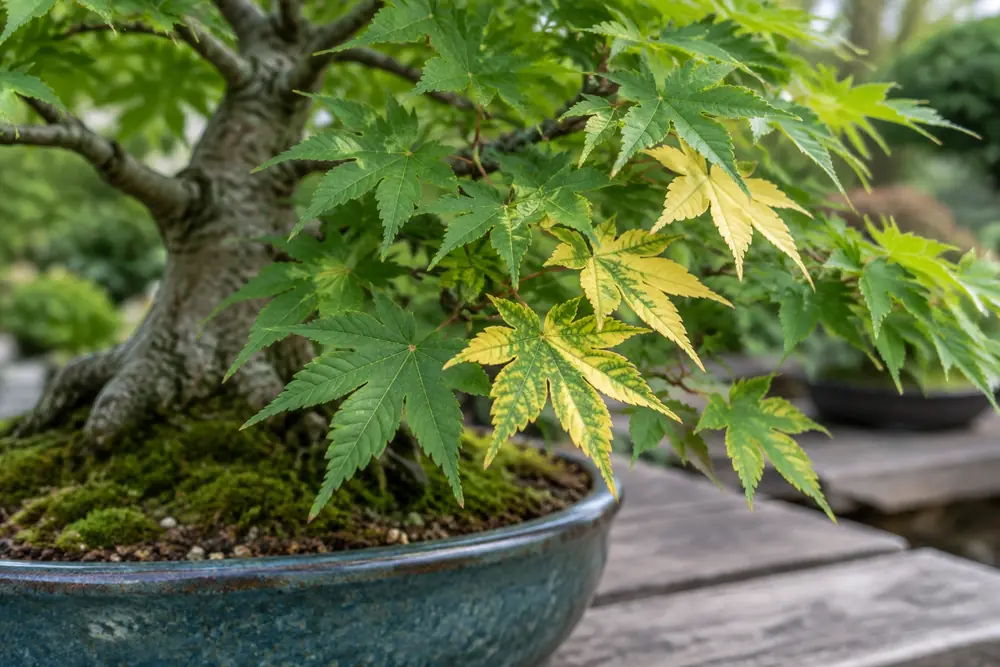
Spring yellowing deserves its own mention. When a Japanese maple opens pale yellow-green leaves that stay pale for weeks, the usual reasons are roots damaged over winter, cold and waterlogged soil in early spring, or a tree that is simply hungry after a long season without feeding. Some cultivars, such as ‘Katsura’ and ‘Orange Dream’, naturally open yellow or orange in spring and turn greener later, so check your cultivar before worrying.
If your maple is a green-leaved type and stays pale, start feeding lightly once the leaves have fully opened, keep the soil evenly moist but not soggy, and check the roots at the next spring repot. Avoid strong feeding while the first leaves are expanding, because it makes them large and soft.
Yellow leaves in late summer
In late summer, a few older leaves inside the canopy often yellow and drop because they are shaded by newer growth. That is normal and needs no action beyond tidying. Widespread yellowing in late summer, on the other hand, usually traces back to heat and drought stress earlier in the season.
Should I remove yellow leaves?
In autumn, no; they will fall naturally. In summer, you can remove fully yellow or scorched leaves to keep the tree tidy, but do not strip healthy ones. Focus on fixing the cause so new growth comes out green. Partial leaf pruning in early summer is a separate technique for healthy trees, not a cure for yellowing.
How to keep Japanese maple leaves green
- Use an akadama-rich, free-draining soil; our bonsai soil mix ratio guide explains a good mix.
- Water by checking the soil, daily in summer.
- Give afternoon shade in hot weather.
- Use rain water or soft water where you can.
- Feed from spring to late summer.
- Protect the pot from hard frost in winter.
- Keep it outdoors all year; see our guide to Japanese maple bonsai indoors for why long indoor stays cause problems.
FAQ: japanese maple bonsai yellow leaves
Is it normal for my Japanese maple bonsai to turn yellow?
In autumn, yes. Many cultivars turn yellow, gold or red before dropping their leaves. In spring and summer, yellowing signals a problem.
Why are my maple leaves yellow with green veins?
That is chlorosis, usually from hard water raising the soil pH or a lack of iron or nitrogen. Use soft water and feed.
Can too much sun turn Japanese maple leaves yellow?
Yes. Hot afternoon sun can bleach leaves pale yellow and then scorch them. Give afternoon shade.
Will yellow leaves turn green again?
Fully yellow leaves will not. Once the cause is fixed, new leaves come out green.
Final thoughts
Japanese maple bonsai yellow leaves are beautiful in autumn and a warning in summer. Check the season and pattern first, then the soil moisture, water quality, feeding and sun. Fix the cause, and your maple will keep its fresh green through the summer before its autumn show.