Trident Maple Bonsai Winter Care: Dormancy and Root Protection

This post contains affiliate links. As an Amazon Associate, OurBonsai earns from qualifying purchases at no extra cost to you. Read our disclosure.
In this guide
- Why trident maples need a cold winter
- How cold can a trident maple bonsai handle?
- Trident maple bonsai winter care checklist
- Where to keep a trident maple in winter
- Protecting fine twigs
- Watering in winter
- Late winter: the best time for structural work
- Preparing your trident for winter in autumn
- Spring wake-up and late frost
- What a healthy trident looks like in late winter
- Common trident maple winter mistakes
- FAQ: trident maple bonsai winter care
- Final thoughts
Trident maple bonsai winter care has one surprise for many growers: while trident maples (Acer buergerianum) are tough, vigorous trees, their roots are less cold-hardy than many other temperate bonsai. In the ground they shrug off frost, but in a shallow bonsai pot the root ball can freeze solid, and trident roots do not tolerate that well. Branches survive the cold; roots may not. Protect the roots and give the tree a proper cold rest, and it will reward you with a burst of growth in spring.
This guide covers dormancy, how cold your tree can handle, where to keep it, watering, and the jobs that suit late winter.
Why trident maples need a cold winter
Tridents are deciduous. Each autumn they color red, orange and yellow, drop their leaves and go into dormancy. That rest is essential. A trident kept warm indoors all winter does not rest properly. It often leafs out weakly, grows long, thin shoots and declines over time. Tridents belong outdoors, alongside the trees in our guide to outdoor bonsai tree types.
How cold can a trident maple bonsai handle?
In the ground, trident maples are hardy to about USDA zone 5 or 6. In a pot, many growers consider the roots safe only to around -5 to -10°C (23 to 14°F) for short periods.
| Conditions | What to do |
|---|---|
| Light frosts to about -3°C (27°F) | Keep outdoors, sheltered from wind |
| -3 to -5°C (27 to 23°F) | Pot on the ground with mulch around it |
| Longer spells below -5°C (23°F) | Cold frame, unheated greenhouse or bury the pot |
| Severe winters | Unheated garage or shed during the coldest weeks |
Check your local winter lows on the USDA plant hardiness map. Tridents are more cautious about root cold than, say, Japanese maples or junipers, so err on the side of protection.
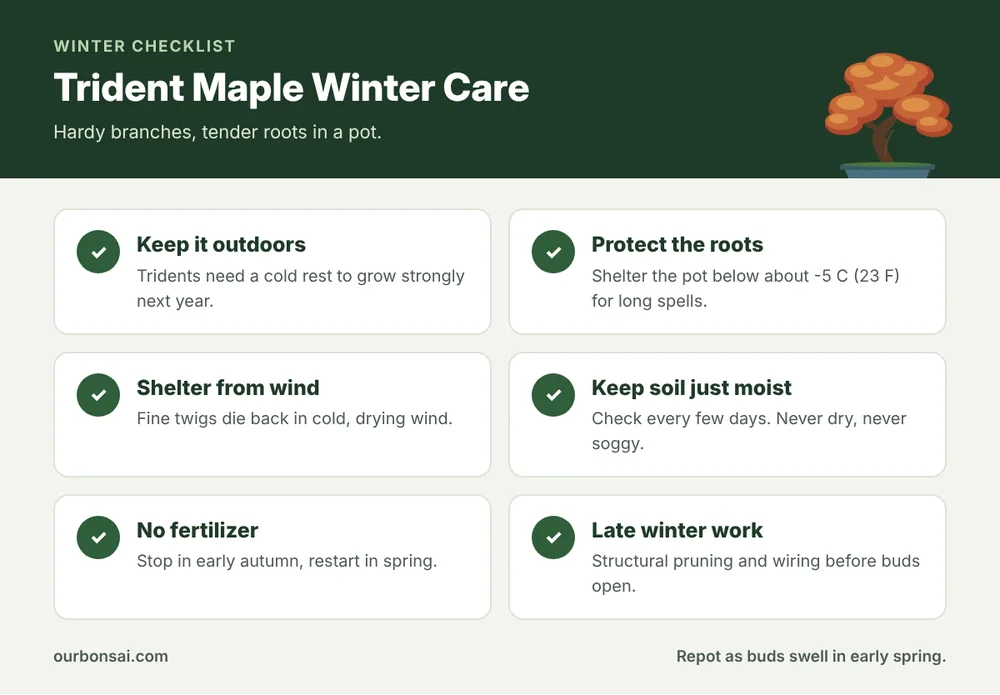
Trident maple bonsai winter care checklist
Where to keep a trident maple in winter
- Mild winters: On the ground in a sheltered corner, out of the wind.
- Moderate winters: Pot on the ground, surrounded by bark mulch or straw, or buried up to the rim in a garden bed.
- Cold winters: A cold frame or unheated greenhouse, ventilated on sunny days so it does not warm up too much.
- Very cold spells: An unheated garage or shed that stays just above freezing. A leafless tree needs little light while dormant, but bring it out once the worst cold passes.
For layout ideas, see our outdoor bonsai display ideas.
Protecting fine twigs
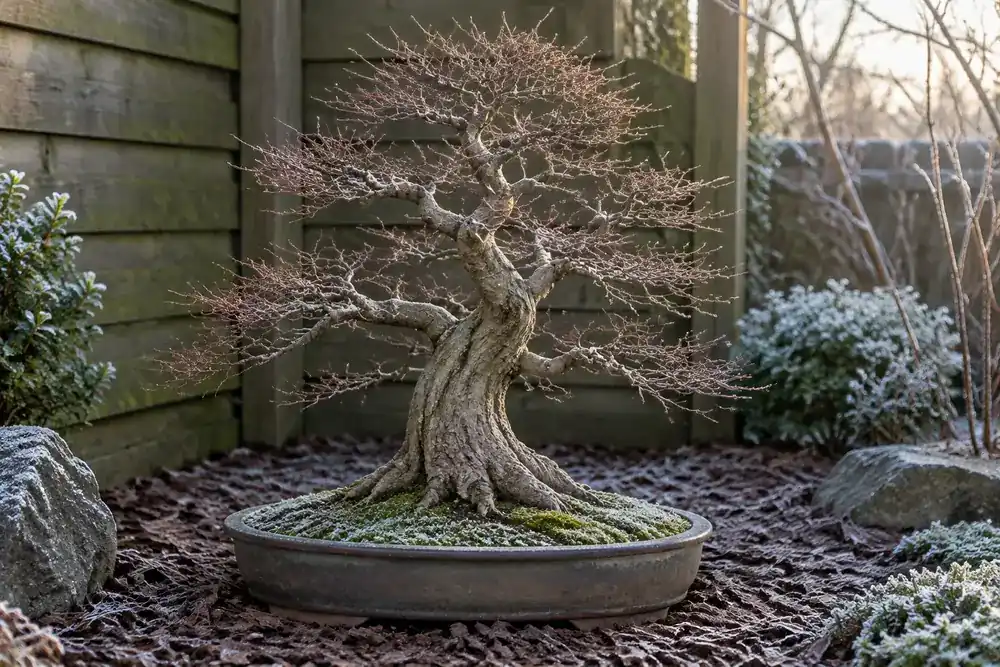
Refined tridents have dense, fine twigs. Cold, drying winds can kill twig tips while the roots are frozen. Shelter the tree from prevailing winds, and group it with other trees. Any tips that die back can be pruned off in spring.
Watering in winter
A dormant trident uses little water, but its roots must not dry out.
- Check every few days.
- Water when the surface has dried, ideally in the morning on mild days.
- Do not water when the pot is frozen.
- Trees under cover get no rain; check them more often.
- Avoid keeping the soil soggy in cold, wet weather.
A free-draining akadama-based soil helps. Our guide to bonsai soil mix ratios explains how to make one.
Late winter: the best time for structural work
Late winter, just before buds swell, is one of the busiest times for trident growers:
- Structural pruning: With no leaves, you can see every branch. Remove unwanted branches and shorten long ones. Our guide on when to prune deciduous bonsai explains the timing.
- Wiring: Branches are easy to see. Tridents thicken quickly in spring, so check wire often once growth starts.
- Repotting: As buds swell, usually early spring. Tridents tolerate heavy root pruning well when healthy.
- Seal large cuts with cut paste; tridents heal well, but sealed cuts close more cleanly. See our guide to a bonsai cut paste alternative.
Preparing your trident for winter in autumn
- Feed through summer to build reserves, then stop by early autumn.
- Enjoy the autumn color, then clear fallen leaves to reduce fungal problems.
- Check for pests such as aphids and scale.
- Leave it outside as nights cool so it hardens off naturally.
- Plan its winter spot before the first hard frost.
You can buy simple plant frost covers on Amazon to protect pots and branches during sudden cold snaps.
Spring wake-up and late frost
Tridents often wake up early. Their buds swell in early spring, and the new leaves are soft. A late frost can blacken them overnight. When buds are opening:
- Watch the forecast.
- Move the tree under cover or cover it with fleece on frosty nights.
- Remove covers in the morning.
Once growth is underway, return the tree to full sun and start feeding when the first leaves have hardened.
What a healthy trident looks like in late winter
By late winter, a trident that came through the cold well has:
- Firm, plump buds along the branches, often with a reddish tint.
- Green tissue under the bark when you scratch a twig gently.
- A root ball that is moist but not waterlogged.
- No signs of bark splitting on the trunk.
If some fine twigs have died back, do not worry. Prune them back to a live bud once growth begins. Tridents push new shoots readily and will fill the gaps within the season.
Common trident maple winter mistakes
- Bringing it into a heated house because it looks bare.
- Leaving it on a high bench during a long freeze.
- Letting the soil dry out in cold, windy weather.
- Feeding in autumn, which pushes soft growth.
- Leaving tender spring leaves exposed to a late frost.
FAQ: trident maple bonsai winter care
Can trident maple bonsai stay outside in winter?
Yes, they should. But protect the roots during long frosts, since trident roots are less cold-hardy in a pot than the branches.
Is my trident maple dead in winter?
Almost certainly not. It is dormant. Check that buds are firm and twigs are green under the bark.
When should I repot my trident maple?
In early spring as buds swell. Tridents respond well to repotting at that time.
Can I prune my trident in winter?
Late winter is ideal for structural pruning. Avoid heavy pruning in autumn. The Wikipedia page on Acer buergerianum describes the species’ natural range.
Final thoughts
Trident maple bonsai winter care is about respecting its one weak point: roots that dislike freezing solid in a shallow pot. Keep the tree outdoors for its cold rest, protect the pot during long frosts, shelter the fine twigs from wind and keep the soil just moist. Use late winter for pruning and wiring, and you will be ready for a strong spring flush. For other species with similar needs, see our guide to deciduous bonsai tree types, and if you are looking for a tree, our Brussel’s trident maple bonsai review.