Pinching Bonsai: How to Pinch for Finer Branches and Smaller Leaves

This post contains affiliate links. As an Amazon Associate, OurBonsai earns from qualifying purchases at no extra cost to you. Read our disclosure.
In this guide
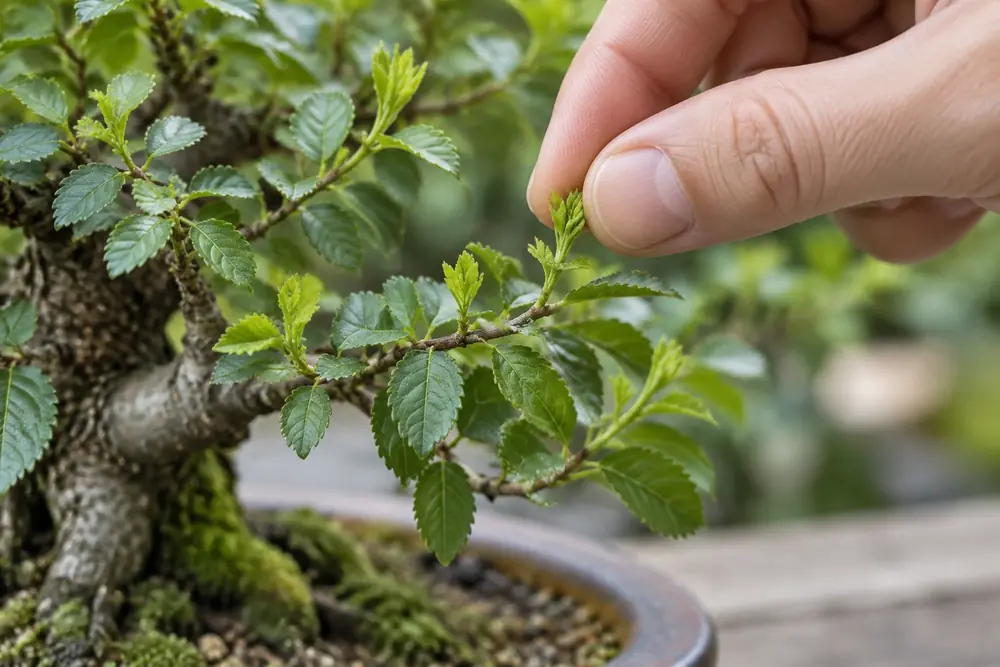
Pinching bonsai means removing the soft, growing tip of a new shoot, usually with finger and thumb, while it is still young. It is the lightest form of pruning and one of the most useful. By stopping a shoot early, you stop it growing long and coarse, and the tree sends energy to the buds lower down, which then grow into more shoots. Over time that builds dense, fine branching and keeps leaves and internodes short. Pinching suits many fine-leaved trees, such as Chinese elm, boxwood, azalea and many junipers, but it is not right for every species or every stage of a tree’s life.
This guide explains what pinching does, which trees to pinch, when and how to do it, and the mistakes that weaken trees.
What pinching does
Every shoot has a growing tip that produces a hormone (auxin) suppressing the buds below it. This is called apical dominance. When you remove the tip, the suppression lifts, and side buds start to grow. The result:
- More shoots, often two or three where there was one.
- Shorter internodes, because the shoot does not keep extending.
- Smaller leaves over time, as growth spreads among more shoots.
- A compact outline, without the stubby look of hard cutting.
Pinching is a maintenance technique for trees that already have their basic structure. It slows growth, so it is the wrong tool for a young tree you are trying to thicken.
Which bonsai trees to pinch
| Tree | Pinch? | Notes |
|---|---|---|
| Chinese elm, zelkova | Yes | Pinch new shoots back to 1 or 2 leaves |
| Boxwood | Yes | Pinch or trim tips to keep a dense dome |
| Azalea | Yes, after flowering | Pinch new shoots to build density for next year’s flowers |
| Junipers (scale-type) | Light pinching or pulling | Pull extending tips; avoid shearing |
| Japanese maple | Pinch central shoot | Remove the tiny center between the first leaf pair |
| Ficus | Prefer trimming | Shoots are tough; scissors work better |
| Pines | Candle pinching | Single-flush pines only; a separate technique |
| Young trees in development | No | Let them grow freely to thicken |
When to pinch bonsai
Pinch during the growing season, from spring to midsummer, whenever new shoots have produced a few leaves. On vigorous trees that can mean every week or two in spring. Stop by late summer so the last growth can harden before autumn. On flowering trees such as azaleas, pinch right after flowering, not before, or you remove the flower buds. Our guide on when to start pruning bonsai explains when a tree is ready for refinement work like pinching.
How to pinch broadleaf bonsai
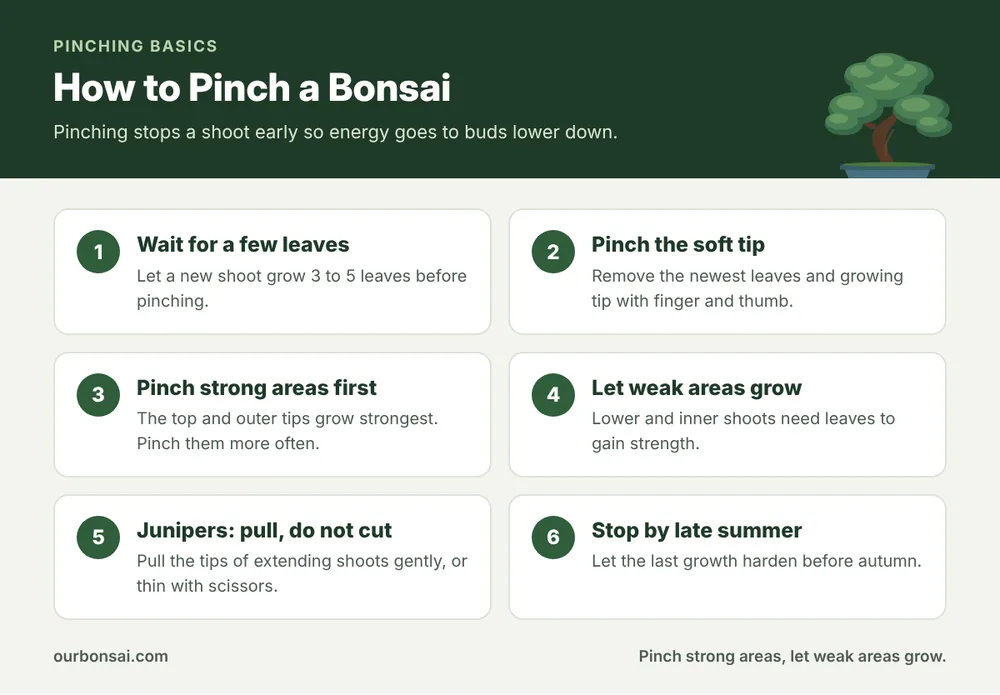
- Let the shoot grow. Wait until it has three to five leaves. Pinching too early, when the shoot is a tiny bud, removes energy the tree needs.
- Pinch the tip. Hold the shoot below the newest leaves and nip off the soft tip with your fingernails, leaving one or two leaves. For tiny shoots, fine tweezers or scissors work too.
- Work around the tree. Pinch the strongest shoots, at the top and outer tips, first and most often.
- Leave weak shoots. Lower and inner shoots that are growing slowly should be left to extend and gain strength.
- Repeat as new shoots develop through spring and early summer.
How to pinch juniper bonsai
Junipers need a gentler approach. Shearing or pinching the foliage flat across the surface leaves brown tips and can weaken the tree, especially on scale-leaf junipers such as Chinese juniper. Instead:
- Pull, do not cut. Hold the base of an extending shoot with one hand and gently pull the soft tip off with the other. It breaks at a natural point.
- Thin rather than shear. Use sharp scissors to remove whole shoots that stick out, cutting at their base inside the foliage pad.
- Leave enough foliage. Junipers need plenty of green to stay strong. Do not pinch every shoot.
Our guide to juniper bonsai styles for beginners shows how pads are shaped over time.
Pinching flowering bonsai
Flowering trees need special timing. Azaleas, for example, set next year’s flower buds at the tips of this year’s shoots during summer. The right moment to pinch is just after the flowers fade in late spring:
- Remove the spent flowers and any seed pods.
- Pinch or cut the new shoots that grow from just below the old flowers, leaving one or two leaves each.
- Remove extra shoots where several emerge from one point, keeping two.
- Stop pinching by early summer, so the remaining shoots can form flower buds.
Pinch later than that and you remove next spring’s flowers. The same idea applies to other spring-flowering bonsai such as quince and wisteria, which also flower on growth made the year before. Our guide to flowering indoor bonsai tree care covers indoor flowering species, which follow different rhythms.
A pinching routine for a Chinese elm
Chinese elm is one of the best trees to practice on. In spring it pushes many shoots at once. Let each shoot grow four or five leaves, then pinch back to two. Within two to three weeks, two new shoots usually grow from the leaf axils below. Pinch those back to two leaves as well. By midsummer, each original shoot has become a small cluster of fine twigs. Stop in late summer and let the tree rest.
Pinching vs pruning
| Pinching | Pruning | |
|---|---|---|
| What | Removes soft tips | Cuts hardened shoots or branches |
| Tool | Fingers, tweezers | Scissors, cutters |
| When | Throughout the growing season | Maintenance in season, structural in dormancy |
| Effect | Gentle, builds density | Stronger, changes shape |
Most trees benefit from both. Pinching keeps growth compact during spring; trimming and structural pruning handle the rest. Our bonsai care guide covers how they fit together.
Tools that help
Fingers do most of the work, but fine tweezers and narrow scissors help on small leaves and in dense foliage. Our guide to the best bonsai pruning shears for beginners covers suitable scissors, or browse bonsai tweezers.
Common pinching mistakes
- Pinching a young tree you want to thicken. It slows development.
- Pinching every shoot evenly. Strong areas keep winning. Pinch strong areas harder.
- Pinching too early, removing tiny buds before they have fed the tree.
- Shearing junipers flat, causing brown tips and weak growth.
- Pinching flowering trees before they bloom.
- Pinching weak or sick trees. They need every leaf.
FAQ: pinching bonsai
What does pinching do to a bonsai?
It removes the growing tip of a shoot, so side buds grow instead. The tree becomes denser, with shorter internodes and finer branches.
How often should I pinch my bonsai?
Every week or two during strong spring growth, less often in summer, and not at all from late summer on.
Can I pinch all types of bonsai?
No. Fine-leaved broadleaf trees and many junipers respond well. Tough-leaved trees like ficus are better trimmed, and pines need candle pruning.
Should I pinch or cut juniper bonsai?
Pull extending tips gently by hand and thin with scissors at the base of shoots. Avoid shearing the foliage.
Final thoughts
Pinching bonsai is the gentle, regular habit that turns a good tree into a refined one. Pinch soft tips once shoots have a few leaves, focus on the strong areas, let weak areas grow, treat junipers gently and stop by late summer. Do it consistently through spring, and you will see denser, finer branching every year. For more on keeping ramification healthy, read our guide to when to prune deciduous bonsai.