Azalea Bonsai Styles: Best Shapes for Beginners


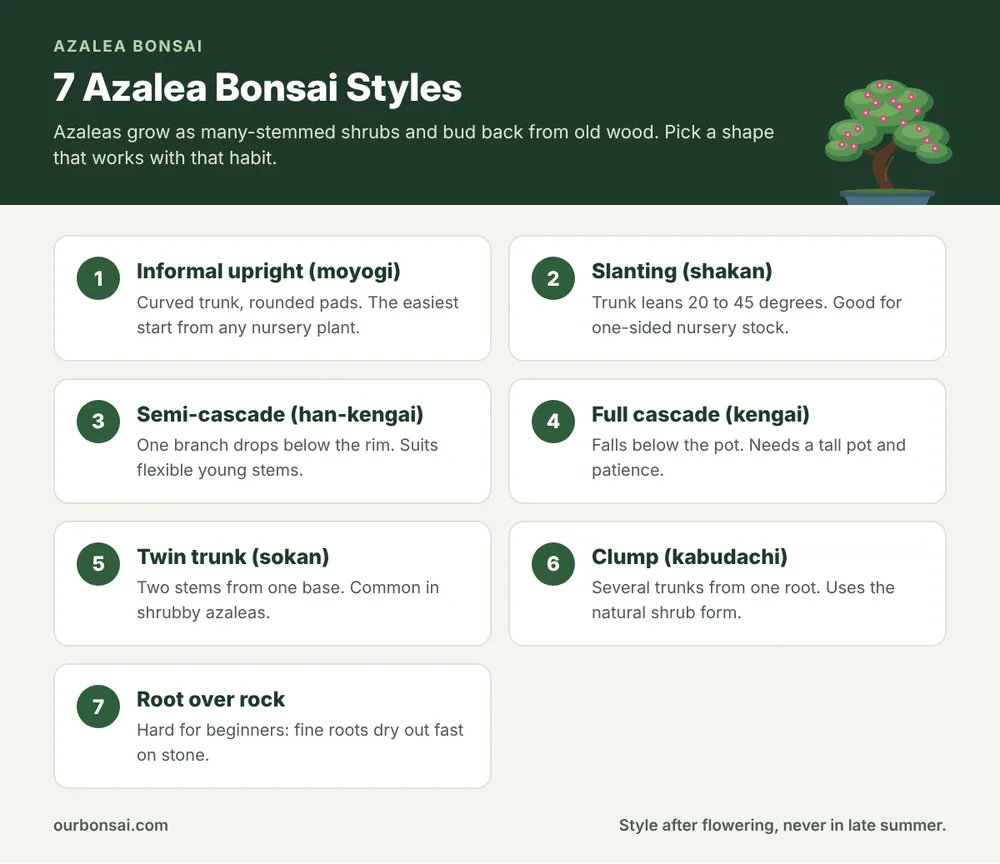
The best azalea bonsai styles for beginners are informal upright, slanting and semi-cascade. All three work with how satsuki and Kurume azaleas naturally grow: as dense, many-stemmed shrubs that sprout new buds from old wood. That ability to back-bud means you can cut a nursery azalea hard and rebuild it. The key timing rule is different from most bonsai: do your pruning and styling right after the flowers fade, usually in June, because next year’s flower buds form on the new shoots in mid to late summer.
In this guide
- What makes azalea styling different
- Azalea bonsai styles compared
- Informal upright: the natural first choice
- Slanting: for plants that already lean
- Semi-cascade and cascade
- Twin trunk and clump
- Broom and formal upright: why they rarely suit azaleas
- Root over rock: why it is harder
- When and how to style an azalea bonsai
- Frequently asked questions
- Final thoughts
What makes azalea styling different
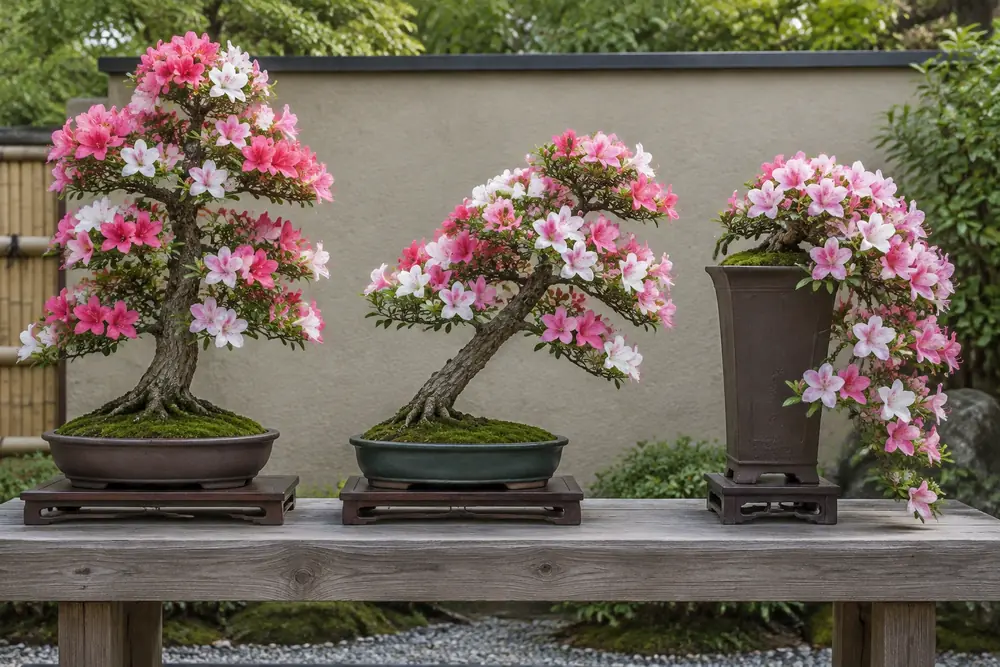
Most bonsai are styled for their trunk and branch structure. Azaleas are styled for a canopy that will be covered in flowers for 2 to 4 weeks each spring. A good azalea design has a strong, tapering trunk and a series of rounded pads or a single domed crown that shows the flowers as a solid mass.
Three habits shape your choices:
- They back-bud freely. Cut a branch to a bare stub and new shoots usually appear within weeks. Junipers and pines will not do this.
- The wood is brittle. Satsuki branches snap more easily than maple or elm. Bend slowly, and use raffia or guy wires for big moves.
- The bark is thin. Wire bites in within a season, so check it often.
Azalea bonsai styles compared
| Style | Difficulty | Best starting material | Time to a presentable tree |
|---|---|---|---|
| Informal upright | Easy | Any nursery plant with a thick main stem | 2 to 3 years |
| Slanting | Easy | One-sided or leaning plants | 2 to 3 years |
| Semi-cascade | Moderate | Plants with a long, low branch | 3 to 4 years |
| Twin trunk | Moderate | Plants with two strong stems from the base | 3 years |
| Clump | Moderate | Shrubby plants with many stems | 2 to 3 years |
| Full cascade | Hard | Young, flexible stock in a tall pot | 4 to 6 years |
| Root over rock | Hard | Young plants with long roots | 5 years or more |
Informal upright: the natural first choice
The trunk curves gently from base to apex, with branches arranged on the outside of the curves. Most nursery azaleas already have a main stem with a slight bend, so you are refining, not forcing.
How to start:
- Pick the front by finding the best surface roots and the most interesting trunk line.
- Remove stems that cross the trunk or grow straight toward the viewer.
- Keep 3 to 5 main branches, alternating left, right and back.
- Shorten everything else, leaving short stubs; azaleas will bud back from them.
- Let the tree grow and flower the next spring before refining the pads.
Slanting: for plants that already lean
A slanting azalea has a trunk leaning 20 to 45 degrees from vertical, with roots that look like they brace the tree on the uphill side. It is a great choice for nursery plants that grew lopsided against a wall. Tilt the tree in its pot during repotting rather than bending the trunk, which avoids breaking brittle wood.
Semi-cascade and cascade
These styles look wonderful on azaleas because flowers hang over the pot edge. In semi-cascade, the main branch or trunk drops below the rim but not below the base of the pot. In full cascade, it falls below the pot base, which needs a tall cascade pot.
Use young, flexible material, and bend in stages over two seasons. Our guide to choosing a tall bonsai pot for cascade shows suitable pot shapes.
Twin trunk and clump
Azaleas sold as small shrubs often have several stems coming from the root. Instead of cutting them down to one, keep two (twin trunk) or three to seven (clump). Choose stems of different thickness and height, so one clearly dominates. This is one of the fastest ways to get a mature-looking azalea.
Broom and formal upright: why they rarely suit azaleas
Formal upright (chokkan) needs a straight, evenly tapering single trunk, and most azaleas grow too shrubby and twisted for that without years of selection. Broom style (hokidachi) suits fine-twigged trees like zelkova and elm, where many branches fan out from one point. On an azalea, the dense flower mass hides that fan of branches anyway, so the effort does not show. Neither shape is wrong, but you will find better results with the curved and leaning styles above.
Root over rock: why it is harder
Azalea roots are fine and shallow. On a rock, they dry out quickly unless you keep them buried in soil for several years while they thicken. It can be done, but most beginners do better leaving this style until they have kept an azalea healthy for a few seasons.
When and how to style an azalea bonsai
- Prune right after flowering, usually late May to June. Cut off spent flowers and their seed pods too, since seed production drains energy.
- Avoid hard pruning after mid July. You will cut off the flower buds forming at the shoot tips.
- Wire in early summer after pruning, when new shoots have hardened slightly. Use aluminum wire and remove it before it marks the bark, often within 8 to 12 weeks.
- Repot in spring before flowering or right after it, in kanuma. See our list of the best soil for azalea bonsai.
If you want to see the styles used by experienced growers, our review of a Brussels satsuki azalea bonsai shows a typical nursery tree, and our page on types of bonsai explains the general style names.
Frequently asked questions
What is the easiest azalea bonsai style?
Informal upright. Almost any nursery azalea already fits it, and you only need pruning, not heavy wiring.
Can I style an azalea in winter?
You can cut back dead wood and plan, but avoid heavy pruning, because it removes flower buds that formed last summer. Major work is best right after flowering.
Why did my azalea branch snap when wiring?
Azalea wood is brittle, especially on older branches. Bend in small steps over several weeks, wrap thick branches in raffia first, and consider guy wires that pull from the pot rim instead of wire coils.
Should I let my azalea bonsai flower while I am styling it?
On a young tree in development, many growers remove most flower buds to put the energy into growth. On an established tree, enjoy the flowers and do the work right after they fade.
Final thoughts
Azaleas forgive hard cuts but not careless bends, and they reward patience with a spectacular spring. Start with informal upright or slanting, prune right after bloom, and leave the rock plantings for later. For more on the species, see the Wikipedia page on Rhododendron indicum, and if you also grow conifers, compare with our juniper bonsai styles for beginners.