Best Soil for Beech Bonsai: Mix and Repotting Tips

The best soil for beech bonsai is a free-draining but moisture-holding mix of roughly 50 percent akadama, 25 percent pumice and 25 percent lava rock, sieved to 2 to 6 mm grains, with a slightly acidic to neutral pH around 5.5 to 6.5. European beech (Fagus sylvatica) and Japanese beech (Fagus crenata) both have fine roots that rot in soggy soil and depend on beneficial soil fungi. So the mix should hold steady moisture without staying wet, and you should keep about a third of the old soil around the trunk each time you repot rather than stripping the roots bare.
In this guide
What beech roots need
Beech grows wild on well-drained soils in European and Japanese forests, usually on slopes where water never sits. Its roots are fine and fibrous, and like many forest trees it lives in partnership with mycorrhizal fungi, which wrap the root tips and help the tree take up water and nutrients. You will often see white threads in the soil of a healthy beech. That is the fungus, not mold.
Three things follow:
- Drainage first. Waterlogged soil suffocates the fine roots and the fungi with them. Beech is one of the species that declines fastest in a heavy, wet mix.
- Steady moisture. Beech also hates drying out, which scorches its thin leaves in summer.
- Gentle root work. Washing all the soil off the roots strips away the fungal partners. Trees that are bare-rooted often stall for a year or more.
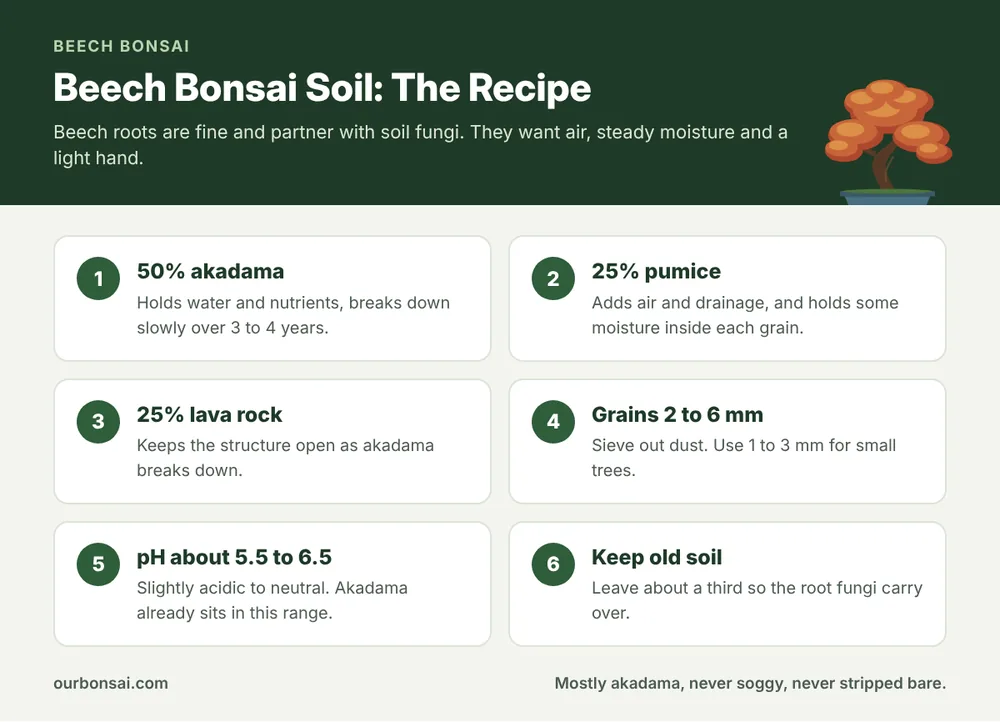
The best soil for beech bonsai: recipe and why
| Component | Share | What it does |
|---|---|---|
| Akadama | 50 percent | Holds water and nutrients, slightly acidic, slowly breaks down |
| Pumice | 25 percent | Light, porous, adds air while holding some water |
| Lava rock | 25 percent | Rigid grains that keep the mix open for years |
This is a balanced mix for most climates. Adjust it to your conditions:
- Hot, dry summers: go to 60 percent akadama, 20 pumice, 20 lava, so the pot holds more water.
- Cool, wet climates: 40 percent akadama, 30 pumice, 30 lava, so it drains faster.
- Large trees in big pots: use coarser grains, 4 to 8 mm, so the middle of the pot stays airy.
Our bonsai soil mix ratio guide explains how each ingredient behaves, and the Kanuma bonsai soil review covers a more acidic option some growers blend in for Japanese beech.
What to avoid
- Garden soil or general potting compost. It compacts in a shallow pot and stays wet. See bonsai soil vs regular soil for why.
- Lots of organic matter. A little fine bark is fine; peat-heavy mixes hold too much water.
- Unsieved dust. Fine particles clog the gaps between grains. Sieve every bag.
- Alkaline additives such as crushed limestone. Beech prefers slightly acidic to neutral soil.
When to repot a beech bonsai
Beech grows more slowly than maples or elms and its roots resent disturbance, so repot less often.
- Young trees in development: every 2 to 3 years.
- Mature trees: every 3 to 5 years.
- Timing: in spring, as the long, pointed, cigar-shaped buds begin to lengthen, often a little later than other deciduous trees.
Beech often keeps dry, coppery leaves through winter. This is called marcescence and is normal. The old leaves drop as the new buds push.
How to repot without harming the roots
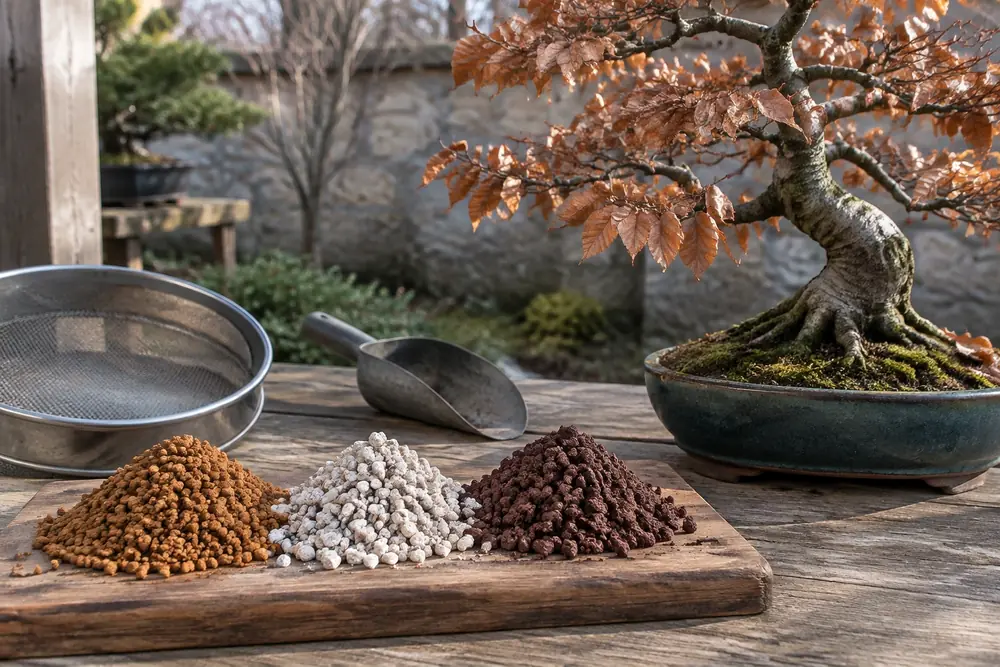
- Sieve and mix your soil the day before.
- Unpot the tree and look at the root ball. White fungal threads are a good sign.
- Comb out the outer third with a root hook, working from the edges and the bottom. Leave the central core around the trunk mostly intact.
- Trim long and circling roots. Remove no more than about a third of the root mass in one session.
- Mix a handful of the old soil into your new soil to carry fungi over.
- Repot, tie in firmly, and work soil into the gaps with a chopstick.
- Water thoroughly, then keep the tree in light shade and out of wind for 2 to 3 weeks.
- Wait 4 weeks before feeding.
Our list of the best bonsai repotting tools covers the root hooks and scissors worth having.
Signs your beech is in the wrong soil
The soil often shows its problems before the tree does. Watch for these:
- Water sits on top for several seconds after watering. The mix has broken down or was too fine.
- Green algae or moss spreading fast across the surface. The top stays wet for too long.
- Leaves scorch at the edges in midsummer even though you water daily. The mix drains too fast or holds too little, often pure lava or pumice.
- Weak spring growth with small, pale leaves. Roots are struggling, from compaction, rot or a recent bare-root repot.
- A sour smell when you water. Roots are short of air.
Any of these is a reason to plan a repot for the next spring rather than waiting the full 3 to 5 years.
Watering beech in this mix
Water when the top centimeter of soil has dried and turns lighter in color. In summer, that may mean once a day, more in heat. Beech leaves scorch at the edges if the pot dries out, so a mix that holds steady moisture is a real help. In winter, water only when needed and keep the tree outside, sheltered from hard frost; beech needs a cold dormancy.
Frequently asked questions
Can I use pure akadama for beech?
Yes, many growers do, especially in dry climates. It holds more water than the mix above and breaks down faster, so repot a little more often and watch for soggy soil in wet weather.
What pH does beech bonsai soil need?
Slightly acidic to neutral, about 5.5 to 6.5. Akadama is naturally in this range.
Is the white stuff in my beech soil mold?
Usually it is mycorrhizal fungus, which is beneficial. Fuzzy mold on the surface with a sour smell is different and points to soil that stays too wet.
Should I fertilize right after repotting beech?
No. Wait about 4 weeks, until new roots have formed, then start at half strength.
Final thoughts
Beech is not fussy about the exact brand of soil, but it is fussy about air, steady moisture and gentle handling. A mostly akadama mix with pumice and lava, repotted every few years and never stripped bare, keeps it healthy. For more on the species, see the Wikipedia article on Fagus sylvatica.