When and How to Repot Brazilian Rain Tree Bonsai

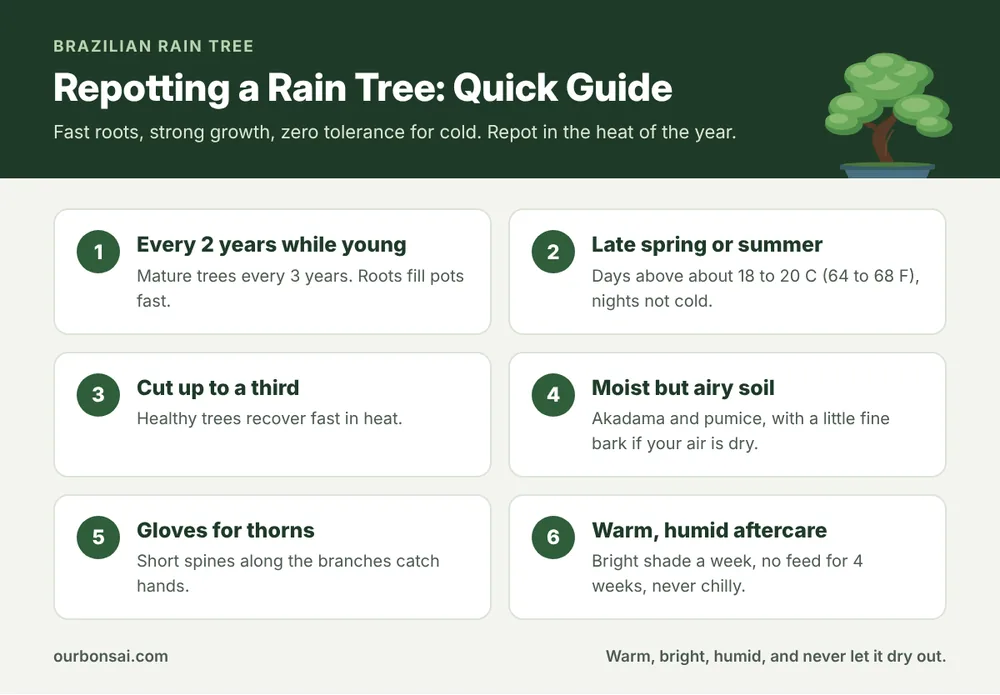
Here is how to repot brazilian rain tree bonsai safely: repot every 2 years while the tree is young and every 3 years once mature, in late spring or summer when days stay above about 18 to 20 C (64 to 68 F); trim up to a third of the roots; and use a moist but airy mix such as akadama and pumice with a little fine bark. Brazilian rain tree (Pithecellobium tortum, also listed as Chloroleucon tortum) grows fast in warmth and fills its pot quickly, but it drops leaves at the first sign of cold. Warmth during and after the repot matters more than any other detail.
In this guide
Why timing matters so much for this tree
Brazilian rain tree comes from tropical and subtropical Brazil. It is a legume, related to acacias, with fine bipinnate leaves made of many small leaflets. Those leaflets fold up at night, in heavy rain, and whenever the tree is stressed, which is where the “rain tree” name comes from.
In warm weather the tree is vigorous, and root cuts heal and regrow within a couple of weeks. In cool conditions, growth stops, and a tree with freshly cut roots in cold, wet soil can lose all its leaves and struggle to recover. That is why repotting in early spring, the standard time for temperate trees, is risky unless your spring is genuinely warm or the tree lives in a heated greenhouse.
Signs your rain tree needs repotting
| Sign | What it tells you |
|---|---|
| Roots growing out of the drainage holes | Pot is full |
| Water sits on the surface | Soil has broken down |
| Tree needs water twice a day even in mild weather | Not enough soil left for moisture |
| Leaves smaller and paler despite feeding | Roots are congested |
Choosing soil
Rain trees like steady moisture but not soggy roots. A mix of roughly 50 percent akadama, 30 percent pumice and 20 percent fine pine bark works well for most indoor and greenhouse growers. Outdoors in hot summers, you can increase the akadama for more water retention. The general logic of these components is in our bonsai soil mix ratio guide.
Avoid dense potting mix. It stays wet and cold indoors through winter, which is a recipe for root rot.
How to repot brazilian rain tree bonsai, step by step
- Wear gloves. Rain tree branches carry short, sharp spines.
- Water the day before so the roots are hydrated.
- Prepare the new pot with mesh, tie-in wire and a layer of fresh soil.
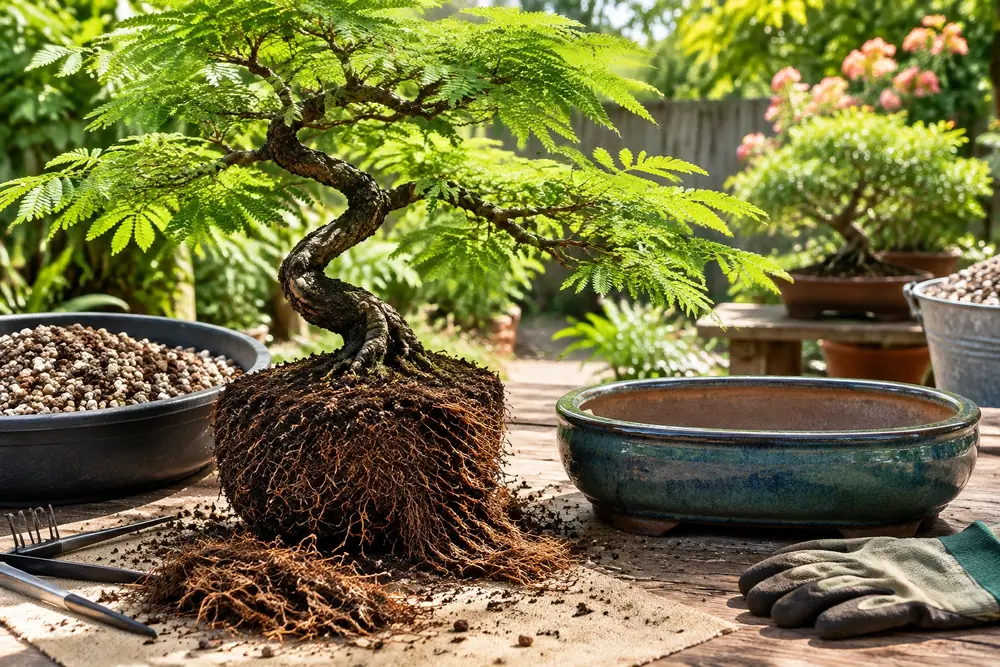
- Remove the tree. Cut tie wires, loosen the root ball with a knife around the pot edge and lift the tree out by the base of the trunk.
- Comb out the outer roots. Rain tree roots are tough and grow fast. Work the old soil out from the bottom and sides with a root hook.
- Trim. Cut away up to a third of the root mass, focusing on thick, long roots and those circling the pot. Keep plenty of fine feeder roots.
- Pot up. Set the tree on a mound of soil, tie it in firmly and fill around the roots with a chopstick.
- Water thoroughly, then mist the foliage.
Our list of the best bonsai repotting tools covers what you need.
Aftercare: warmth and humidity first
- Temperature: keep the tree above about 18 C (64 F) day and night for several weeks. Indoors, keep it away from cold windows at night and from air conditioning drafts.
- Light: bright shade for about a week, then return to full sun or a strong grow light. Rain trees need a lot of light to keep leaflets small and growth compact.
- Humidity: these trees like 50 percent humidity or more. A humidity tray or grouping plants helps indoors.
- Water: never let the soil dry out completely, but do not keep it soaking either. Water when the top 1 cm is dry.
- Feeding: wait about 4 weeks, then resume a balanced feed every 2 weeks in the growing season.
It is normal for leaflets to fold up for a few days after a repot. If they stay folded for more than a week, check that the tree is warm enough and that the soil is not waterlogged.
Growing a thicker trunk while you repot
Many rain trees are bought as small, thin trees, and owners want a thicker trunk. The fastest way is not more frequent repotting but a bigger root run. For a few years, put the tree into a larger training pot or a mesh-sided pond basket, let it grow freely in strong light and warmth, and feed well. Repot back into a smaller bonsai pot only once the trunk is close to the size you want. Rain trees respond quickly: with a long, hot growing season, noticeable thickening in one or two years is common. Use these big-pot years to improve the surface roots too, spreading them outward at each repot.
Mistakes that cause leaf drop
- Repotting in early spring indoors while nights by the window are still cold.
- Moving the tree to a new spot right after repotting. Changes in light add stress.
- Letting the fresh soil dry out. Fine roots die quickly.
- Heavy pruning at the same time. Let the tree recover from one stress at a time.
If your tree does drop leaves, keep it warm, bright and evenly moist. Rain trees usually regrow from the branches within a few weeks once conditions are right. For more on indoor tropical care, see how to take care of a bonsai tree inside, and for other warm-climate species, our guide to tropical bonsai species.
Frequently asked questions
When is the best time to repot a Brazilian rain tree bonsai?
Late spring to midsummer, when temperatures are consistently warm. In tropical climates, any time outside the coolest months.
Can I bare-root a Brazilian rain tree?
Healthy, vigorous trees in warm weather tolerate heavy root work, but there is little benefit to full bare-rooting. Removing old soil from the outer half is usually enough.
Why are my rain tree leaves folding after repotting?
Folding is the tree’s stress response. It is normal for a few days. Keep it warm, humid and evenly moist.
How big should the new pot be?
For trees in development, a larger training pot speeds trunk growth. For display, a pot about two thirds the height of the tree works well, with good drainage.
Final thoughts
Brazilian rain tree is easy to repot as long as you respect its need for heat. Wait for warm weather, trim moderately, and keep it bright and humid while it recovers. For more about the species, see our guide to the best tropical bonsai tree and the Wikipedia article on Pithecellobium tortum.