Chinese Elm Bonsai Yellow Leaves: Causes and Fixes

This post contains affiliate links. As an Amazon Associate, OurBonsai earns from qualifying purchases at no extra cost to you. Read our disclosure.
In this guide
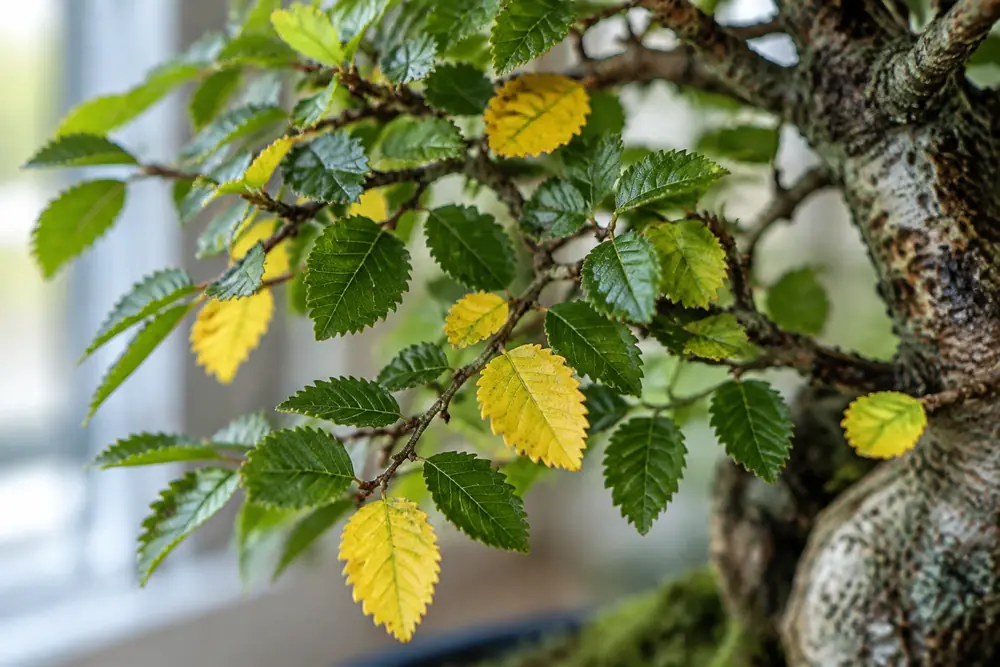
Chinese elm bonsai yellow leaves are one of the most common questions from owners of this popular tree. The good news is that the Chinese elm (Ulmus parvifolia) is very forgiving, and yellowing usually has a simple cause: the soil is too wet or too dry, the tree needs more light, it is hungry, or it is simply responding to the season. Once you fix the cause, it bounces back quickly with fresh green growth.
This guide explains how to tell normal yellowing from a problem, the main causes and how to fix each one.
Normal yellowing vs a problem
Chinese elm is semi-evergreen. In mild climates and indoors, it keeps many of its leaves all year but replaces older ones gradually. Outdoors in colder climates, it behaves more like a deciduous tree, with leaves turning yellow and dropping in autumn.
It is normal when:
- A few older, inner leaves turn yellow and drop now and then
- An outdoor tree turns yellow in autumn as nights get cold
- New green buds keep appearing
It is a problem when:
- Many leaves turn yellow within a week or two
- Yellowing appears in spring or summer on an outdoor tree
- New leaves at the tips come in yellow or pale
- Yellowing comes with wilting, spots or sticky residue
6 causes of chinese elm bonsai yellow leaves
1. Overwatering
The most common cause indoors. When the soil stays wet, the roots lack oxygen and cannot work properly. Leaves turn an even yellow and drop easily. The soil may smell sour.
Fix: water only when the top centimeter of soil is just dry. Empty saucers after watering and make sure the drainage holes are open. If the soil is dense potting mix, repot into a gritty bonsai mix at the right time of year. Our guide to the best soil for Chinese elm bonsai explains good mixes, and our guide to root rot in bonsai helps if roots are damaged.
2. Underwatering
Chinese elms use a lot of water in the growing season. If the root ball dries out, leaves turn yellow, then brown and crisp, and drop within days.
Fix: check the soil daily and water thoroughly when the top is just dry. Soak the pot in a basin for ten minutes if it has dried out badly.
3. Too little light
Indoor Chinese elms often sit too far from a window. With weak light, they cannot support their full canopy. Older leaves yellow and fall, and new shoots grow long and pale.
Fix: move the tree right next to your brightest window and add a grow light in winter. Consider moving it outdoors for spring and summer. Our guide on how much light a bonsai tree needs explains why this matters.
4. Nutrient shortage
Bonsai soil holds few nutrients, and Chinese elm grows fast. A hungry tree turns pale yellow-green all over, starting with older leaves.
Fix: feed every two to four weeks during the growing season with a balanced bonsai fertilizer. Our guide to the best Chinese elm bonsai fertilizer compares good options. A simple liquid bonsai fertilizer used at the label rate works well.
5. Seasonal change and moves
Outdoor elms naturally yellow in autumn. Indoor elms often yellow and drop leaves after being moved, for example from a greenhouse to a store to your home, or from a summer outdoors back inside.
Fix: for autumn yellowing outdoors, nothing is needed. For yellowing after a move, choose a bright spot, keep it there and wait. New leaves follow within a few weeks.
6. Pests
Spider mites cause fine yellow speckles and dull leaves, especially indoors in dry air. Aphids cluster on new shoots and curl the leaves. Scale insects appear as small brown bumps on twigs and leave sticky honeydew.
Fix: inspect leaf undersides and twigs. Rinse the tree and treat with insecticidal soap or neem oil. See our guide to spider mites on bonsai trees and scale on bonsai trees.
How to diagnose step by step
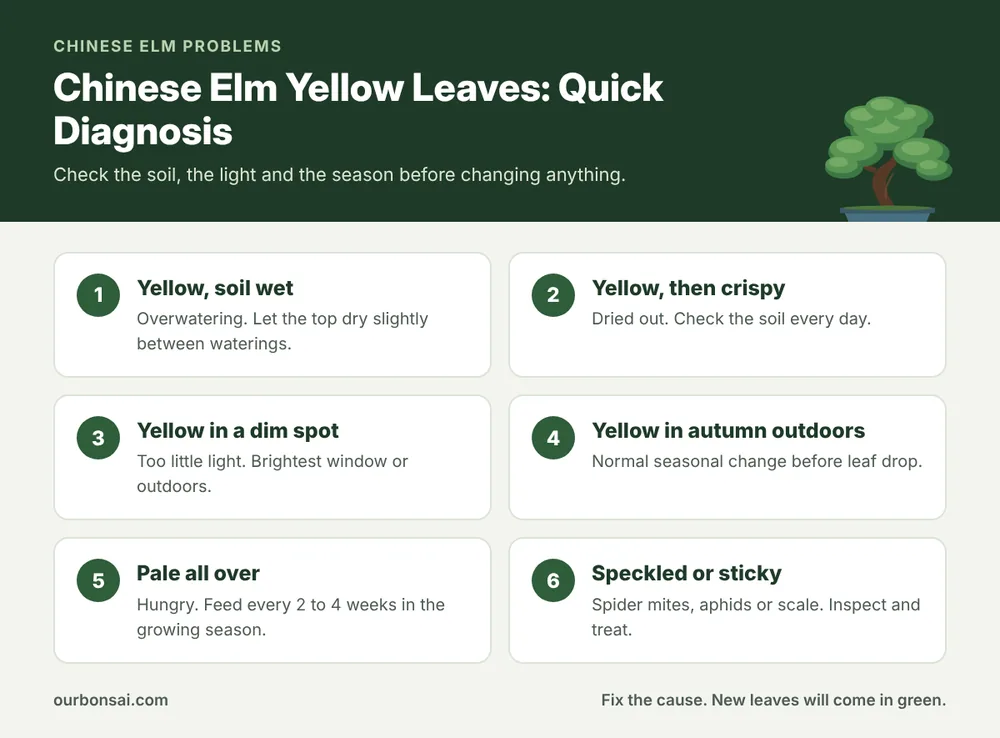
- Feel the soil. Wet and heavy points to overwatering. Bone dry points to underwatering.
- Check the light. Is the tree right next to a bright window or outdoors?
- Check the season. Autumn yellowing outdoors is normal.
- Look at the pattern. Old leaves only: hunger or normal turnover. Spread across the tree: water or light.
- Inspect for pests. Speckles, webs, bumps or sticky residue.
- Think about recent changes. A move, repotting or pruning in the last few weeks?
Quick reference
| What you see | Most likely cause | First step |
|---|---|---|
| Soft yellow leaves, wet soil | Overwatering | Water less, improve drainage |
| Yellow then crispy, dry soil | Underwatering | Check daily, soak if very dry |
| Pale leaves, long shoots | Low light | Brighter spot, grow light |
| Even yellow in autumn outdoors | Seasonal change | Nothing to fix |
| Pale green all over | Hunger | Feed regularly |
| Speckles, webs, sticky twigs | Pests | Rinse and treat |
Indoor Chinese elm and yellow leaves in winter
Winter is when indoor elms most often yellow. Light is weak, heating dries the air, and owners often keep watering as in summer. In winter, water a little less often, give the brightest spot or a grow light, use a humidity tray and keep the tree away from radiators. Our Chinese elm bonsai care guide covers year-round indoor care.
Yellow leaves after repotting or pruning
Chinese elm sometimes yellows and drops some leaves after repotting, especially if many roots were cut or the work was done in the wrong season. The tree simply cannot support all its leaves until new roots grow. Keep it in bright, indirect light, sheltered from wind, keep the soil evenly moist and do not fertilize for about a month. New buds usually follow within a few weeks.
Heavy pruning or defoliation can have a similar effect on the remaining older leaves. As long as new buds are swelling, there is nothing to worry about. To avoid stress, repot outdoor elms in early spring as buds swell, and indoor elms in spring when growth is strong, and do not combine repotting with heavy pruning.
Should you remove yellow leaves?
Yellow leaves that come away easily can be removed to tidy the tree and help air reach the inside of the canopy. Leaves still partly green are still feeding the tree, so leave them until they drop. Pick fallen leaves off the soil surface so it can dry evenly and pests have fewer hiding places.
FAQ: chinese elm bonsai yellow leaves
Why are my Chinese elm bonsai leaves turning yellow and falling off?
Most often watering problems or too little light. Check the soil moisture and move the tree to a brighter spot.
Is it normal for a Chinese elm to have yellow leaves?
A few yellow older leaves are normal, and outdoor trees yellow in autumn. Many yellow leaves at once is a sign of stress.
Can yellow Chinese elm leaves turn green again?
Usually not. Once fully yellow they drop, but new leaves will be green once the cause is fixed.
Should I fertilize a Chinese elm with yellow leaves?
Only if hunger is the cause and the roots are healthy. Do not feed a tree with wet, rotting roots.
Final thoughts
Chinese elm bonsai yellow leaves almost always come down to watering, light, feeding or the season. Read the pattern, fix the main cause and keep the tree stable. Chinese elm recovers quickly, and fresh green leaves usually follow within a few weeks. For more background on the species, see the Wikipedia article on Ulmus parvifolia.