When and How to Repot Fukien Tea Bonsai

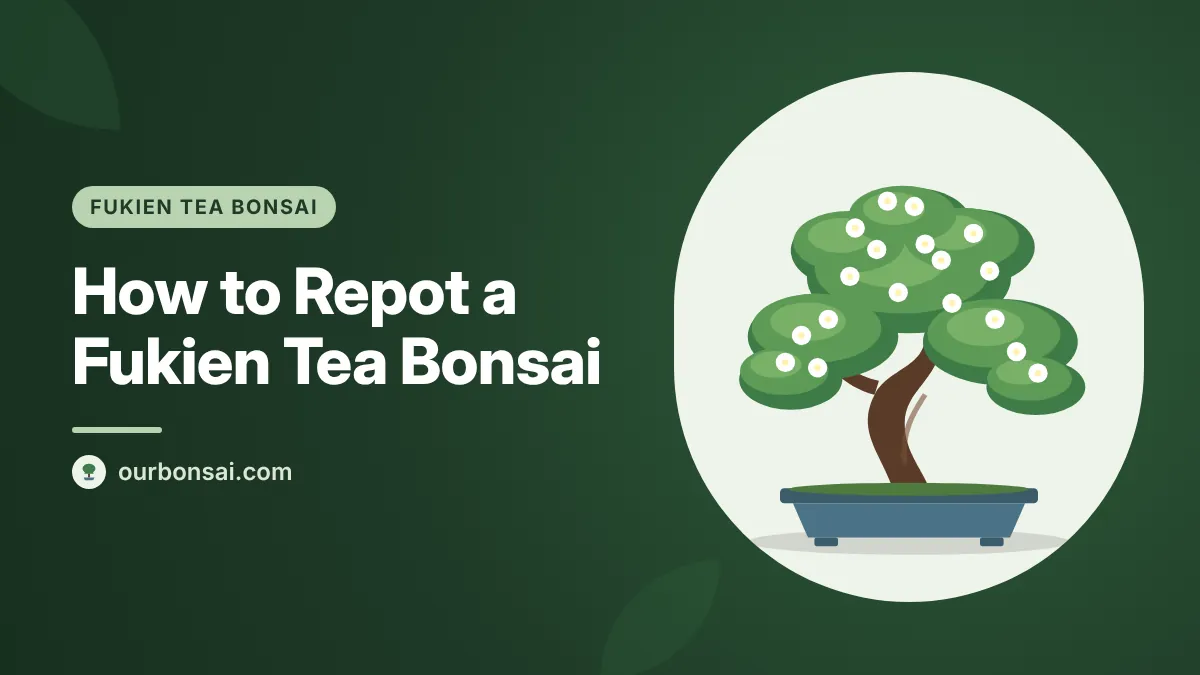
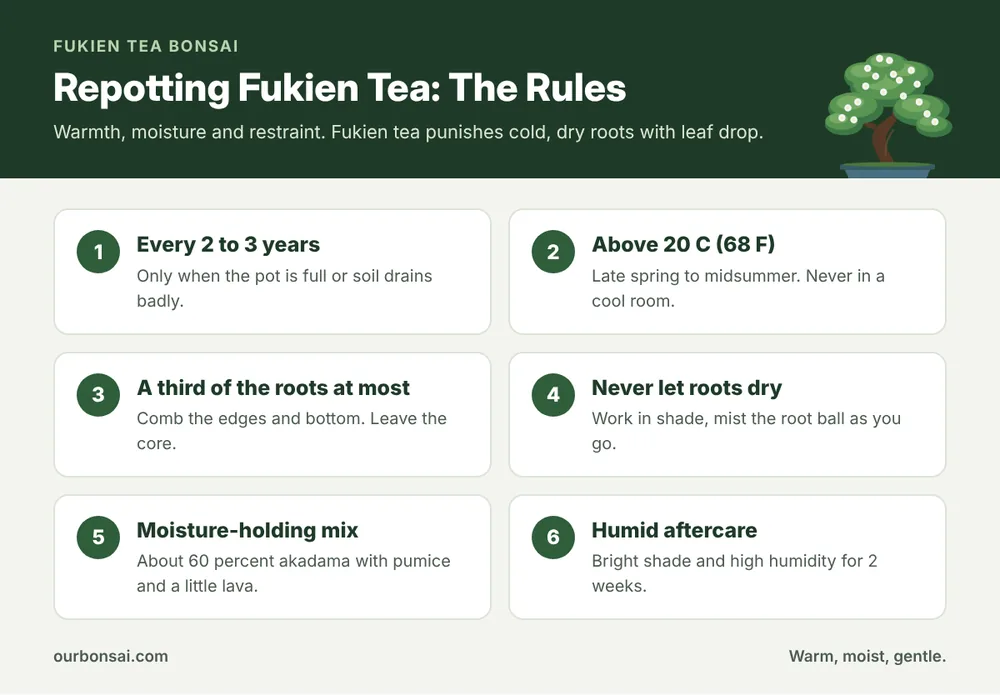
Here is how to repot fukien tea bonsai without triggering heavy leaf drop: repot every 2 to 3 years, in late spring or summer when temperatures stay above about 20 C (68 F); remove no more than a third of the roots; keep the root ball moist the whole time it is out of the pot; and use a moisture-holding mix of mostly akadama. Fukien tea (Ehretia microphylla, also sold as Carmona retusa) is a tropical shrub from southern China and Southeast Asia that reacts badly to cold, dry or rough root work. Get the conditions right, and it recovers in a few weeks.
In this guide
Why Fukien tea is fussier than ficus
Fukien tea is often sold alongside ficus as an easy indoor bonsai, but its roots behave differently. They are finer, slower to regrow and quick to dry out. A ficus can be bare-rooted on a summer day and shrug it off; a Fukien tea treated the same way often drops most of its leaves and takes months to recover.
Three things trigger stress:
- Cold. Below about 15 C (59 F), growth stops and cut roots sit idle.
- Dry roots. Even 15 minutes in dry air can kill the fine feeder roots.
- Heavy root pruning. Cutting half the roots, which ficus tolerates, is too much here.
When to repot
| Sign | Act? |
|---|---|
| Water runs off the surface or soaks in very slowly | Yes, next warm season |
| Roots circle the pot and push out of holes | Yes |
| Tree healthy, water drains well | No, wait another year |
| Tree is weak, dropping leaves | Fix light, water and temperature first |
The best window is late spring to midsummer. Indoors, choose a period of warm weather and avoid repotting near a cold window or air conditioner. Our guide on the best time to repot tropical bonsai covers the general timing.
Soil for Fukien tea
Fukien tea likes evenly moist soil, more than most tropical bonsai. A mix of about 60 percent akadama, 30 percent pumice and 10 percent lava holds water well while keeping air in the root zone. In very dry indoor air, some growers add 10 percent fine bark. Our list of the best soil for Fukien tea bonsai compares ready-made options.
How to repot fukien tea bonsai, step by step
- Water the tree the day before. Start with moist roots.
- Prepare everything first: pot, mesh, tie-in wire, sieved and lightly dampened soil, and a spray bottle of water.
- Work in the shade, away from wind or fans.
- Remove the tree carefully, cutting old wires and loosening the pot edge with a knife.
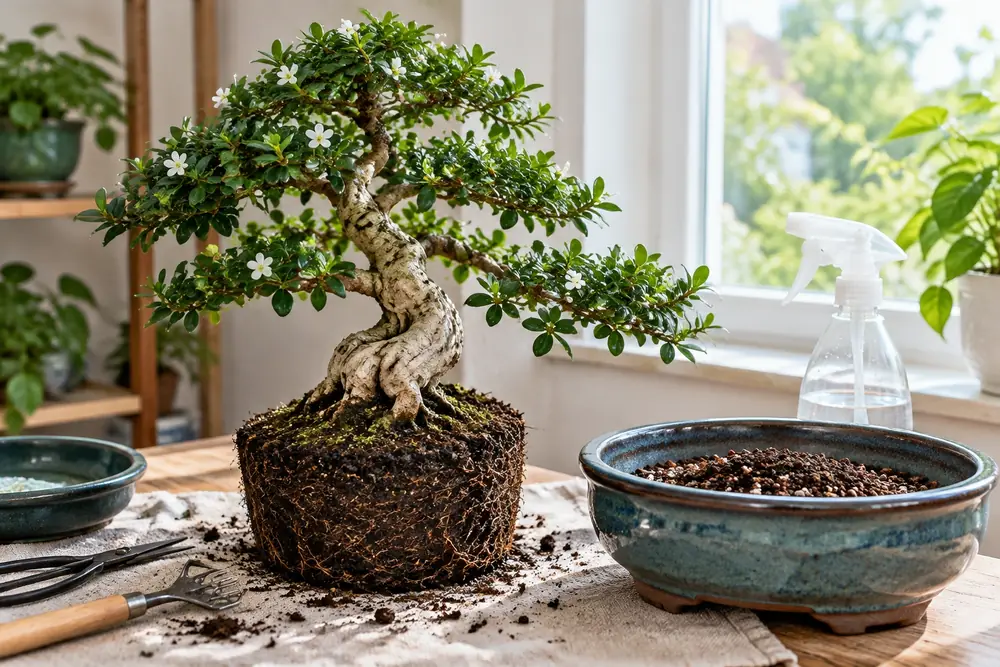
- Comb the outer edge and bottom only. Use a root hook gently. Leave the central core around the trunk intact.
- Trim no more than a third of the root mass, focusing on circling and very long roots.
- Mist the roots every few minutes so they never dry.
- Pot up, tie in firmly, and work soil around the roots with a chopstick.
- Water thoroughly until it runs clear.
Aftercare: warmth, humidity, patience
- Bright shade for about 2 weeks. No direct midday sun.
- High humidity. A humidity tray, grouping plants, or a clear plastic tent with a few holes for the first week helps. Remove the tent gradually.
- Steady warmth, above 20 C (68 F) day and night if possible.
- Even moisture. Do not let the soil dry out, but do not let it stay soaking.
- No fertilizer for 4 weeks, then a balanced feed at half strength. Our guide to the best fertilizer for Fukien tea bonsai suggests options.
- No pruning until new shoots are growing well.
Water quality and Fukien tea roots
Fukien tea is sensitive to hard water and salt buildup, and freshly cut roots are at their most sensitive. For the first few weeks after a repot, use rainwater, filtered water, or tap water that has stood overnight if you can. Water thoroughly each time so that any salts are flushed out of the drainage holes, rather than giving small sips that let minerals collect near the surface. If you see a white crust forming on the soil or the pot rim over the following months, flush the pot with plenty of plain water. A tree in clean, slightly acidic soil grows new roots faster than one sitting in salty, alkaline soil.
Outdoors in summer
In warm climates, or anywhere with summer nights above about 15 C (59 F), Fukien tea does very well outdoors in summer. Repotting at the start of that outdoor season, then placing the tree in bright shade on a patio, often gives faster recovery than keeping it inside. The higher humidity and stronger light help it push new roots and leaves. Bring it back indoors before nights cool in autumn.
If the leaves drop anyway
Some leaf drop after repotting is common. Do not move the tree around or change its routine. Keep it warm, bright and evenly moist. If the twigs stay flexible and green under the bark, new leaves normally appear within 3 to 6 weeks. Overwatering a leafless tree is the main risk now; it uses much less water without leaves.
Common mistakes
- Repotting in winter on a windowsill.
- Washing off all the soil.
- Leaving roots exposed while you look for the right pot.
- Placing it in full sun right after repotting.
- Moving the tree to a “better spot” during recovery. Stability helps more.
For other Fukien tea problems, see our Fukien tea bonsai tree review, which covers typical care issues, and our guide to Fukien tea bonsai styles for shaping once it has recovered.
Frequently asked questions
How often should I repot a Fukien tea bonsai?
Every 2 to 3 years, or when water no longer drains well. Do not repot just because a year has passed.
Why did my Fukien tea lose its leaves after repotting?
Usually cold, dry roots during the repot, or too much root removed. Keep it warm, humid and evenly moist, and it should regrow.
Can I bare-root a Fukien tea?
It is not recommended. Keep the core of the root ball intact.
What size pot is best?
A pot similar in size to the old one, with good drainage. Fukien tea does not need a big jump in pot size.
Final thoughts
Fukien tea needs a gentler hand than ficus: warm weather, moist roots, modest pruning and humid aftercare. Treat it that way and repotting becomes routine. For the species background, see the Wikipedia article on Ehretia microphylla.