Best Soil for Dwarf Jade Bonsai: Mix and Repotting Tips

The best soil for dwarf jade bonsai is a very fast-draining mineral mix, roughly one third akadama, one third pumice and one third lava rock, sieved to 3 to 6 mm, with no peat or compost. Dwarf jade (Portulacaria afra) is a succulent from South Africa that stores water in its thick leaves and stems, and its roots rot quickly in soil that stays wet. Water should run straight through the pot within seconds. Repot every 2 to 3 years in late spring or summer when it is warm and growing, and let the soil dry almost completely between waterings.
In this guide
Dwarf jade is not the same as jade plant
Two plants are sold as “jade bonsai,” and they are not closely related:
| Dwarf jade (Portulacaria afra) | Jade plant (Crassula ovata) | |
|---|---|---|
| Leaves | Small, round, about 1 to 2 cm | Larger, oval, 3 to 5 cm |
| Stems | Reddish brown, more flexible | Thick, gray-green to brown |
| Growth | Fast, branches freely | Slower, chunkier |
| Soil needs | Very fast draining | Very fast draining |
Both are succulents and both need gritty soil, so the recipe here works for either. Dwarf jade grows faster and makes a finer bonsai with small leaves. Our Brussels dwarf jade bonsai review shows a typical tree.
Why soil is the number one factor
In its native habitat in the Eastern Cape and nearby regions, Portulacaria afra grows in dry thicket on rocky, well-drained ground, surviving long droughts on the water stored in its tissues. In a pot, the danger is the opposite: soil that holds water. Peat-based potting mixes, garden soil or even a standard bonsai mix with fine particles can keep the roots wet for days, especially indoors in winter when the plant grows slowly. Root rot follows, and it often shows first as soft, shriveling leaves that look like underwatering.
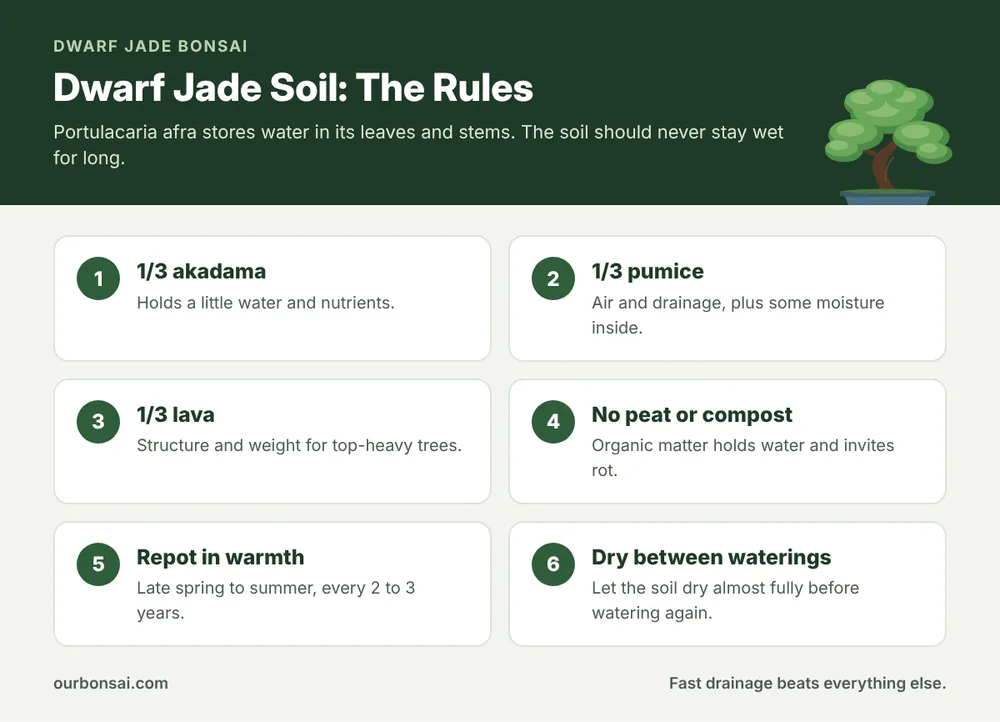
Best soil for dwarf jade bonsai: recipe and variations
- Standard: 1 part akadama, 1 part pumice, 1 part lava, all sieved to 3 to 6 mm.
- Indoors in low light or a humid home: cut akadama and use 2 parts pumice to 1 part lava, so the pot dries faster.
- Outdoors in hot, sunny summers: standard mix; it may need water every 2 to 3 days in heat.
- No akadama available: pumice and lava alone, half and half, work well for succulents.
Sieve out dust carefully. Fine particles hold water in the bottom of the pot. If you prefer a ready-made blend, our review of Bonsai Jack succulent soil covers a popular option. Our bonsai soil mix ratio guide explains the role of each ingredient.
Repotting dwarf jade
When: late spring to midsummer, when the tree is warm and growing strongly. Avoid winter repotting indoors.
How often: every 2 years while young, every 3 years once refined.
Steps:
- Let the soil dry out for a few days before repotting. Dry roots are easier to comb and less likely to rot after cutting.
- Remove the tree from the pot and gently comb out old soil.
- Trim long and circling roots, up to about a third of the root mass. Remove any soft, dark roots.
- Pot up in fresh, dry mix and tie in firmly. Dwarf jade is top-heavy and rocks easily.
- Wait 3 to 5 days before the first watering, so cut roots can seal. Keep the tree in bright shade during that time.
- Return to full sun or a bright south window after about a week.
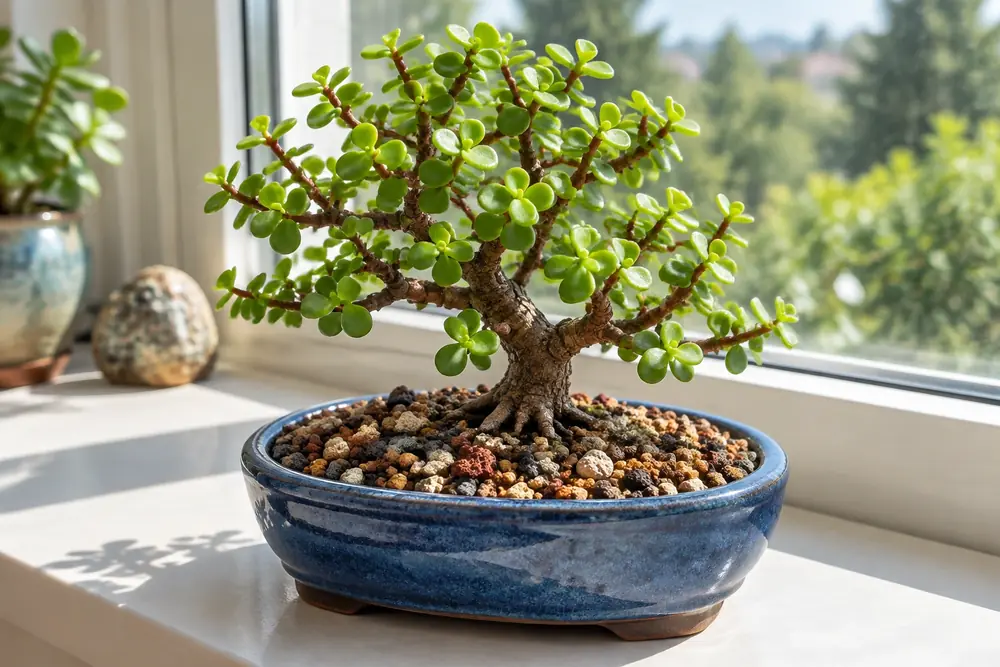
Watering in a gritty mix
Water deeply, until it runs out of the drainage holes, then let the soil dry almost completely before watering again. In summer outdoors, that may be every 2 to 4 days. Indoors in winter, it can be every 1 to 3 weeks. Slightly wrinkled leaves are a sign the tree is ready for water. Soft, translucent or yellow leaves usually mean too much water. Our article on jade bonsai pests and diseases covers rot and pests in more detail.
Signs the soil is wrong
Dwarf jade tells you fairly quickly when its soil is not working. Watch for these:
- Leaves drop in large numbers after watering, often green and plump. A classic sign of roots sitting wet.
- Stems turn soft or black at the soil line. Rot has started. Unpot at once, cut back to firm tissue, let it dry for a few days and repot in fresh, dry mineral soil.
- The pot still feels heavy three or four days after watering in summer. The mix holds too much water.
- Water pools on the surface before soaking in. The soil has broken down or is too fine.
- Leaves stay wrinkled even after watering. Roots may already be damaged and unable to take up water.
If you catch these early, a change to a coarser mix usually fixes the problem within a few weeks of warm weather.
Light makes the soil work
The same mix that drains perfectly in a sunny spot can stay damp too long in a dim one, because the plant uses so little water. Dwarf jade needs strong light: full sun outdoors in summer, or the brightest south window or a grow light indoors. More light means faster drying, tighter growth and smaller leaves.
Frequently asked questions
Can I use cactus soil for dwarf jade bonsai?
Many bagged cactus soils still contain a lot of peat. They are better than regular potting soil, but a mineral mix of akadama, pumice and lava drains far better. If you use cactus soil, mix in at least half pumice.
Should I water dwarf jade right after repotting?
Most growers wait 3 to 5 days, so cut roots can seal before they get wet. Keep the tree out of strong sun meanwhile.
Does dwarf jade need fertilizer in this mix?
Yes, lightly. Use a balanced liquid feed at half strength every 3 to 4 weeks during the growing season. None in winter if it is not growing.
What pot is best for dwarf jade bonsai?
A shallow to medium pot with large drainage holes. Unglazed pots dry a little faster, which suits succulents.
Final thoughts
For dwarf jade, drainage beats everything. Use a coarse mineral mix, water deeply but rarely, and give it all the light you can. For style ideas once the roots are settled, see our article on jade bonsai styles, and for the species itself, the Wikipedia article on Portulacaria afra.