Best Soil for Crape Myrtle Bonsai: Mix and Repotting Tips

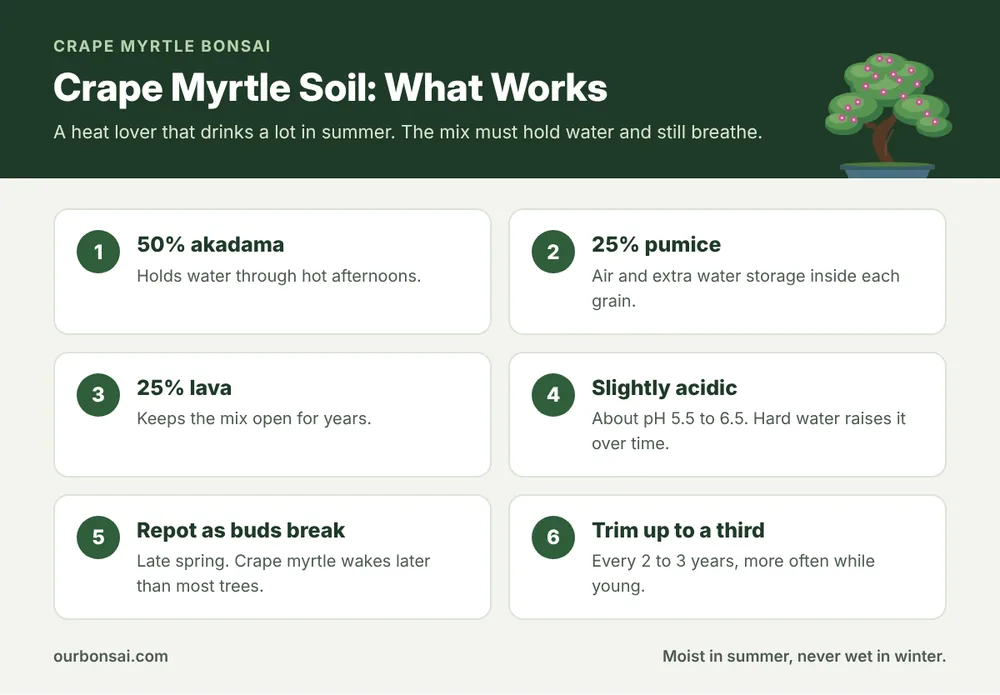
The best soil for crape myrtle bonsai is a mix that holds plenty of water for hot summers but still drains fast: about 50 percent akadama, 25 percent pumice and 25 percent lava rock, sieved to 2 to 6 mm grains, with a slightly acidic pH of about 5.5 to 6.5. Crape myrtle (Lagerstroemia indica) flowers on new shoots grown in summer, and it uses a lot of water in heat, so a soil that dries out by midafternoon means fewer flowers. Repot every 2 to 3 years in late spring, once buds have broken, because crape myrtle wakes up later than most deciduous trees.
In this guide
What crape myrtle wants from its soil
Crape myrtle is native to China, Korea and parts of Southeast Asia and has been planted across the American South for generations. In the landscape it copes with a wide range of soils, even clay, because its roots can spread deep and wide. In a shallow pot, it has none of that buffer. Two things matter most:
- Water during heat. On a 32 C (90 F) day, a crape myrtle in full leaf and flower empties a small pot fast. Soil that holds water inside its grains keeps it growing.
- Air in winter. When dormant, the same tree uses almost nothing. Soil that stays soggy in a cold, wet winter rots its roots.
A granular, inorganic mix meets both needs. Water sits inside the akadama and pumice grains, while the gaps between grains stay full of air.
Best soil for crape myrtle bonsai: recipe and adjustments
| Situation | Akadama | Pumice | Lava | Notes |
|---|---|---|---|---|
| Standard | 50% | 25% | 25% | Good for most climates |
| Very hot, dry summers | 60% | 20% | 20% | More water holding |
| Cool, wet climate | 40% | 30% | 30% | Faster drainage |
| Young tree in development | 50% | 25% | 25% plus 10% fine bark | Faster growth, repot more often |
Sieve all components to remove dust. Our bonsai soil mix ratio guide explains what each part does.
About pH and water
Crape myrtle prefers slightly acidic soil. Akadama is naturally in that range, so the mix above suits it well. Hard tap water, used for months, slowly raises the pH and can cause yellow leaves with green veins as iron becomes harder to take up. If your water is hard, collect rainwater when you can, flush the pot heavily once a month, and use a fertilizer with chelated micronutrients.
Pot choice changes the soil you need
The same mix behaves differently in different pots. In a shallow display pot, 4 to 5 cm deep, there is little soil to hold water, so lean toward the higher akadama version and expect to water twice a day in summer. In a deeper training pot, a mesh pond basket or a wooden box, the extra volume holds more water, and the standard or even the faster-draining mix is safer through winter. Unglazed pots lose water through their walls on hot days, while glazed pots hold it a little longer. Many growers keep young crape myrtles in larger training containers for several years to build trunk thickness, then move to a smaller display pot once the tree flowers well and the base has developed. When you make that move, use slightly finer grains so the smaller pot holds water more evenly.
Ready-made options
If you buy a bagged mix, look for an inorganic gritty bonsai soil with mostly 2 to 6 mm grains. Our reviews of premium bonsai soil and Bonsai Jack gritty mix compare two common choices. For hot climates, you may want to blend in extra akadama, since many ready mixes are tuned for good drainage first.
Repotting crape myrtle
When: late spring, as buds break and the first leaves appear. Crape myrtle is one of the last trees to leaf out, often weeks after maples and elms. Repotting it too early, while roots are still cold and inactive, slows recovery.
How often: every 2 years when young, every 3 years when mature.
Steps:
- Prepare the pot, mesh and tie-in wire, and sieve the soil.
- Lift the tree out and comb out the outer and bottom roots with a root hook.
- Remove up to a third of the root mass, cutting thick downward roots first.
- Spread surface roots outward to build a wide base.
- Pot up, tie in firmly, and work soil around the roots with a chopstick.
- Water thoroughly. Keep in bright shade for a week, then return to full sun.
- Start feeding after about 3 to 4 weeks.
Our list of the best bonsai repotting tools covers root hooks and scissors.
Watering in this mix
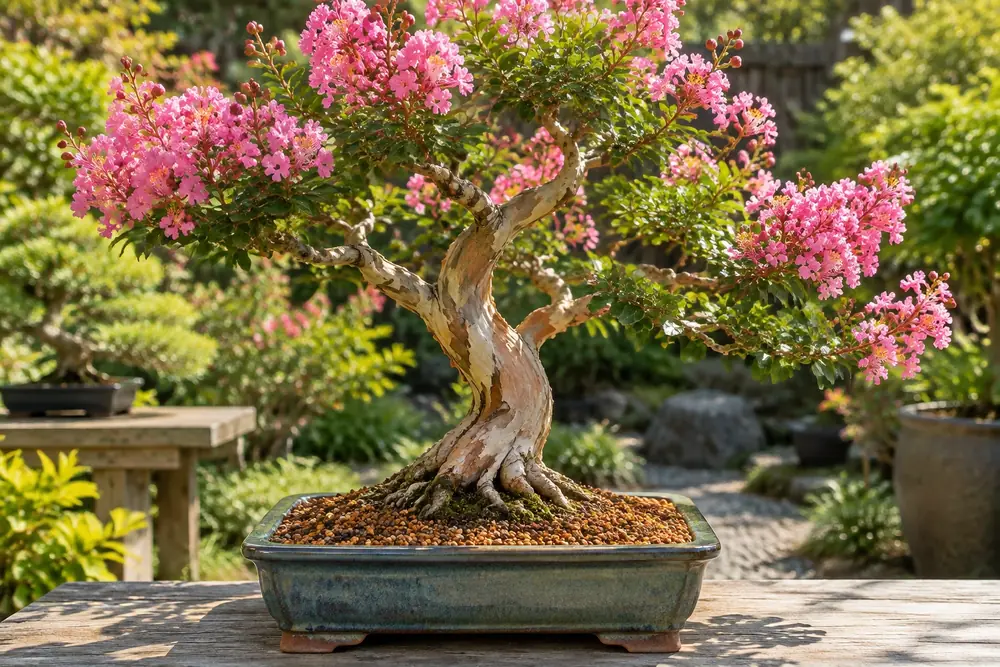
In summer, check twice a day. Many crape myrtles in bonsai pots need water every morning and again in the late afternoon during heat waves. A slightly deeper pot during development helps. In winter, the tree is leafless and needs water only when the soil dries, perhaps every 7 to 14 days. Our guide to watering bonsai in summer covers hot-weather routines.
Soil-related problems
- Few flowers: often a tree that ran dry repeatedly in summer, or one fed too much nitrogen. Flowers form on vigorous new growth in full sun.
- Yellow leaves with green veins: pH crept up from hard water.
- Weak spring growth: compacted, old soil or root damage over a wet winter.
- Powdery mildew (white coating on leaves): not a soil problem, but common on crape myrtle in humid, shaded spots. Give full sun and good air flow. Our guide to powdery mildew on bonsai trees has the fixes.
Frequently asked questions
Can crape myrtle bonsai grow in regular potting soil?
It will survive for a while, but potting soil compacts and stays wet in winter. A gritty bonsai mix is far healthier long term.
When should I repot a crape myrtle bonsai?
Late spring, once buds have broken. It wakes up later than most deciduous trees.
Does crape myrtle need acidic soil?
Slightly acidic, around pH 5.5 to 6.5, is ideal. Akadama-based mixes provide that.
How do I keep my crape myrtle from drying out in summer?
Use a mix with more akadama, water twice a day in heat, and consider a slightly deeper pot while the tree is developing.
Final thoughts
Crape myrtle needs a soil that works hard in July and stays out of the way in January. A mostly akadama mix with pumice and lava does both. For more on the plant, see Clemson Extension’s crape myrtle factsheet and the Wikipedia article on Lagerstroemia indica.