Money Tree Bonsai Pests and Diseases: Identification, Treatment, and Prevention

Quick Answer
Money tree bonsai (Pachira aquatica) commonly develops problems involving mealybugs, scale insects, aphids, spider mites, fungal leaf spots, powdery mildew, and root rot. Yellow leaves, sticky residue, white cottony patches, fine webbing, and soft roots provide useful clues, but similar symptoms can result from incorrect watering or insufficient light. For accurate diagnosis, inspect the foliage, stems, and soil before choosing a treatment, and consult the North Carolina Extension Gardener’s money tree guide.
Common warning signs and likely causes
- White cottony patches: Check leaf joints and stems for mealybugs.
- Brown attached bumps: Inspect woody stems and leaf undersides for scale insects.
- Fine webbing: Look for spider mites and tiny pale speckles on leaves.
- Sticky leaves: Check for sap-feeding pests such as aphids and scale.
- Dark, mushy roots: Suspect root rot, especially when the growing medium stays wet.
- White powder or spreading spots: Consider powdery mildew or a leaf-spot disease, while ruling out residue and physical damage.
What to do first
- Isolate the affected tree from other plants.
- Inspect both sides of the leaves, branch joints, trunk crevices, and soil surface.
- Remove pests mechanically when practical, then use an appropriate labeled treatment if necessary.
- Correct watering and drainage problems before adding fertilizer or undertaking major pruning.
Money tree bonsai pests and diseases can look deceptively similar, especially when leaves begin yellowing or falling. I find it useful to approach these problems systematically rather than treating every damaged leaf as an insect or fungal issue.
This guide explains how to recognize common infestations, distinguish diseases from ordinary care problems, choose suitable treatments, and prevent recurring damage to your Pachira aquatica bonsai.
In This Guide
- How do you identify money tree bonsai pests?
- What diseases affect money tree bonsai?
- How can you diagnose yellow leaves, leaf drop, and other symptoms?
- How do you treat pests and diseases safely?
- How can you prevent recurring problems?
- How do you help an affected money tree bonsai recover?
- Frequently asked questions
How do you identify money tree bonsai pests?
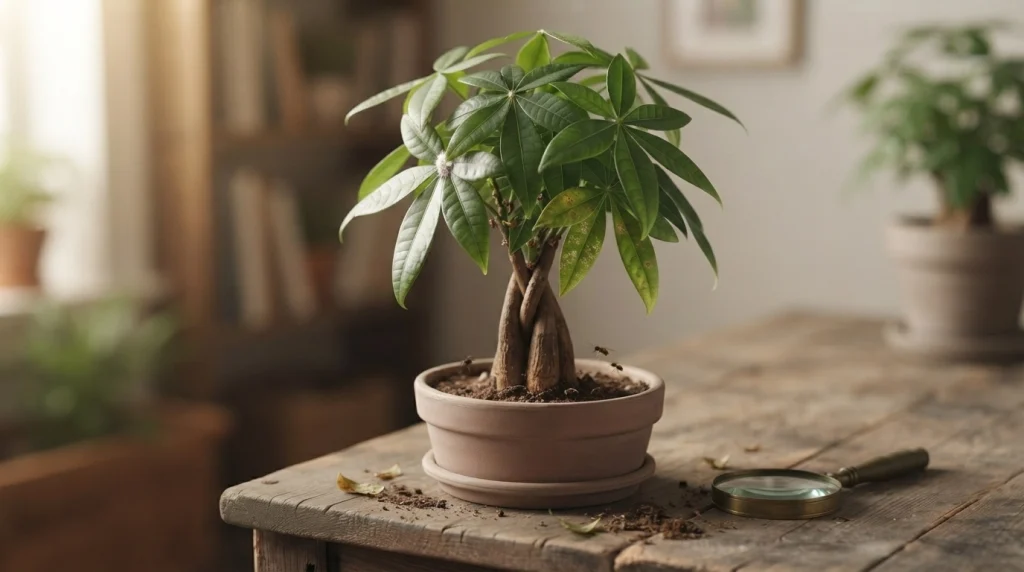
Money tree bonsai pests are small organisms that feed on plant tissue, draw sap from leaves and stems, or develop in persistently damp growing media. Identifying the pest before treating the tree helps you choose a suitable control method and avoid unnecessary chemical applications.
Pachira aquatica is a tropical evergreen commonly grown indoors, where limited airflow, stressed growth, and nearby infested houseplants can increase pest problems.
Which insects commonly attack money tree bonsai?
Mealybugs, scale insects, and aphids are important pests to check for first. Spider mites and fungus gnats can also become troublesome under suitable indoor conditions.
- Mealybugs: Look for white, cotton-like clusters around leaf bases, branch junctions, and tender shoots. These insects feed on sap and may leave sticky honeydew.
- Scale insects: Search for small brown, tan, or gray bumps attached firmly to stems and leaves. Some produce honeydew, and heavy infestations can weaken growth.
- Aphids: Inspect fresh shoots and the undersides of young leaves for small, soft-bodied insects. Their feeding can distort new growth and leave sticky residue.
- Spider mites: Look for fine webbing, tiny pale stipples, and a faded appearance. A magnifying glass helps because these mites are difficult to see clearly.
- Fungus gnats: Watch for small dark flies around the potting medium. Their larvae develop in damp organic material and can damage roots when populations become substantial.
What do pest symptoms look like on a bonsai?
Different pests leave different clues, but no single symptom proves a particular infestation. Examine the actual insects, feeding marks, and surrounding growing conditions together.
| Pest | Typical evidence | First response |
|---|---|---|
| Mealybugs | White cottony clusters | Isolate and remove visible insects |
| Scale insects | Fixed, shell-like bumps; sometimes sticky leaves | Inspect stems and carefully remove accessible scales |
| Aphids | Clusters on tender growth; curled leaves | Wash off accessible insects |
| Spider mites | Fine webbing and pale leaf stippling | Rinse foliage and inspect repeatedly |
| Fungus gnats | Small flies near damp soil | Correct excessive moisture and monitor larvae |
These are diagnostic clues, not guarantees. For additional identification and management guidance, consult the University of California’s houseplant pest management resource.
Why do pests keep returning?
Many infestations persist because eggs, immature insects, or hidden adults survive the first treatment. Scale and mealybugs are particularly easy to miss around tight leaf joints and braided trunks.
Repeat inspections every few days initially, following the treatment label and the pest’s life cycle. Check neighboring plants too, because treating only the visibly affected bonsai may leave the source of reinfestation untouched.
Section Takeaway: Identify the pest from physical evidence before choosing a treatment. Thorough inspection and repeated monitoring are more reliable than treating symptoms alone.
What diseases affect money tree bonsai?
Money tree bonsai can develop root rot, fungal leaf spots, and powdery mildew. Root rot is strongly associated with poorly drained, persistently wet growing media, while leaf diseases can be encouraged by susceptible foliage and favorable environmental conditions.
Not every brown spot or yellow leaf indicates an infection. Watering errors, sun scorch, temperature changes, and pest feeding can produce similar damage.
How do you recognize root rot?
Root rot occurs when roots are damaged and decay, often because the growing medium remains saturated and oxygen becomes limited. Affected roots may turn brown or black, become soft, or lose their firm outer tissue.
Above the soil, the tree may show several warning signs:
- Leaves yellowing or dropping despite damp soil.
- Persistent wilting even though the potting medium is wet.
- A sour or unpleasant smell from the root zone.
- Soft, darkened roots or a deteriorating lower trunk in severe cases.
Healthy roots are generally firm rather than mushy, although their natural color varies with age and growing medium. Avoid diagnosing root rot from leaf color alone.
Money trees tolerate moisture better than some dry-climate plants, but that does not mean their bonsai pots should remain waterlogged. Drainage holes and an open, suitable growing medium are essential.
What does fungal leaf spot look like?
Leaf-spot diseases often produce brown, dark, or irregular patches that may expand over time. Some lesions develop yellow margins, but appearance varies with the pathogen and growing conditions.
Inspect whether spots appear on several leaves, whether they spread, and whether new lesions develop after watering. Inconsistent watering, sun damage, physical injury, and certain pest attacks can also create spots.
Remove badly affected fallen leaves and avoid leaving infected plant debris around the pot. Water the growing medium carefully rather than repeatedly wetting foliage, and improve airflow without exposing the tree to cold drafts.
How can you tell powdery mildew from ordinary residue?
Powdery mildew typically appears as white, powder-like patches on leaf surfaces and sometimes stems. Mineral deposits, dried spray residue, and mealybug wax can look similar, so inspect the material closely before applying a fungicide.
Unlike cottony mealybug clusters, mildew often spreads as a thin, irregular coating across leaf tissue. However, appearance alone may not establish the exact cause.
- Check for insects beneath or beside the white material.
- Look for gradual expansion of powdery patches on living foliage.
- Consider recent spraying, hard-water deposits, and other possible sources of residue.
- Remove heavily damaged leaves when appropriate and improve air circulation.
If the problem spreads or the diagnosis remains uncertain, obtain advice from a plant clinic or qualified horticultural specialist. A correctly identified disease is easier to manage than one treated with the wrong product.
Which problems are pests, diseases, or care errors?
The distinction matters because pesticides cannot correct waterlogged roots, and fungicides will not eliminate a scale infestation. Use the following comparison to guide your first inspection.
| Problem | Clue to check | Priority |
|---|---|---|
| Insect infestation | Visible insects, attached bumps, honeydew, or webbing | Isolate and identify the pest |
| Fungal leaf disease | Spreading lesions or characteristic powdery growth | Remove affected debris and improve growing conditions |
| Root rot | Soggy medium and soft, deteriorating roots | Restore drainage and assess root damage |
| Watering stress | Dry or saturated medium without clear pest evidence | Adjust watering to actual soil moisture |
| Light or temperature stress | Scorched foliage or leaf drop after a location change | Stabilize the environment |
For further background on root health and bonsai disease prevention, the University of Wisconsin’s Plant Disease Diagnostics Clinic provides plant-disease resources.
Section Takeaway: Root rot, leaf infections, and pest damage require different responses. Check the roots, foliage, and growing conditions before selecting a treatment.
How can you diagnose yellow leaves, leaf drop, and other symptoms?
Yellow leaves and falling foliage are warning signs, but they do not identify a specific disease. Check the soil moisture, light exposure, recent changes in location, and underside of the leaves before deciding what your money tree needs.
Money tree bonsai respond to environmental changes, especially when grown in small containers with limited root space. Several problems can occur at once, so look for more than one explanation.
Why are money tree bonsai leaves turning yellow?
Yellowing can result from overwatering, underwatering, insufficient light, nutrient problems, pest feeding, or root damage. The pattern of yellowing and the condition of the growing medium help narrow down the cause.
- Wet soil and widespread yellowing: Check drainage and inspect for root damage if the decline continues.
- Very dry soil and drooping foliage: Water thoroughly when the root zone needs moisture.
- Pale, stippled leaves: Inspect closely for spider mites or other sap-feeding pests.
- Scorched patches after stronger sunlight: Consider sun damage and move the tree gradually to suitable light.
- Older leaves yellowing gradually: Consider normal leaf turnover, particularly if new growth remains healthy.
Don’t respond to every yellow leaf by watering more. If the roots are already oxygen-starved, extra water can make the situation worse.
Why are the leaves falling off?
Leaf drop can follow changes in light, temperature, humidity, watering, or root health. A recent move, repotting, cold draft, or pest outbreak may help explain when the problem began.
Check whether the potting medium is dry, evenly moist, or saturated. Then examine the stems and leaf joints for insects before changing several care practices at once.
Sudden environmental changes deserve particular attention. A money tree moved from a bright window to a dim corner may lose foliage even when watering remains unchanged.
Why are the leaves sticky, curled, or covered in spots?
Sticky foliage often points toward honeydew-producing insects, while curling may accompany sap feeding or environmental stress. Spots can result from disease, insect damage, sun scorch, or physical injury.
- Sticky residue: Search for aphids, mealybugs, and scale insects above and below the affected leaves.
- Curling new growth: Inspect tender shoots for aphids and other small pests.
- Tiny pale dots: Examine the leaf undersides for spider mites.
- Expanding dark lesions: Consider a leaf-spot disease and remove fallen debris.
- Dry brown edges: Review watering consistency, humidity, root condition, and exposure to hot sunlight.
How can you check the roots without damaging the bonsai?
Start by checking drainage holes, the soil surface, and any unusual odor from the pot. If the tree continues to decline in wet soil, a closer root inspection may be justified.
Do not repeatedly pull a healthy tree out of its container just to investigate individual yellow leaves. Unnecessary root disturbance can add stress and complicate recovery.
If serious root rot is suspected, inspect the root system carefully and remove only clearly decayed tissue using clean tools. Major root work is best performed when the tree’s condition and seasonal timing make it appropriate.
Section Takeaway: Diagnose the pattern, not just the symptom. Soil moisture, visible pests, recent environmental changes, and root condition provide stronger evidence than leaf color alone.
How do you treat pests and diseases safely?
The safest treatment starts with isolation, accurate identification, and removal of accessible pests or diseased material. Use pesticides or fungicides only when appropriate, following the product label and confirming that the intended use is permitted.
Money tree bonsai have compact canopies and small root systems, so aggressive treatments and unnecessary pruning can cause additional stress. Start with the least disruptive effective option.
How do you remove mealybugs, aphids, and scale?
For a small infestation, physical removal can reduce pest numbers before a broader treatment becomes necessary. Work slowly around leaf joints and stems, where insects often hide.
- Move the bonsai away from other plants.
- Remove visible insects with a damp cloth, soft brush, or cotton swab as appropriate.
- Rinse accessible foliage gently if the tree and growing medium can be protected from excessive water.
- Inspect the entire plant again, including hidden stem crevices.
- If pests remain, select a labeled insecticidal soap or horticultural oil suitable for the plant and target pest.
Do not assume that one cleaning eliminates an infestation. Eggs and concealed insects can survive, so repeat inspections and follow the product’s directions for repeat applications.
Test a spray on a small area first when the label permits, and avoid treating a heat-stressed or severely dehydrated tree. Never mix household cleaning products, rubbing alcohol, oils, and pesticides into an improvised spray.
How do you control spider mites and fungus gnats?
Spider mites and fungus gnats require different approaches because one attacks foliage while the other develops mainly in the growing medium. Treat the location where the pest lives.
- Spider mites: Rinse the foliage, paying attention to leaf undersides, and use a suitable labeled miticide or other approved treatment if necessary.
- Fungus gnats: Allow the upper growing medium to dry appropriately between waterings without letting the money tree’s root ball become excessively dry.
- Adult fungus gnats: Yellow sticky traps can help monitor or reduce flying adults, but they do not eliminate larvae in the soil.
- Fungus gnat larvae: Consider a locally approved biological control or labeled treatment intended for soil-dwelling larvae.
Avoid saturating the soil with insecticide simply because small flies are present. First determine whether the problem comes from persistently wet growing media and decaying organic material.
What should you do about root rot?
Root rot requires attention to both damaged roots and the conditions that allowed the problem to develop. Simply applying a fungicide without correcting poor drainage is unlikely to solve the underlying issue.
- Stop leaving the pot standing in a saucer of water.
- Confirm that the drainage holes are open and the growing medium allows excess water to escape.
- If the tree is deteriorating and root rot is strongly suspected, assess the roots rather than repeatedly watering in response to wilting.
- Remove clearly rotten roots with clean tools when intervention is necessary.
- Use fresh, appropriate, free-draining growing medium and a container with working drainage.
- Resume careful watering and monitor the tree instead of immediately fertilizing it.
Pro tip: Extensive root removal can be irreversible, especially in a weakened bonsai. If much of the root system is damaged, consult an experienced bonsai grower or local bonsai club before undertaking major root work.
Should you use fungicides for leaf spot and powdery mildew?
A fungicide may be appropriate for a confirmed fungal disease, but treatment depends on the organism, severity, and product label. Removing badly affected material and correcting environmental conditions should accompany any necessary chemical treatment.
- Remove fallen and severely diseased leaves where practical.
- Improve airflow while maintaining suitable warmth and light.
- Water carefully to avoid prolonged leaf wetness when leaf disease is suspected.
- Choose a product labeled for the identified disease and ornamental plant use.
- Follow all instructions for application rate, protective equipment, re-entry, and repeat treatments.
Neem oil is not a universal cure for every pest or fungal problem. Its effectiveness depends on the target, application, and product formulation, and it can injure foliage under unsuitable conditions.
For a bonsai kept indoors, consider people, pets, nearby plants, and ventilation before applying any pesticide. Use products only in the locations and manner specified on their labels.
Section Takeaway: Isolate the tree, use targeted treatments, and correct the conditions behind the problem. Avoid harsh home remedies, indiscriminate spraying, and unnecessary root disturbance.
How can you prevent recurring problems?
Prevention depends on stable growing conditions, good drainage, and regular inspection. A healthy money tree bonsai is better positioned to tolerate minor pest pressure than a tree already weakened by root damage or inconsistent care.
Prevention does not mean keeping the tree completely dry or spraying pesticides on a fixed schedule. It means matching care to the plant’s needs and spotting changes early.
What watering and soil conditions help prevent disease?
Money tree bonsai prefer moisture with good drainage, not continuously saturated roots. Water when the growing medium needs it, then allow excess water to drain freely from the pot.
- Use a bonsai-appropriate growing medium that retains some moisture while maintaining air spaces.
- Choose a pot with functional drainage holes.
- Check the moisture within the root zone instead of following a rigid daily watering schedule.
- Adjust watering for temperature, light, growth rate, and the condition of the medium.
- Remove standing drainage water rather than allowing the container to remain submerged.
A shallow bonsai pot can dry more quickly than a large houseplant container, especially during warm weather. However, a compact pot with dense, poorly draining soil can also remain wet for too long.
Which light and humidity conditions reduce stress?
Pachira aquatica generally grows well in bright, indirect light and warm conditions. Strong direct sunlight through hot glass can scorch leaves, while insufficient light can weaken growth and slow the drying of wet soil.
Provide a stable position with good light and airflow, avoiding cold drafts and sudden changes in exposure. Increase light gradually when moving a tree from a dim location.
Moderate to high humidity can suit this tropical species, but humidity alone does not prevent pests. Spider mites can still develop, and excessive dampness with poor airflow may favor certain diseases.
How often should you inspect a money tree bonsai?
A brief weekly inspection is a useful starting point for a healthy indoor bonsai. During an active infestation or after treatment, check more frequently and follow the recommended treatment interval.
Inspect these areas systematically:
- Upper and lower leaf surfaces.
- New shoots and leaf attachment points.
- Stem junctions and braided trunk crevices.
- The soil surface and drainage holes.
- Nearby plants that could harbor the same pests.
Quarantine newly acquired plants when practical, particularly if they come from a greenhouse, nursery, or mixed houseplant display. Keep pruning tools clean and remove fallen foliage promptly.
Should you fertilize a tree that has pests or disease?
Fertilizer supports healthy growth but does not cure pest infestations or root rot. Applying extra fertilizer to a declining tree can increase root stress or contribute to fertilizer injury.
Correct drainage, light, and active pest problems first. Once the tree stabilizes and resumes healthy growth, return to a suitable bonsai feeding routine using the product’s directions and the plant’s seasonal growth pattern.
Section Takeaway: Good drainage, bright indirect light, appropriate watering, and consistent inspection are the foundations of prevention. Avoid routine pesticide use when no pest problem has been identified.
How do you help an affected money tree bonsai recover?
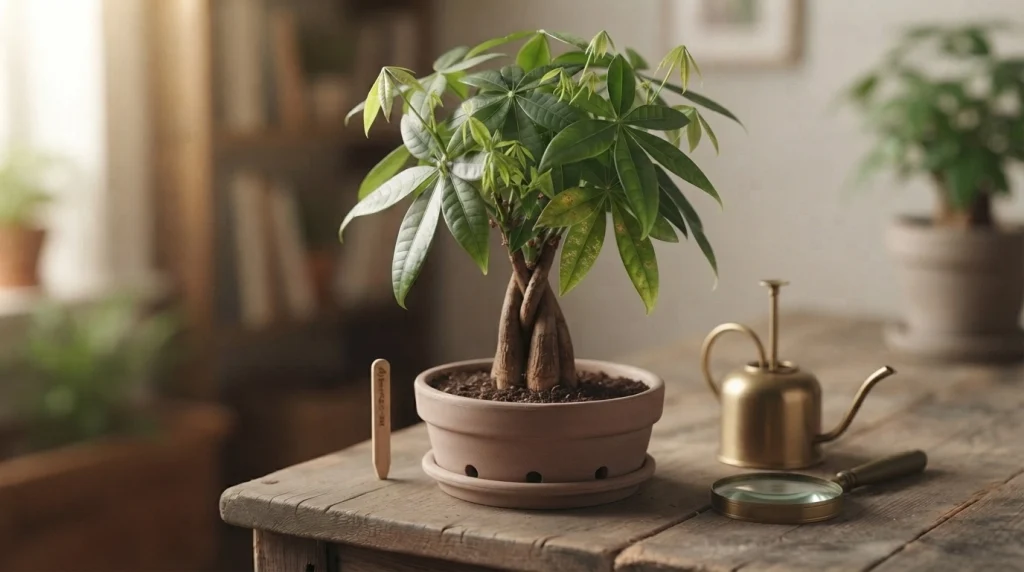
Recovery depends on how much damage occurred and whether the original cause has been corrected. A tree with a small pest infestation may recover relatively quickly, while severe root rot can require a longer period of careful monitoring.
The goal is to restore healthy growing conditions without creating additional stress through excessive pruning, repotting, spraying, or fertilizing.
What should you do during the first week?
After the initial treatment, concentrate on stabilizing the tree and checking whether the problem is continuing. Avoid making several major changes at once unless an urgent problem, such as severe root rot, requires intervention.
- Day 1: Isolate the bonsai, identify likely causes, and carry out the appropriate initial treatment.
- Days 2–3: Check for surviving pests, worsening lesions, persistent wilting, or continuing soil saturation.
- Days 4–7: Reinspect the foliage and stems, review watering, and repeat treatment only as directed by the label.
This is a monitoring framework, not a guaranteed recovery schedule. Severe infestations and root diseases may require longer treatment or professional diagnosis.
When should you repot or prune a sick bonsai?
Repotting is appropriate when the growing medium has failed, drainage is seriously compromised, or root damage requires intervention. It is not automatically necessary whenever a tree develops yellow leaves.
Likewise, removing every damaged leaf or cutting back healthy branches can reduce the tree’s ability to recover. Remove clearly diseased or dead material when necessary, but preserve healthy foliage whenever possible.
Pro tip: If the tree has extensive root damage or the trunk is becoming soft, seek advice from an experienced bonsai grower before combining repotting, root pruning, and canopy pruning.
When should you seek specialist help?
Ask a horticultural specialist, plant clinic, or experienced bonsai grower for help when the diagnosis remains uncertain or the tree continues to decline despite appropriate care.
Specialist advice is particularly useful when:
- Root rot affects much of the root system.
- Dark lesions spread rapidly across multiple branches.
- Repeated pest treatments fail to control the infestation.
- The trunk or main branches become soft or discolored.
- You need to distinguish a fungal disease from bacterial damage or chemical injury.
Photographs of the whole tree, close-ups of affected leaves, pictures of the soil surface, and a record of recent watering changes can help a specialist assess the problem.
Section Takeaway: Recovery requires patience and stable care. Monitor new growth and pest activity, and reserve major pruning or root work for situations where the benefits outweigh the added stress.
Frequently asked questions about money tree bonsai pests and diseases
What are the most common pests on money tree bonsai?
Common pests include mealybugs, scale insects, aphids, spider mites, and fungus gnats. Mealybugs produce white cottony clusters, scale resembles small attached bumps, and spider mites may cause fine webbing and pale stippling on leaves.
Why does my money tree bonsai have white spots on its leaves?
White marks may indicate powdery mildew, mealybug wax, dried mineral deposits, or spray residue. Inspect the leaves closely for insects and check whether the material spreads before choosing a treatment.
Can an overwatered money tree bonsai recover from root rot?
Recovery is possible if enough healthy roots remain and the underlying drainage problem is corrected. Remove clearly decayed roots when necessary, use suitable fresh growing medium, and water carefully while monitoring the tree’s response.
Is neem oil safe for money tree bonsai?
Neem-based products may help control certain labeled pests, but they are not suitable for every problem or every application condition. Follow the label, test a small area when permitted, and avoid spraying heat-stressed foliage or using homemade mixtures of uncertain strength.
How often should I check my money tree bonsai for pests?
Inspect a healthy tree at least weekly, checking leaf undersides, stem joints, and new growth. During an infestation, inspect more frequently and repeat treatments according to the product label and the pest’s life cycle.
Should I remove yellow leaves from my money tree bonsai?
Remove leaves that are dead, badly diseased, or harboring pests when removal is appropriate. A few yellow leaves do not automatically require pruning, so first identify whether the cause is watering stress, light, pests, or root damage.
Can I keep a diseased money tree bonsai near other houseplants?
It’s safer to isolate a tree with a suspected pest infestation until the problem is controlled. Some pests spread readily to nearby plants, and isolation makes inspection and treatment easier.
Final thoughts: Keep your money tree bonsai healthy
Successful money tree bonsai care starts with identifying the actual problem rather than reacting to every damaged leaf. Mealybugs, scale, spider mites, leaf diseases, and root rot leave different clues, and each requires an appropriate response.
Check the foliage and roots, maintain a well-drained growing medium, provide suitable light, and monitor the tree consistently. With early detection and careful treatment, many common problems can be controlled before they cause serious damage.
If symptoms continue to worsen, don’t keep adding treatments at random. Seek a reliable diagnosis, correct the underlying growing conditions, and give your bonsai time to recover.