Schefflera Bonsai Pests and Diseases: Identification, Treatment, and Prevention

Quick Answer
Schefflera bonsai most often develop pest problems involving spider mites, scale insects, and mealybugs, while excessive moisture and poor drainage can lead to root rot. Inspect leaf undersides, stems, and the soil before treating symptoms, because yellow leaves and leaf drop can also result from watering mistakes or sudden changes in light and temperature. For reliable identification, compare your findings with the Clemson University Schefflera care and pest guidance.
Common problems and their warning signs
- Spider mites: Tiny pale speckles, dull foliage, and fine webbing around leaves or growing tips.
- Scale insects: Fixed brown or tan bumps on stems and leaves, sometimes accompanied by sticky residue.
- Mealybugs: White, cotton-like clusters around leaf joints, branch forks, and sheltered stem areas.
- Root rot: Persistently wet soil, yellowing leaves, wilting despite moisture, and soft, dark roots.
- Leaf spot: Expanding brown or black lesions that may develop yellow margins or appear water-soaked.
- Environmental stress: Leaf drop, weak growth, or yellowing without visible pests, often following a change in watering, light, or temperature.
What to do first
- Isolate the affected bonsai, inspect it with a magnifier, and check both sides of the leaves.
- Wash away accessible pests, remove badly damaged foliage when appropriate, and use only treatments labeled for the plant and pest.
- Correct drainage, watering, light, and airflow before adding fertilizer or attempting major root work.
- Reinspect every few days and repeat treatment according to the product label, since surviving eggs or hidden insects can restart an infestation.
Schefflera bonsai are popular for their glossy, umbrella-shaped leaves, adaptable growth, and ability to develop attractive aerial roots. However, pests and diseases can weaken even a healthy-looking tree when growing conditions change.
In this guide, I’ll explain how to identify common Schefflera bonsai pests and diseases, distinguish infections from care problems, and choose a treatment that protects the tree’s long-term health.
In This Guide
- How to identify Schefflera bonsai pests and diseases
- Which pests attack Schefflera bonsai?
- What diseases affect Schefflera bonsai?
- How to treat an infested or diseased Schefflera bonsai
- How to distinguish pests, diseases, and care mistakes
- How to prevent future pest and disease problems
- Frequently asked questions
How do you identify Schefflera bonsai pests and diseases?
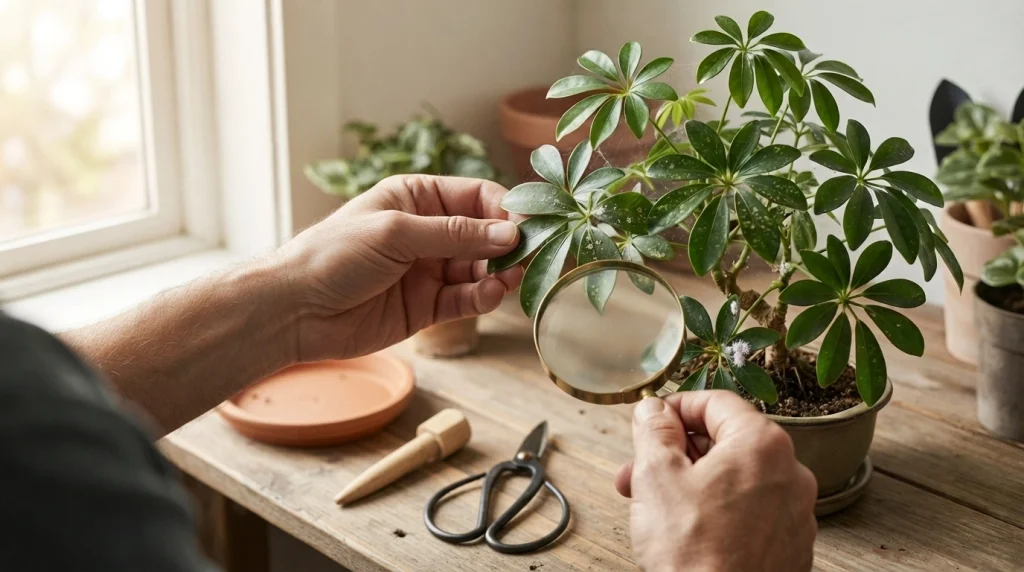
The fastest way to diagnose a Schefflera bonsai problem is to examine the damage alongside the growing conditions. Yellow leaves alone don’t prove that a pest or disease is present.
Inspect the entire tree before treating it
Start with the newest leaves, the undersides of mature leaves, and the junctions where leaf stalks meet the stems. These sheltered areas often hide pests before an infestation becomes obvious.
- Leaves: Look for stippling, silver patches, yellow halos, curling, or premature drop.
- Stems: Check for brown bumps, white cottony deposits, sticky residue, and localized dieback.
- Growing tips: Examine distorted young leaves, fine webbing, and unusually slow growth.
- Soil surface: Look for persistent moisture, mold-like growth, and small flying insects.
- Drainage holes: If accessible, check for foul odors or visibly dark, mushy roots without unnecessarily disturbing the root ball.
A handheld magnifier makes the inspection easier. Gently tap a suspect leaf over white paper and watch for tiny moving specks, but remember that movement alone doesn’t identify the species.
Understand what Schefflera bonsai needs
Schefflera bonsai are tropical or subtropical broadleaf trees, commonly grown from Schefflera arboricola or related umbrella-tree species. They generally prefer bright light, warmth, adequate airflow, and a growing medium that drains freely.
Indoor trees can become vulnerable when dry air, low light, or cramped growing conditions persist. Overwatering and compacted soil can also damage roots, leaving foliage weak and making recovery from pests more difficult.
In 2026, the most useful diagnostic approach remains straightforward: identify the physical evidence, review recent care changes, and treat the confirmed cause rather than every visible symptom.
Which pests attack Schefflera bonsai?
Spider mites, scale insects, and mealybugs are among the most important pests to check for on indoor Schefflera. Aphids, thrips, and fungus gnats can also occur, although their damage and treatment needs differ.
Spider mites: fine webbing and pale leaf speckles
Spider mites are tiny arachnids that feed on plant cells, causing small pale dots that gradually give foliage a faded, bronze, or dusty appearance. Fine webbing may develop between leaflets or around growing tips during heavier infestations.
Warm, dry indoor conditions can favor spider mite outbreaks. Schefflera trees near heaters, in dry rooms, or beside dusty windows deserve particularly close inspection.
To manage spider mites:
- Isolate the tree from other plants.
- Rinse the upper and lower leaf surfaces thoroughly with lukewarm water, protecting the soil from excessive saturation.
- Remove heavily damaged leaves if doing so won’t strip the tree of too much healthy foliage.
- Use a labeled insecticidal soap or horticultural oil if needed, following all directions and testing a small area first.
- Recheck the foliage frequently because a single wash may not eliminate every mite or egg.
Increasing humidity modestly may reduce favorable conditions for mites, but it isn’t a substitute for removing an established infestation. Avoid keeping the foliage continuously wet or placing the bonsai in stagnant, humid air.
Scale insects: stubborn brown bumps on stems
Scale insects often look like small, stationary brown, tan, or gray bumps attached to stems, leaf veins, and leaf undersides. Soft scales may produce honeydew, a sticky substance that attracts ants and encourages black sooty mold.
Because mature scales can resemble natural bark features, inspect suspicious bumps closely before scraping them away. Look for repeated clusters on young stems and along leaf stalks.
For a manageable infestation, remove accessible insects with a damp cotton swab or carefully lift them away with a suitable tool. A horticultural oil or another labeled treatment may help control remaining insects, especially vulnerable immature stages.
Repeat inspections are essential. Hidden insects and newly hatched crawlers can survive the first treatment, and mature scale coverings can make some individuals harder to reach.
Mealybugs: white, cotton-like clusters
Mealybugs appear as white, waxy masses in leaf axils, branch junctions, and other sheltered spaces. They suck sap, weaken growth, and may leave sticky honeydew behind.
For small outbreaks, remove visible insects with a damp cotton swab. Some growers use a small amount of rubbing alcohol for individual pests, but alcohol can injure foliage, so test one inconspicuous area first and avoid saturating the tree.
For larger infestations, use a product specifically labeled for mealybugs and the intended plant setting. Inspect nearby pots because these insects can spread between closely grouped houseplants.
Other pests worth recognizing
- Aphids: Small insects clustered on tender shoots, often accompanied by sticky leaves and distorted new growth.
- Thrips: Slender insects that can cause silvery scarring, distorted leaves, and tiny dark specks of waste.
- Fungus gnats: Small flies around moist soil; their larvae can become a concern when growing media remain excessively wet.
Don’t automatically spray for every insect you see. Fungus gnats, for example, often point toward a moisture-management problem, while spider mites require attention to the foliage itself.
Section takeaway: Identify the pest before selecting a treatment, and repeat inspections until new damage stops appearing. Washing, isolation, and correctly labeled products are more reliable than one aggressive treatment.
What diseases affect Schefflera bonsai?
Root rot is a major concern when a Schefflera bonsai stays wet for too long, while fungal or bacterial leaf spots may occur under favorable conditions. However, many cases of yellowing and leaf drop come from environmental stress rather than an infectious disease.
Root rot: when wet soil damages the roots
Root rot describes the deterioration of roots, often associated with oxygen-starved growing media and root-damaging pathogens. Persistently wet soil, poor drainage, and repeated watering before the substrate has begun drying can create the conditions for serious root problems.
Warning signs include:
- Yellowing leaves that continue to drop despite moist soil.
- Weak growth or wilting when the root system can no longer supply enough water.
- A sour or unpleasant smell from persistently wet growing media.
- Dark, soft roots that lose their firm texture when examined.
Start by checking the drainage holes and reviewing your watering routine. Water according to the moisture level of the actual root zone, not a rigid daily schedule.
If the tree is severely declining and root rot is strongly suspected, a root inspection may be necessary. Remove only clearly dead or rotted material with clean tools, and avoid combining emergency root pruning with heavy canopy pruning or wiring.
Pro tip: Major root removal can permanently weaken a small bonsai. If you’re unsure how much root tissue is healthy, consult an experienced grower or local bonsai club before cutting.
Leaf spot: brown or black lesions
Leaf spot produces localized areas of dead or discolored tissue, sometimes with yellow margins. Depending on the cause, spots may enlarge, merge, or develop a water-soaked appearance.
Fungal and bacterial problems can look similar, so photographs alone may not establish the exact pathogen. Repeated spotting across new leaves, especially alongside persistent leaf wetness or poor airflow, deserves closer investigation.
To reduce the risk of spread:
- Remove severely affected leaves with clean, disinfected scissors.
- Keep fallen leaves and other plant debris away from the pot.
- Water the substrate carefully rather than repeatedly soaking the foliage.
- Provide gentle airflow without exposing the tree to harsh drafts.
- Avoid reusing contaminated tools or growing media.
Don’t apply a fungicide simply because a leaf has a brown spot. Treatment depends on the cause, and many chemical products won’t correct bacterial disease or noninfectious leaf damage.
Sooty mold: black coating caused by insect honeydew
Sooty mold is a dark surface growth that commonly develops on honeydew left by sap-feeding insects such as soft scale, aphids, and mealybugs. The black coating can reduce the amount of light reaching the leaf surface.
Wipe a small affected area gently to see whether the coating comes away. Then inspect the stems and leaf undersides for the insects producing the sticky residue.
Cleaning the leaves may improve their appearance, but the mold can return if the insects remain. Control the underlying infestation first, then clean accessible foliage without damaging the leaves.
Leaf yellowing and drop without disease
Yellow leaves and sudden leaf drop are not diagnoses by themselves. Schefflera can react to insufficient light, excessive watering, prolonged dryness, cold drafts, and abrupt changes in its surroundings.
Review recent changes before reaching for pesticides or fungicides:
- Overwatering: The substrate stays wet, and leaves may yellow or fall.
- Underwatering: The root ball becomes excessively dry, and foliage may wilt or drop.
- Low light: Growth becomes weak or stretched, and lower foliage may yellow.
- Temperature stress: Chilling or hot drafts can damage leaves and trigger shedding.
- Recent relocation: A sudden change in light or humidity may cause temporary adjustment-related leaf drop.
Change one major care factor at a time when practical, and observe whether new growth improves. This makes it easier to distinguish an environmental problem from an active infestation.
Section takeaway: Treat root problems as a drainage and root-health issue, and investigate recurring leaf spots separately. Yellowing alone is not enough evidence to justify pesticide or fungicide use.
How do you treat an infested or diseased Schefflera bonsai?
The safest treatment plan starts with isolation, accurate identification, and removal of accessible pests. After that, correct the conditions that allowed the problem to develop and choose a targeted treatment if necessary.
Follow a practical treatment sequence
- Isolate the bonsai. Move it away from other plants while leaving it in suitable light and temperature conditions.
- Inspect carefully. Check leaf undersides, stem joints, branch forks, the trunk base, and the soil surface.
- Remove visible pests. Wash the foliage or remove individual insects where appropriate, taking care not to break delicate branches.
- Address damaged foliage. Remove leaves that are badly diseased or dying when their removal won’t leave the tree excessively bare.
- Correct the growing conditions. Adjust watering, improve airflow, and provide adequate light without exposing a stressed tree to sudden harsh sun.
- Apply a targeted product if needed. Follow the label for the pest, plant, application rate, protective equipment, and repeat-treatment interval.
- Monitor the recovery. Look for fresh pest activity and new damage rather than expecting old scarred leaves to become green again.
Choose the right treatment for the problem
Insecticidal soap and horticultural oil can control certain soft-bodied insects and mites when the label specifically permits their use. They work through direct contact, so thorough coverage and appropriate repeat applications matter.
Before treating the entire tree, test the product on a small section of foliage. Avoid spraying a drought-stressed tree, applying products in excessive heat, or mixing treatments unless the labels explicitly allow it.
Never assume that a household detergent is equivalent to a formulated insecticidal soap. Unlabeled mixtures can damage leaves, and some products are unsuitable for sensitive foliage or particular indoor environments.
Fungicides should be reserved for situations where the suspected disease and product label justify their use. They cannot restore rotted roots, reverse cold injury, or correct a potting medium that remains waterlogged.
When should you repot a sick Schefflera bonsai?
Repotting may be necessary when the growing medium has collapsed, drainage has failed, or root rot is advanced. However, repotting every pest-infested tree can add unnecessary stress when the roots and substrate remain healthy.
Before intervening, consider whether the tree can recover with improved watering and targeted pest control. If repotting is necessary, use a suitable bonsai substrate, a pot with clear drainage holes, and clean tools.
Pro tip: Avoid drastic root pruning on a tree already weakened by severe pests or disease. For advanced root damage, ask an experienced bonsai grower to help assess how much healthy root tissue can safely remain.
Section takeaway: Use the least disruptive treatment that addresses the confirmed cause. Isolation, careful cleaning, suitable growing conditions, and repeated monitoring form the foundation of recovery.
How can you distinguish pests, diseases, and care mistakes?
The best way to narrow down a Schefflera bonsai problem is to compare visible symptoms with the moisture level, recent care changes, and physical evidence. Several problems can occur together, so use the table as a starting point rather than a definitive diagnosis.
| Observed symptom | Likely cause | How to verify | First response |
|---|---|---|---|
| Fine webbing and pale speckles | Spider mites | Inspect leaf undersides with a magnifier. | Isolate and wash the foliage. |
| Brown bumps and sticky leaves | Soft scale insects | Examine stems and leaf veins for attached insects. | Remove accessible scales and consider a labeled treatment. |
| White cotton-like patches | Mealybugs | Check leaf joints and branch forks. | Remove visible insects and inspect nearby plants. |
| Yellow leaves and persistently wet soil | Overwatering or root damage | Check drainage, soil moisture, and root condition if necessary. | Correct watering and investigate damaged roots. |
| Expanding dark leaf spots | Possible fungal or bacterial leaf spot | Look for recurring lesions and assess foliage wetness. | Remove affected leaves and improve airflow. |
| Yellowing or leaf drop without visible pests | Light, watering, temperature, or acclimation stress | Review recent moves, drafts, and watering patterns. | Stabilize growing conditions before applying chemicals. |
| Small flies hovering above the soil | Fungus gnats | Observe insects near the substrate and inspect moisture levels. | Reduce persistent wetness without letting the roots dry excessively. |
Why a correct diagnosis matters
Spider mite damage and nutrient-related yellowing can look similar, while root rot and underwatering can both cause wilting. Treating the wrong problem wastes time and may add chemical or watering stress to an already weakened tree.
For a broader diagnostic reference, the University of California’s houseplant problem guide compares symptoms associated with insects, root problems, watering errors, and environmental stress.
If the tree continues to decline despite correcting its care and treating visible pests, seek advice from a qualified plant-health professional. A persistent or rapidly spreading problem may require closer examination to identify the actual pathogen.
Section takeaway: Physical evidence is more useful than symptoms alone. Check the foliage, roots, and growing conditions together before choosing a treatment.
How do you prevent future Schefflera bonsai pest and disease problems?
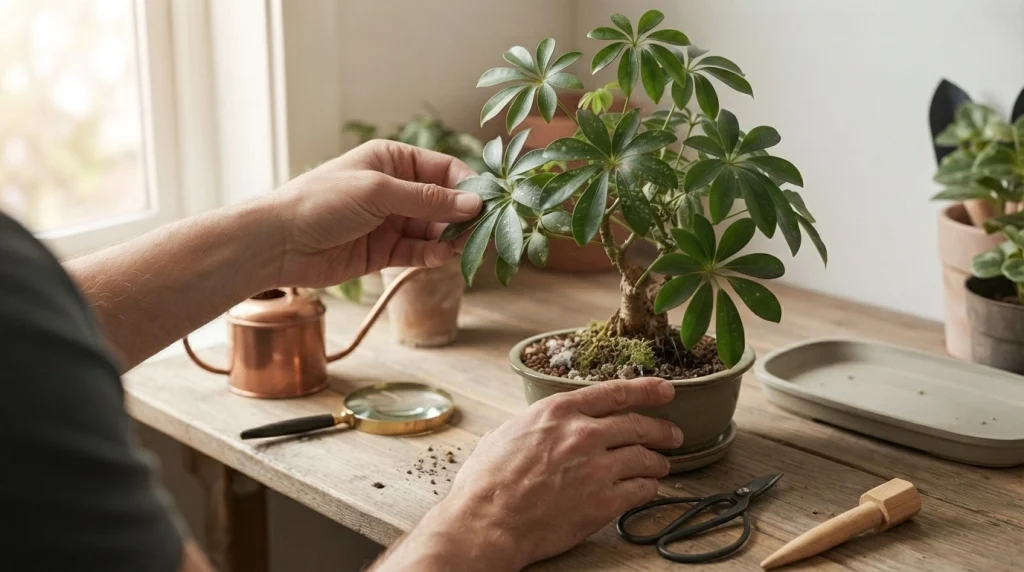
Prevention depends on consistent care, clean growing conditions, and early detection. A healthy Schefflera bonsai is better equipped to withstand a limited pest attack than a tree already struggling with poor drainage or insufficient light.
Water according to soil moisture
Water thoroughly when the substrate needs it, allowing excess water to drain freely through the pot. Don’t water automatically every morning or evening without checking the soil.
A shallow bonsai pot can dry quickly in warm weather, bright light, or moving air. Conversely, a tree in low light or cool conditions may use water slowly and remain wet longer than expected.
Check moisture within the root zone rather than relying only on a dry-looking surface. Avoid leaving the pot standing in water.
Provide suitable light, warmth, and airflow
Schefflera generally performs well in bright, indirect light indoors, although its exact light needs depend on the species, acclimation, and growing environment. Introduce stronger light gradually to prevent leaf scorch.
Keep the tree away from cold windows, air-conditioning outlets, and hot heating vents. Warm, stable conditions support growth, while sudden temperature changes can trigger leaf damage or shedding.
Good airflow helps foliage dry after watering and discourages prolonged dampness. However, strong drafts can stress the tree, so aim for gentle air movement rather than a direct fan blowing continuously onto the leaves.
Inspect the tree on a regular schedule
Make pest checks part of ordinary bonsai maintenance instead of waiting for leaves to turn yellow. Weekly inspections are especially useful for newly purchased trees, recently treated plants, and specimens moved between indoor and outdoor environments.
- Examine new growth and leaf undersides.
- Check stem joints for scale and mealybugs.
- Remove fallen leaves and dead plant material.
- Clean tools between trees, especially after working on diseased foliage.
- Keep newly acquired plants separate until you are confident they aren’t carrying pests.
For a tree recovering from an infestation, continue frequent inspections after the visible pests disappear. Reduce the frequency only when new growth remains healthy and repeated checks reveal no returning activity.
Use fertilizer carefully and avoid unnecessary stress
Fertilizer supports healthy growth when used appropriately, but excess fertilizer can damage roots and contribute to leaf discoloration. Follow the fertilizer label and adjust feeding to the tree’s growth, light, and seasonal conditions.
A severely infested or root-damaged bonsai doesn’t need aggressive feeding to recover. Restore suitable light, moisture, and root function first, then resume normal feeding as healthy growth returns.
Pruning and wiring also require judgment. Avoid heavy styling work while the tree is struggling with severe infestation, root rot, or widespread leaf loss.
Build a simple prevention routine
| When | What to check | Why it helps |
|---|---|---|
| At each watering | Substrate moisture and drainage | Reduces the risk of prolonged waterlogging and severe drying. |
| Weekly | Leaf undersides, stems, and growing tips | Finds small infestations before they spread. |
| After moving the tree | Light exposure, temperature, and moisture changes | Helps separate acclimation stress from pest damage. |
| After treatment | Live pests and new damage | Shows whether further label-directed treatment is needed. |
Section takeaway: Consistent watering, suitable light, sanitation, and routine inspection prevent many recurring problems. Small corrections made early are usually safer than drastic treatment after the tree has declined.
Frequently asked questions about Schefflera bonsai pests and diseases
Why is my Schefflera bonsai losing leaves?
Schefflera bonsai may lose leaves because of overwatering, underwatering, inadequate light, cold drafts, sudden environmental changes, or pest damage. Check the substrate and inspect leaf undersides and stems before treating the tree. If the soil remains wet and roots appear soft, investigate root damage.
How do I get rid of spider mites on a Schefflera bonsai?
Isolate the tree and rinse the foliage, especially the leaf undersides. If mites persist, use a labeled insecticidal soap or miticide suitable for Schefflera and the intended setting. Repeat inspections and treatments according to the label, since eggs or hidden mites may survive the initial application.
What are the white cottony spots on my Schefflera bonsai?
White cotton-like clusters around leaf joints and stems commonly indicate mealybugs. Isolate the bonsai, remove accessible insects, and inspect nearby plants. A labeled treatment may be necessary for larger infestations. Check the treated tree regularly because hidden insects can cause a new outbreak.
Can an overwatered Schefflera bonsai recover from root rot?
Recovery depends on how much healthy root tissue remains and whether the damaging conditions can be corrected. Improve drainage, stop keeping the substrate continuously saturated, and assess the roots if the tree continues to decline. Severe root damage may require careful intervention and expert guidance.
Should I cut off yellow leaves from my Schefflera bonsai?
Remove fully dead or badly damaged leaves when doing so won’t leave the tree excessively bare. Yellow leaves alone don’t identify the cause, so first check watering, light, temperature, and possible pests. Removing foliage won’t solve the underlying problem if the cause remains.
Can I use neem oil on Schefflera bonsai?
Some neem-based products are labeled for particular ornamental plant pests, but suitability depends on the formulation, pest, and growing conditions. Check the label, test a small area, and avoid applying oils during excessive heat or to stressed foliage. Never assume every neem product has the same approved uses.
How often should I inspect my Schefflera bonsai for pests?
Inspect the tree at least weekly when it is newly acquired, recovering from an infestation, or growing near other affected plants. Once it remains healthy and pest-free, routine monthly checks can supplement ordinary watering inspections. Increase monitoring whenever new symptoms appear or growing conditions change.
Keep your Schefflera bonsai healthy with early diagnosis
Most Schefflera bonsai pest and disease problems become easier to manage when you identify the cause before making major changes. Spider mites, scale insects, and mealybugs need targeted control, while root rot requires attention to drainage and root health.
Don’t treat every yellow leaf as an infection. Inspect the tree carefully, correct the growing conditions, and monitor new growth before deciding whether stronger intervention is necessary.
With consistent care and early attention, you can protect your Schefflera bonsai’s foliage, maintain healthy roots, and give it a better chance of recovering from future problems.
For additional species-specific background, the University of Florida IFAS Schefflera reference discusses pest concerns including scale insects, sooty mold, and spider mites.