How to Treat Scale on Bonsai Naturally
Quick Answer
To treat scale on bonsai naturally, isolate the tree, confirm the pest, physically remove visible scales, and monitor for young crawlers. If scale remains, use a label-approved horticultural oil or insecticidal soap with thorough coverage, following guidance such as the UC IPM scale management guide.
Natural Scale Treatment Steps
- Isolate the bonsai: Keep it away from healthy trees while you inspect and treat it.
- Confirm scale: Look for attached brown, tan, white, gray, or waxy bumps on stems and leaves.
- Remove visible insects: Gently dislodge accessible scales with a cotton swab, soft toothbrush, or similar soft tool.
- Watch for crawlers: Young scale insects are more vulnerable than protected adults and are often the best treatment target.
- Use low-impact sprays: Apply labeled horticultural oil or insecticidal soap when physical removal is not enough.
- Keep monitoring: Eggs and hidden scales can survive the first cleanup, so one treatment may not finish the infestation.
One Important Precaution
- Do not replace plant-labeled insecticidal soap with ordinary dish detergent. Household soaps can injure bonsai foliage.
Scale insects are frustrating because they rarely look like normal insects. On bonsai, a few harmless-looking bumps can quietly turn into sticky foliage, yellow leaves, weak growth, and branch dieback.
I treat scale as an identification and timing problem first. The small size of a bonsai gives us an advantage because every branch can be inspected closely before reaching for a stronger treatment.
In This Guide
What Does Scale Look Like on Bonsai?
Scale insects usually look like small stationary bumps attached to leaves, twigs, branches, or trunks. Depending on the species, they may appear brown, tan, white, gray, black, waxy, or shell-like.
Scale insects are sap-feeding insects whose older stages often develop waxy or shield-like protective coverings. Their mobile immature stage is commonly called the crawler stage.
That crawler stage matters. Once many scale insects settle and build protective coverings, contact treatments become less effective.
What are the signs of scale on a bonsai tree?
Do not diagnose scale from one bump alone. Look at the entire tree and combine visible insects with feeding symptoms.
- Attached bumps: Small raised structures remain fixed to stems, bark, leaf veins, or leaves.
- Sticky surfaces: Soft scales can produce sugary honeydew that coats leaves, pots, shelves, or benches.
- Sooty mold: Dark fungal growth can develop on honeydew-coated surfaces.
- Yellow leaves: Sustained sap feeding can weaken foliage and cause discoloration.
- Weak new growth: Shoots may become less vigorous as pest pressure increases.
- Branch decline: Heavy infestations can contribute to twig or branch dieback.
- Ant activity: Ants may repeatedly visit honeydew-producing scale colonies.
A 10× hand lens makes inspection easier. I like to check branch junctions, leaf undersides, trunk crevices, and the protected interior of the canopy first.
Soft scale vs. armored scale: what is the difference?
Knowing which general group you have helps you choose a treatment. Soft scale and armored scale do not behave exactly the same way.
| Feature | Soft Scale | Armored Scale |
|---|---|---|
| Protective covering | Waxy covering is part of the insect | Harder protective cover sits over the insect |
| Honeydew | Common with many species | Usually absent |
| Sticky leaves | Useful diagnostic clue | Less useful as a clue |
| Contact treatment | Most useful against exposed crawlers | Crawler timing and thorough oil coverage are especially important |
The Bonsai Empire pest and disease overview also shows scale alongside several other common bonsai pests. Comparing symptoms can prevent you from treating mites, aphids, or mealybugs as scale.
Section Takeaway: Confirm attached scale insects before treating. Honeydew points more strongly toward soft scale, while armored scale may cause damage without sticky residue.
How Do You Treat Scale on Bonsai Naturally?
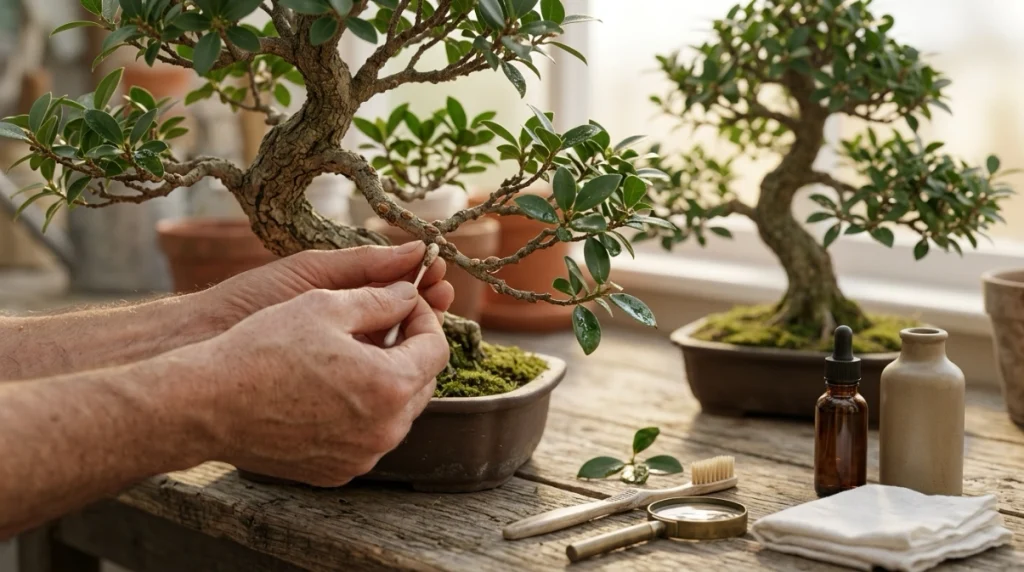
The best natural approach combines isolation, mechanical removal, careful monitoring, and low-impact sprays when needed. Do not rely on one spray to solve the entire infestation.
1. Isolate the affected bonsai
Move the infested tree away from the rest of your collection. Give it suitable light and airflow rather than placing it in a dark corner just because it is quarantined.
Check neighboring plants too. Crawlers are tiny enough to go unnoticed during an early outbreak.
2. Remove visible scale by hand
Bonsai are unusually well suited to mechanical pest removal. Their compact canopies make individual branches accessible.
- Use a soft-bristled toothbrush on sturdy bark.
- Use a cotton swab around delicate branches.
- Use a wooden toothpick carefully in bark crevices.
- Support thin twigs with your other hand while cleaning them.
- Inspect both sides of every affected leaf.
Remove pests gently rather than scraping bark aggressively. Damaging a fine branch to remove one insect creates a new problem.
If heavily infested leaves can be removed without weakening the design or tree, selective leaf removal may reduce the population. Avoid major defoliation on a stressed bonsai.
Pro tip: Any pruning that removes live branches is permanent. If an infestation would require substantial branch removal, ask an experienced grower or local bonsai club before cutting important structure.
3. Clean away honeydew and debris
Soft-scale infestations can leave sticky honeydew behind. Cleaning the residue makes future monitoring much easier.
Sooty mold may also grow on honeydew. Removing the pest source is more important than treating the superficial mold alone.
4. Check for crawlers
Young crawlers lack the heavy protection of mature scale. That makes them a key target for natural contact treatments.
The University of Minnesota Extension scale guide recommends monitoring crawler activity with methods such as double-sided tape on infested branches. It also suggests checking regularly until crawlers appear.
5. Use horticultural oil if scale remains
Horticultural oil works mainly by contacting and smothering susceptible pest stages. Coverage matters because it is not a magic residue that hunts hidden insects later.
Apply only a product labeled for the plant and intended use. Follow its temperature, concentration, timing, and repeat-treatment directions.
The University of Maryland notes a 1% horticultural-oil dilution for growing-season scale management in its guidance. Product labels still take priority because formulations and plant sensitivities differ.
6. Consider insecticidal soap for exposed stages
Insecticidal soap is another lower-impact contact option. It works best when the spray reaches vulnerable insects directly.
Do not substitute household dishwashing detergent. Household formulas can contain ingredients or concentrations that damage foliage.
Section Takeaway: Natural scale control works best as a sequence. Remove what you can see, target vulnerable crawlers, and keep checking instead of expecting one application to finish every life stage.
Which Natural Scale Treatment Works Best?
For a lightly infested bonsai, physical removal is my preferred starting point. Horticultural oil becomes more useful when scale is widespread or crawlers are active.
| Method | Best Use | Main Limitation | Bonsai Consideration |
|---|---|---|---|
| Manual removal | Light or localized infestations | Hidden insects and eggs can remain | Excellent control on small, accessible canopies |
| Horticultural oil | Crawlers and susceptible overwintering stages | Requires thorough contact and correct timing | Some species or foliage types are oil-sensitive |
| Insecticidal soap | Exposed soft-bodied stages | Little useful activity after the spray dries | Test sensitive foliage and follow the label |
| Neem or botanical oil | Label-approved contact management | Coverage, formulation, and pest stage affect results | Never assume “natural” means foliage-safe |
| Natural enemies | Outdoor or protected growing environments | Hard to control as a stand-alone treatment | Avoid unnecessary broad-spectrum sprays that kill predators |
Is horticultural oil natural?
Horticultural oils are refined oils used as contact pest treatments. They are commonly included in lower-impact integrated pest management programs, although “natural” is not the same as risk-free.
Some evergreens can be sensitive. The University of Maryland Extension scale guidance specifically warns that oil can remove the blue waxy appearance from some junipers, spruces, and cypresses.
That warning matters for bonsai. A prized blue-foliaged juniper can lose part of its visual character even if the treatment controls pests.
Does insecticidal soap kill scale?
It can help against exposed, vulnerable scale stages, especially crawlers. Mature protected scale insects are harder to reach effectively.
The University of Florida IFAS natural pest-management guide explains that insecticidal soaps work through direct contact. It also notes that ordinary household soaps can pose a greater risk of plant injury.
What about neem oil?
Neem-based products may be useful when their labels include the target pest and plant use. As with horticultural oils, thorough coverage and correct application conditions matter.
Do not make a concentrated homemade mixture because neem is plant-derived. Bonsai leaves can be damaged by excessive concentrations, heat, strong sunlight, or an unsuitable formulation.
Section Takeaway: Start with the least disruptive method that matches the infestation. Manual removal is excellent for small colonies, while labeled oils or soaps can help when scale is too widespread to clean individually.
When Should You Treat Scale Crawlers?
The crawler stage is often the easiest scale stage to control with contact treatments. Crawlers have not yet developed the stronger protective covering found on older scale insects.
Calendar dates alone are unreliable. Climate, host plant, scale species, and seasonal temperatures all affect when eggs hatch.
How can you tell when crawlers are active?
- Use double-sided tape: Wrap or place it near an infested branch and inspect it for tiny moving crawlers.
- Use a white surface: Check dislodged material against white paper where tiny insects are easier to see.
- Use magnification: A 10× hand lens makes identification much easier.
- Check weekly: Continue monitoring while you expect hatch activity.
Do not confuse dead adult shells with living insects. Scale coverings can remain attached after the insect underneath has died.
One useful check is to gently lift or crush a questionable scale. A dry, hollow covering suggests an old shell, while fresh moist material underneath suggests living tissue.
Is dormant oil useful for bonsai scale?
Dormant-season horticultural oil can suppress some overwintering scale stages. Whether it fits your bonsai depends on species, dormancy status, climate, foliage type, and the product label.
A tropical ficus growing indoors should not automatically receive the same seasonal treatment as a dormant deciduous outdoor bonsai. Match the treatment to the tree rather than copying a landscape-tree calendar.
Why Does Scale Keep Coming Back on Bonsai?
Scale often returns because the visible adults were removed while eggs, crawlers, or hidden insects remained. Reinfestation can also come from nearby plants.
You treated only the visible insects
Removing adult scales lowers the population immediately. It does not guarantee that every egg or crawler disappeared.
This is why follow-up inspection matters more than repeatedly spraying on autopilot. Look first, then treat what is still present.
Ants are protecting honeydew-producing scale
Ant activity deserves attention when soft scale produces honeydew. Ants feed on sugary honeydew and can interfere with predators or parasites that otherwise attack sap-feeding pests.
UC IPM emphasizes conserving natural enemies and managing pest-tending ants when appropriate. That biological side of scale management is easy to overlook.
Nearby plants remain infested
A clean bonsai beside an infested houseplant is still at risk. Inspect plants sharing the same shelf, greenhouse, patio, or overwintering area.
- Check newly purchased plants before adding them to the collection.
- Inspect plants that recently spent time outdoors.
- Clean benches, trays, and work surfaces.
- Clean tools before moving to healthy trees.
- Keep infested plant material away from the growing area.
The bonsai is already stressed
Pest control does not replace proper bonsai care. A tree struggling with poor light, damaged roots, incorrect watering, or severe heat stress has less room for another problem.
Keep watering appropriate for the species and substrate. Do not compensate for scale damage by suddenly overfertilizing weak growth.
Section Takeaway: Recurring scale usually means part of the pest cycle survived or another source remains nearby. Follow-up inspection and collection-wide sanitation are as important as the first treatment.
How Do You Protect a Bonsai After Treatment?
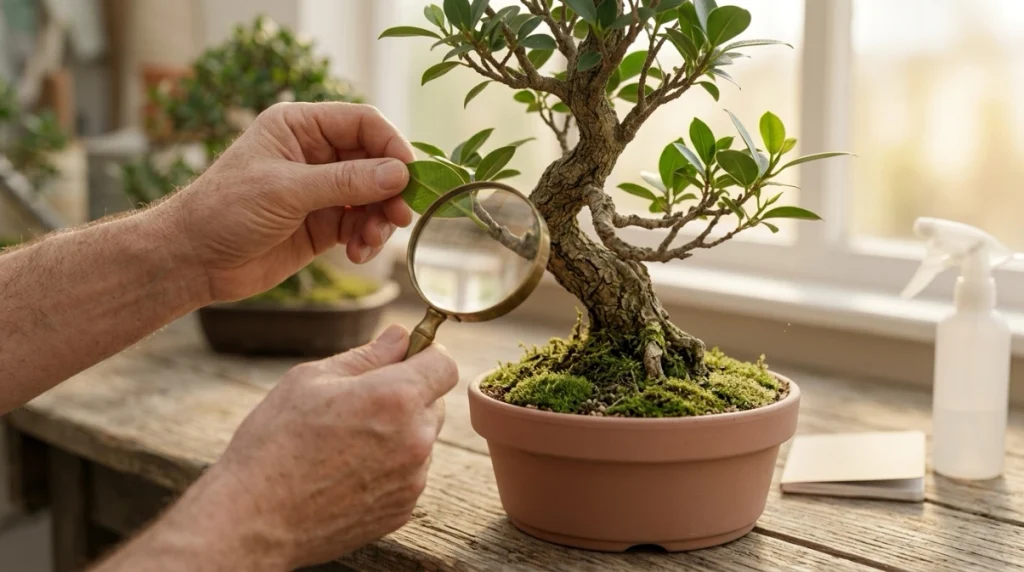
Keep the tree isolated until repeated inspections stop finding living scale or active crawlers. Returning it to the collection after one clean-looking day is too early.
Build a simple inspection routine
Check the areas where scale hides before looking at the tree from a distance. Small colonies are easiest to solve before yellowing or branch decline becomes obvious.
- Inspect branch junctions.
- Check the underside of leaves.
- Look along major leaf veins.
- Examine rough bark and trunk crevices.
- Check tender new shoots.
- Watch for fresh honeydew or ant traffic.
During periods when you are waiting for crawlers, weekly monitoring is a useful baseline. Increase attention when you find fresh activity.
Avoid unnecessary repeat spraying
More treatment is not automatically better. Repeated oil or soap applications outside label directions can stress foliage while giving little extra control.
Treat based on pest activity and product instructions. That is especially important on small-leaved bonsai with limited foliage.
Protect beneficial insects outdoors
Predators and parasitoids can help suppress scale populations. Broad-spectrum pesticide use can disrupt these natural enemies and sometimes make pest problems harder to manage.
As of 2026, integrated pest management remains the most sensible framework for bonsai scale: identify the pest, monitor it, use physical and cultural controls first, then choose the lowest-impact effective treatment.
Natural treatment does not mean ignoring a serious infestation. It means using careful observation and targeted intervention instead of treating the whole tree blindly.
Frequently Asked Questions
Can I remove scale from bonsai by hand?
Yes. Manual removal works especially well on bonsai because their branches are accessible. Use a cotton swab, soft toothbrush, or similar gentle tool, then monitor the tree for surviving scales and newly hatched crawlers because physical removal may not eliminate hidden eggs.
Will neem oil kill scale on a bonsai?
A label-approved neem product may help control susceptible scale stages when it contacts them properly. Results depend on the scale type, life stage, coverage, and formulation, so follow the product label and test sensitive foliage instead of assuming every bonsai tolerates neem.
Does insecticidal soap work on scale insects?
Insecticidal soap can help against exposed crawlers and other vulnerable stages because it works through direct contact. Mature scale protected beneath waxy or armored coverings can be harder to control, making crawler monitoring and repeat inspection important.
Can I use dish soap for scale on bonsai?
I do not recommend ordinary dish detergent as a substitute for plant-labeled insecticidal soap. Household detergents vary in ingredients and concentration and can damage foliage, especially on stressed or sensitive bonsai.
Why are my bonsai leaves sticky after treating scale?
Sticky residue may be old honeydew left by soft scale, or it may indicate that living insects remain. Clean the leaves gently, inspect stems and foliage closely, and watch whether fresh stickiness returns after cleaning.
How long does it take to get rid of scale on bonsai?
There is no reliable single treatment period for every infestation. Scale species, egg hatch, crawler timing, infestation size, temperature, and treatment method all affect control, so continued monitoring is more useful than expecting the pests to disappear on a fixed number of days.
Should I throw away a bonsai with scale?
Usually not. Light and moderate infestations can often be managed with isolation, careful cleaning, monitoring, and appropriate treatments, although a severely declining low-value plant may require a different decision if it threatens a larger collection.
The key is to catch scale early. Inspect your bonsai closely, remove visible insects first, monitor for crawlers, and use labeled lower-impact treatments only when they are needed.
If scale keeps returning, stop repeating the same spray and reassess the pest, neighboring plants, ants, hidden colonies, and treatment timing. That careful approach protects both the tree and the wider bonsai collection.