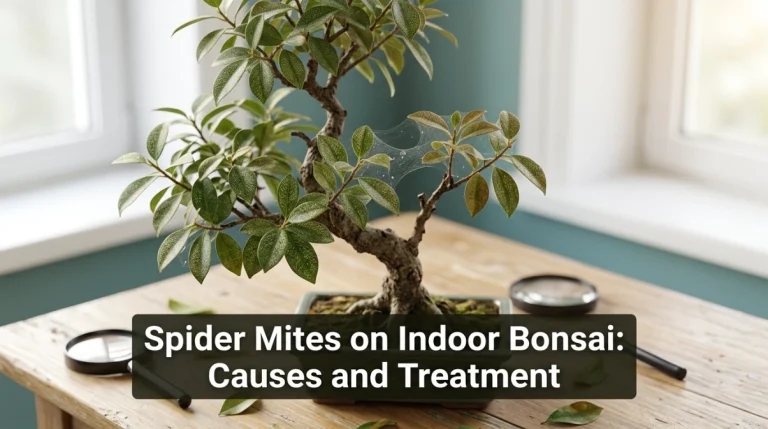
How to Identify Scale on Bonsai: Signs, Types, and Look-Alikes
Quick Answer
To identify scale on bonsai, look for small brown, tan, gray, white, or cream bumps that remain attached to leaves, twigs, bark, or needles. Soft scale often produces sticky honeydew, while armored scale usually does not. Compare suspicious bumps with the identification guidance from UC Integrated Pest Management before treating the tree.
Signs That Point to Scale
- Fixed bumps: Mature scale insects often remain attached in one position instead of walking around the tree.
- Shell-like appearance: Armored types may resemble tiny flat shields, flakes, or crusty spots.
- Sticky residue: Soft scale can produce sugary honeydew on leaves, branches, pots, and benches.
- Sooty mold: Dark fungal growth may develop on honeydew beneath a soft-scale infestation.
- Plant decline: Larger infestations may accompany yellowing, weak growth, leaf drop, or twig dieback.
- Tiny crawlers: Newly hatched scale insects are mobile and may appear as minute yellowish or orange specks.
Best Confirmation Tip
- Use a 10× hand lens and inspect several bumps. Check their shape, location, movement, honeydew, and whether the suspected pest is clearly sitting on the plant rather than being part of the bark.
Learning how to identify scale on bonsai can be frustrating because scale insects rarely look like normal insects. They often resemble bark, scars, buds, mineral deposits, or tiny shells.
I treat scale identification as a process rather than relying on one clue. In 2026, that remains the safest approach because different scale species can look surprisingly different.
In This Guide
How Do You Identify Scale on a Bonsai?
Scale insects are small sap-feeding insects that spend much of their lives attached to plant tissue. Mature females often lack the obvious legs, wings, and body shape growers expect from an insect.
That strange appearance is the first important clue. A scale infestation can look more like scattered bumps than a colony of bugs.
Definition: A scale insect is a sap-feeding insect that develops a waxy, leathery, or shield-like protective covering while feeding on plant tissue.
Look for bumps that seem separate from the tree
Start with the actual suspicious objects. Scale may appear circular, oval, elongated, dome-shaped, oyster-shell-shaped, or almost flat.
- Brown or tan bumps: Common with several soft and armored scales.
- Gray or cream spots: Easy to mistake for aged bark or dried residue.
- White scales: Especially noticeable against dark bark or green needles.
- Rounded domes: Often associated with soft-scale types.
- Flat shields: More typical of armored scales.
Color alone cannot confirm scale. Bark texture, fungal growth, buds, lenticels, and old pruning scars can create similar marks.
Check whether the bumps move
Most settled scale insects appear motionless. That helps separate them from aphids, mites, thrips, and other pests that may move when disturbed.
There is one major exception. Newly hatched scale insects are called crawlers, and they can move across leaves and stems before settling.
The crawlers are tiny. A hand lens often reveals them more reliably than the naked eye.
Use magnification instead of guessing
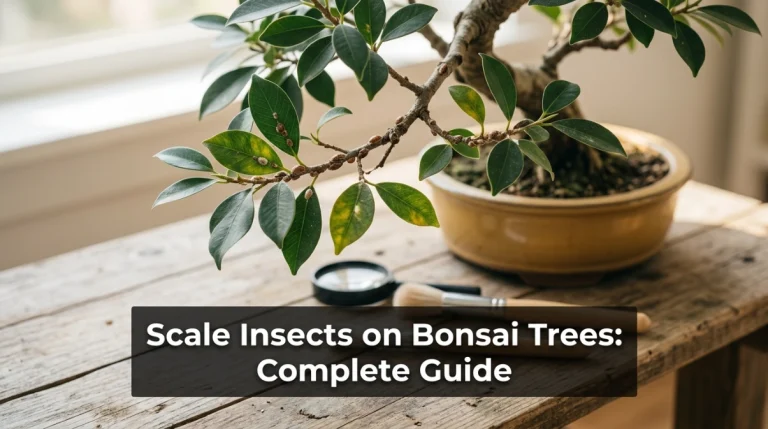
I like a simple 10× hand lens for bonsai pest checks. It is strong enough to reveal details while remaining easy to use around fine branches.
- Inspect several suspicious bumps.
- Check both sides of affected leaves.
- Follow branches toward their junctions.
- Look around buds and petioles.
- Check nearby clean-looking growth for crawlers.
The general Bonsai Empire pest and disease guide also includes scale among insects commonly encountered on bonsai.
Section Takeaway: Scale usually looks like an attached bump rather than a recognizable insect. Shape, location, movement, and surrounding symptoms provide a stronger diagnosis than color alone.
Where Should You Look for Scale on a Bonsai?
Check stems, branch junctions, leaf undersides, veins, petioles, needles, and bark crevices. Scale often settles in protected areas that receive little disturbance.
Do not inspect only the most damaged leaves. The heaviest colony may be several inches away on a woody branch.
Start with young stems and branch junctions
Fine branches deserve close attention because small scale insects can disappear against bark texture. Look where one shoot joins another.
- Young twigs
- Branch forks
- Bud bases
- Bark cracks
- Pruning junctions
- Areas beneath dense foliage
On a small-leaved elm or ficus, I would inspect every fine branch before deciding the problem is limited to one leaf.
Inspect the undersides of leaves
Some scales settle along veins or other protected leaf surfaces. Turn each suspicious leaf over instead of examining the canopy only from above.
Sticky leaves deserve extra attention. Honeydew can drip from feeding insects located higher in the canopy.
Check conifer needles carefully
Scale on juniper, pine, or other conifers may look different from scale on broadleaf bonsai. Pale scales can stand out against green needles, while darker species may blend into stems.
Do not assume every pale spot is a pest. Wax, dried spray residue, and normal foliage markings can also create white patches.
Inspect the pot and bench too
The plant itself is not your only source of clues. Sticky residue may collect on the pot rim, humidity tray, shelf, windowsill, or bench beneath an infested bonsai.
- Clear stickiness: May be honeydew.
- Black coating: May be sooty mold growing on honeydew.
- Repeated ants: Can indicate a honeydew-producing pest nearby.
- Tiny moving specks: Could be scale crawlers or another pest requiring closer identification.
Follow those clues upward. The pest may be hidden directly above the contaminated surface.
Is It Soft Scale or Armored Scale?
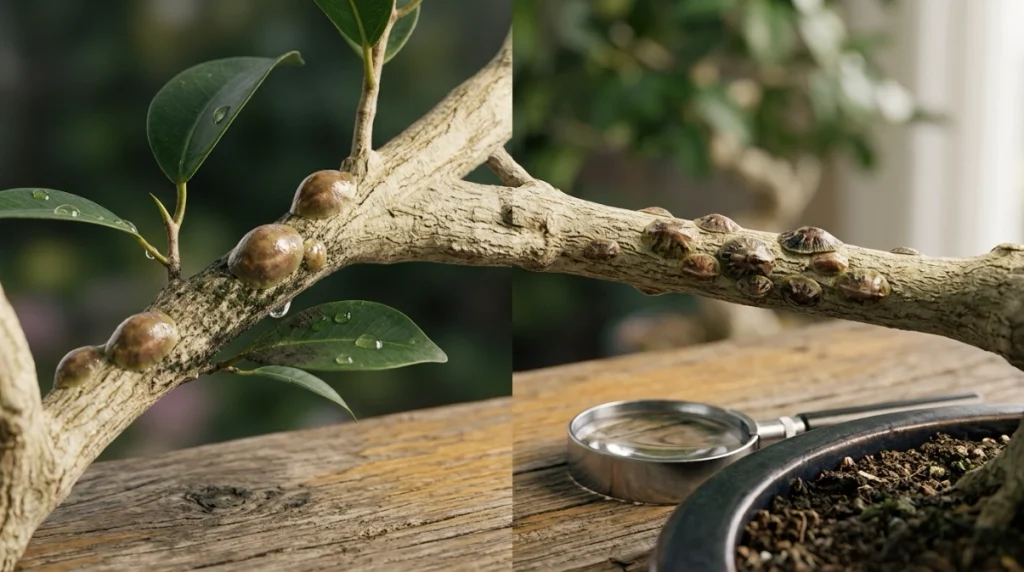
The simplest distinction is this: soft scale often produces honeydew and has a rounded body, while armored scale generally does not produce honeydew and usually has a flatter protective cover.
This distinction matters because the two groups differ in appearance, biology, and management.
| Feature | Soft Scale | Armored Scale |
|---|---|---|
| Typical adult size | Often about 1/8–1/4 inch | Often about 1/16–1/8 inch |
| Profile | Usually rounded or convex | Usually flatter and shield-like |
| Honeydew | Common | Generally absent |
| Sooty mold | May develop on honeydew | Not normally caused directly by the scale |
| Protective covering | Body and covering are closely integrated | Plate-like cover may be separable from the insect beneath |
| Young stage | Mobile crawler | Mobile crawler |
The University of Minnesota Extension scale guide describes these differences and emphasizes that correct identification matters for management.
Does sticky honeydew prove you have soft scale?
No. Honeydew makes soft scale more likely, but aphids, mealybugs, and whiteflies also produce it.
You still need to locate and inspect the pest itself.
Does no honeydew mean armored scale?
Not automatically. A small soft-scale population may produce little visible residue, and environmental conditions can make honeydew harder to notice.
The pest’s physical appearance should remain part of the diagnosis.
Section Takeaway: Honeydew is one of the best clues separating soft from armored scale, but it is not a complete identification test.
How Can You Tell Scale From Other Bonsai Pests?
Scale is commonly confused with aphids, mealybugs, spider mites, whiteflies, buds, and bark features. Confirm the actual pest before choosing a treatment.
Scale vs. aphids
Aphids usually have visible soft bodies and often gather on tender growth. They move slowly but are still much more insect-like than settled scale.
- Aphids: Pear-shaped bodies, visible legs, colonies around soft growth.
- Scale: Fixed bumps, shells, shields, or domes attached to plant tissue.
Both soft scale and aphids can cause honeydew. Sticky leaves alone cannot separate them.
Scale vs. mealybugs
Mealybugs usually look white, fluffy, cottony, or covered with loose wax. Scale tends to form a more defined attached bump or shell.
Some scale species also produce wax. Examine the insect beneath or around the wax when identification remains uncertain.
Scale vs. spider mites
Spider mites are far smaller than most mature scale insects. Their classic clues are fine stippling, bronzing, and delicate webbing.
- Scale: Distinct attached bumps.
- Spider mites: Tiny moving dots plus stippled foliage.
- Scale honeydew: Possible with soft scale.
- Spider mite honeydew: Not expected.
Scale vs. normal bark
This is one of the easiest mistakes to make. Corky bark, lenticels, healed scars, buds, and old branch marks may look like scale under poor lighting.
Compare suspicious spots across the whole tree. Natural bark features usually follow a consistent pattern, while an infestation often appears irregularly clustered.
Try a careful close inspection
Do not aggressively scrape bonsai bark. Instead, choose one clearly suspicious object and gently examine its edge with a fingernail, wooden toothpick, or cotton swab.
An armored scale cover may sometimes lift and reveal the insect underneath. Never dig into living bark just to prove a diagnosis.
Pro tip: If checking a suspicious bump risks damaging thin bark, fine twigs, or important buds, photograph it under magnification and ask an experienced grower or local bonsai club before removing tissue.
What Does Scale Damage Look Like on Bonsai?
Scale feeding can contribute to yellowing foliage, weak growth, premature leaf drop, twig decline, or general loss of vigor when populations become heavy. Symptoms vary with the scale species, host tree, and infestation level.
A few scales do not automatically mean a bonsai is dying. The condition of the whole tree matters.
Yellow leaves and weak shoots
Persistent feeding can reduce vigor. New shoots may extend poorly, and affected foliage can become pale or yellow.
That symptom is not unique to scale. Watering problems, root stress, nutrient issues, heat, and other pests can also cause yellow foliage.
Sticky leaves and sooty mold
Soft scales feed on phloem sap and may excrete sugary honeydew. The residue often feels shiny or sticky.
Dark sooty mold can then grow on the honeydew. The mold is a secondary clue pointing you toward the underlying sap-feeding pest.
Branch decline
Heavy scale populations can weaken twigs and branches. Armored scales can be especially easy to overlook because they may blend with bark without creating obvious honeydew.
Guidance from Colorado State University Extension also notes that armored scale can cause spotting and dieback when populations become abundant.
Why bonsai needs close monitoring
Bonsai growers care about individual shoots more than most landscape gardeners do. One damaged branch may represent several seasons of careful ramification development.
That is why I inspect early instead of waiting for obvious decline. Early identification gives you more choices and reduces unnecessary treatment.
What Should You Do After Finding Scale?

If you confirm scale, isolate the bonsai from nearby plants and inspect the entire tree. Do not treat only the first branch where you found insects.
The crawler stage can spread to new feeding sites, so nearby plants deserve inspection too.
Follow these steps first
- Separate the tree: Move the bonsai away from other susceptible plants when practical.
- Inspect completely: Check foliage, bark, fine twigs, branch junctions, and protected crevices.
- Identify the type: Decide whether the evidence points toward soft or armored scale.
- Check neighboring plants: Look for bumps, honeydew, crawlers, or similar decline.
- Record what you see: Take close photos so you can compare the population over time.
- Choose treatment carefully: Use only products labeled for the pest and the plant situation.
Do you need to spray immediately?
Not always. A small infestation on an accessible bonsai may allow careful physical removal and close monitoring before stronger measures are considered.
Large or persistent infestations may require a labeled horticultural oil, insecticidal soap, or another appropriate treatment. Timing matters because crawlers are less protected than settled adults.
Always follow the product label. Bonsai species, tender growth, temperature, sunlight, and application concentration can affect plant response.
Recheck instead of assuming the problem is solved
Scale can hide beneath leaves, around branch unions, and under protective coverings. Eggs or crawlers may also escape the first inspection.
- Inspect the tree again after treatment or removal.
- Look for new crawlers.
- Watch for fresh honeydew.
- Check whether new bumps appear.
- Keep nearby plants under observation.
Good identification is the foundation of control. Treating the wrong pest wastes time and can add unnecessary stress to a bonsai.
FAQs About Identifying Scale on Bonsai
What does scale look like on a bonsai tree?
Scale usually looks like small brown, tan, gray, white, cream, or yellowish bumps attached to leaves, bark, twigs, or needles. Depending on the species, the insects may appear flat and shield-like or rounded and dome-shaped.
How do I know if a brown bump is scale or bark?
Inspect several bumps with a hand lens and compare their shape and distribution. Natural bark features tend to follow consistent patterns. Scale insects often appear as separate objects clustered irregularly on stems, leaves, veins, or protected branch junctions.
Does scale move on a bonsai?
Mature scale usually appears stationary, but newly hatched nymphs called crawlers are mobile. They are often tiny yellowish or orange specks that move before choosing a feeding site and developing a protective covering.
Does scale make bonsai leaves sticky?
Soft scale commonly produces sticky honeydew, which may coat leaves, branches, pots, or surfaces beneath the tree. Armored scale generally does not produce honeydew. Aphids, mealybugs, and whiteflies can also cause stickiness, so inspect the insect itself.
Can scale look white on a bonsai?
Yes. Some scale insects or their protective coverings can look white, pale gray, cream, or waxy. On conifers, pale scales can be especially noticeable against green needles. White residue alone is not enough to confirm an infestation.
What magnification is useful for identifying scale?
A 10× hand lens is practical for routine bonsai inspection. It can help reveal crawlers, edges of protective covers, body shapes, and other details that are difficult to see with the naked eye.
Should I isolate a bonsai if I suspect scale?
Yes, temporary separation is sensible when scale is strongly suspected or confirmed, especially in a crowded collection. Crawlers can spread to new feeding sites, and isolating the tree makes inspection and monitoring easier while protecting nearby plants.
What’s the Main Takeaway?
The best way to identify scale on bonsai is to combine several clues. Look for fixed bumps, inspect protected plant surfaces, check for honeydew, and use magnification to compare the suspected insects with common look-alikes.
Do not spray simply because you found a strange brown spot. Confirm what you are seeing first, then choose a response that fits the pest and the condition of your tree.
Make pest inspection part of your normal bonsai routine. A few minutes with a hand lens can catch scale long before weakened branches or widespread foliage decline becomes obvious.