How to Tell Spider Mites From Other Bonsai Pests
Quick Answer
Spider mites usually leave fine pale stippling, bronzed foliage, and delicate silk webbing, while aphids, scale, mealybugs, thrips, and whiteflies leave different clues. Confirm mites by checking leaf undersides with a 10× hand lens and tapping suspicious foliage over white paper, a method also recommended in the UC IPM spider mite guide.
Fast identification clues
- Spider mites: Fine stippling, tiny moving specks, bronzing, and thin webbing around leaves or twigs.
- Aphids: Pear-shaped insects clustered on tender growth, often with sticky honeydew and curled leaves.
- Scale insects: Firm or waxy bumps attached to stems and leaves rather than crawling specks.
- Mealybugs: White, cotton-like wax around branch forks, leaf joints, and other protected areas.
- Thrips: Slender insects associated with silvery streaks, scars, distortion, and tiny dark fecal spots.
- Whiteflies: Small white adults that often flutter upward when an infested bonsai is disturbed.
Best confirmation tip
- Don’t diagnose spider mites from yellow leaves alone. Confirm living mites, eggs, stippling, or mite-style webbing before treating.
Spider mites are easy to confuse with other bonsai pests because the first symptom may be nothing more than faded or yellow-speckled foliage. The difference becomes much clearer once you know where each pest feeds and what evidence it leaves behind.
When I inspect a suspicious bonsai, I don’t start with a pesticide. I start with the leaf undersides, a hand lens, and a plain sheet of white paper.
In This Guide
What Do Spider Mites Look Like on a Bonsai?
Spider mites look like tiny moving dots rather than obvious insects. Adults of common webspinning species are less than about 1/20 inch long, so a 10× hand lens makes identification much easier.
Definition: Spider mites are plant-feeding arachnids related to spiders and ticks. They pierce individual plant cells, producing pale stippling, bronzing, leaf decline, and sometimes fine silk webbing.
The first clue is often damage rather than the mite itself. Look for many tiny pale dots scattered across a leaf instead of one large yellow or brown patch.
- Fine stippling: Numerous white, cream, or yellow pinpoints develop where mites have fed.
- Bronzing: Heavy feeding can make green foliage appear dull, gray-green, yellow, reddish, or bronze.
- Fine webbing: Silk may stretch between leaves, needles, petioles, and fine twigs as populations increase.
- Leaf decline: Badly damaged foliage may dry, yellow, curl, or fall prematurely.
- Moving specks: Magnification may reveal mites walking beneath leaves.
Spider mites commonly spend time on protected leaf undersides. On conifers, inspect between needles and around dense interior shoots as well.
Hot, dry conditions often favor common spider mite outbreaks. Water-stressed trees may also show more serious feeding damage.
- Check foliage more frequently during hot weather.
- Inspect indoor bonsai near heaters or dry ventilation.
- Look closely at recently acquired plants before placing them beside your collection.
One important clue is what spider mites normally don’t produce: sticky honeydew. Sticky foliage should make you look harder for aphids, soft scale, mealybugs, or whiteflies.
How Can You Tell Spider Mites From Other Bonsai Pests?
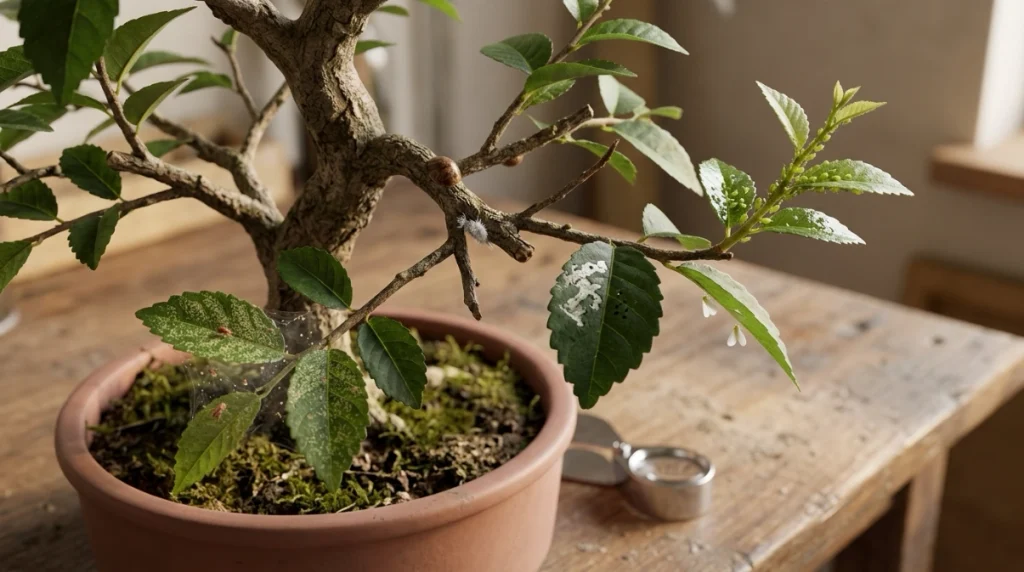
The fastest way to separate spider mites from other bonsai pests is to compare four things: body shape, feeding damage, residue, and movement. No single symptom is as reliable as that combination.
| Pest | Typical appearance | Main damage clue | Best separating clue |
|---|---|---|---|
| Spider mites | Tiny moving dots, often under 1/20 inch | Fine stippling and bronzing | Fine silk plus moving mites beneath foliage |
| Aphids | Soft, pear-shaped insects, usually 1/16–1/8 inch | Curled or distorted young growth | Visible colonies and sticky honeydew |
| Scale | Fixed shell-like, waxy, or rounded bumps | Yellowing and declining vigor | Attached coverings rather than crawling dots |
| Mealybugs | White, oval insects covered with cottony wax | Yellowing and weak growth | Cotton-like masses and honeydew |
| Thrips | Slender insects around 1/16 inch long | Silvery streaks or irregular scars | Dark fecal specks and no mite-style silk |
| Whiteflies | Small white winged adults beneath leaves | Yellowing and leaf decline | Adults flutter upward when disturbed |
Spider mites vs. aphids
Aphids are much easier to see than spider mites. They usually gather around tender shoots, buds, stems, and young leaf undersides.
Look for pear-shaped bodies, visible legs, and two small tail-like structures called cornicles. The University of Minnesota Extension aphid guide describes adults as roughly 1/16 to 1/8 inch long.
- Aphids: Sticky honeydew, curled new growth, colonies, and sometimes ants.
- Spider mites: Fine stippling, bronzing, tiny moving dots, and delicate silk.
Spider mites vs. scale insects
Scale insects often don’t resemble insects at all. Many look like brown, tan, gray, or pale bumps attached firmly to bark, twigs, or leaves.
Soft scales can also produce honeydew, while armored scale generally does not. The University of Minnesota scale guide explains the differences between these main groups.
- Scale: Stationary coverings that remain attached in one location.
- Spider mites: Tiny mobile organisms that become easier to see on white paper.
Spider mites vs. mealybugs
Mealybugs are usually easier to identify because their bodies have a distinctive white, waxy appearance. Colonies often resemble tiny pieces of cotton trapped in branch forks.
- Check leaf axils and branch crotches.
- Look beneath overlapping leaves.
- Inspect protected areas near stems.
- Watch for sticky honeydew or black sooty mold.
Spider mite webbing is silk stretched across or around foliage. Mealybug wax stays clustered around the insects and often looks fuzzy rather than thread-like.
Spider mites vs. thrips
Thrips can cause stippling, so they sometimes create the closest visual match. Their feeding more often develops into irregular silvery streaks, scars, or distorted tissue.
Thrips are slender and may run quickly when disturbed. The University of Minnesota indoor plant pest guide also notes shiny dark excrement around heavily damaged tissue.
- Thrips: Silvery scars, slender insects, and dark fecal dots.
- Spider mites: Pinpoint stippling, bronzing, tiny mites, and possible silk.
Spider mites vs. whiteflies
Whiteflies reveal themselves through movement. Disturb an infested branch and tiny pale adults may flutter from the underside of the leaves.
Whitefly nymphs stay attached beneath foliage and can be overlooked. Honeydew is another clue because whiteflies produce it while spider mites generally do not.
How Do You Confirm Spider Mites on a Bonsai?
You don’t need laboratory equipment to confirm most spider mite infestations. A careful inspection, a 10× hand lens, and the white-paper test usually give you enough evidence.
1. Inspect the underside of several leaves
Turn affected leaves over without damaging their petioles. Look along veins, leaf bases, sheltered branch junctions, and areas close to visible stippling.
- Tiny moving mites
- Small round eggs
- Cast skins or pale debris
- Fine strands of silk
2. Use the white-paper test
- Hold clean white paper beneath a suspicious branch.
- Tap or gently shake the branch several times.
- Wait a few seconds.
- Watch the fallen specks closely.
- Use a hand lens to check whether any dots are crawling.
Dust and soil stay still. Active mites begin moving across the paper, making them far easier to detect than when they are hidden against green foliage.
3. Match the pest to the damage
A moving speck alone doesn’t prove that spider mites caused every damaged leaf. Look for the characteristic combination of mites plus fine stippling or bronzing.
- Mites + stippling: Strong evidence.
- Mites + fine webbing: Stronger evidence.
- Webbing without feeding damage: Check for an ordinary spider.
- Yellowing without mites: Investigate watering, roots, light, nutrition, or another pest.
As of 2026, this identify-first approach remains central to integrated pest management. It helps avoid spraying a bonsai for a pest that isn’t present.
Can Webbing, Stippling, or Sticky Leaves Identify the Pest?
These clues can narrow the diagnosis quickly, but none should be used alone. The pattern matters more than one isolated symptom.
Fine webbing
Dense, delicate silk wrapped close to damaged foliage strongly raises suspicion of spider mites. Webbing becomes more obvious as some spider mite populations increase.
A harmless spider usually creates a larger structural web between branches or nearby objects. Check whether the leaves inside that web also have stippling and mites underneath.
- Fine silk + stippling: Spider mites become likely.
- Large web + healthy foliage: An ordinary spider becomes more likely.
Pale stippling
Spider mite stippling looks like many tiny pale feeding points. Severe injury can merge into larger dull, yellow, or bronze areas.
Thrips may also create speckling, but their injury often becomes more silvery, streaked, or scarred. Dark fecal spots push the diagnosis further toward thrips.
Sticky foliage
Sticky leaves are one of the best clues that you’re probably dealing with something other than spider mites. The sticky substance is often honeydew from sap-feeding insects.
- Aphids
- Soft scale
- Mealybugs
- Whiteflies
Honeydew may also attract ants or support black sooty mold. When I find both stickiness and ants, I inspect new shoots and branch joints before I spend much time looking for mites.
White material on leaves or branches
Don’t automatically call white material spider mite webbing. Texture and attachment give you better clues.
- Fine threads: Possible spider mite silk.
- Cottony clumps: More consistent with mealybugs.
- Firm raised bumps: Possible scale.
- Powder-like coating: Consider powdery mildew rather than an insect or mite.
What Should You Do After Identifying the Pest?
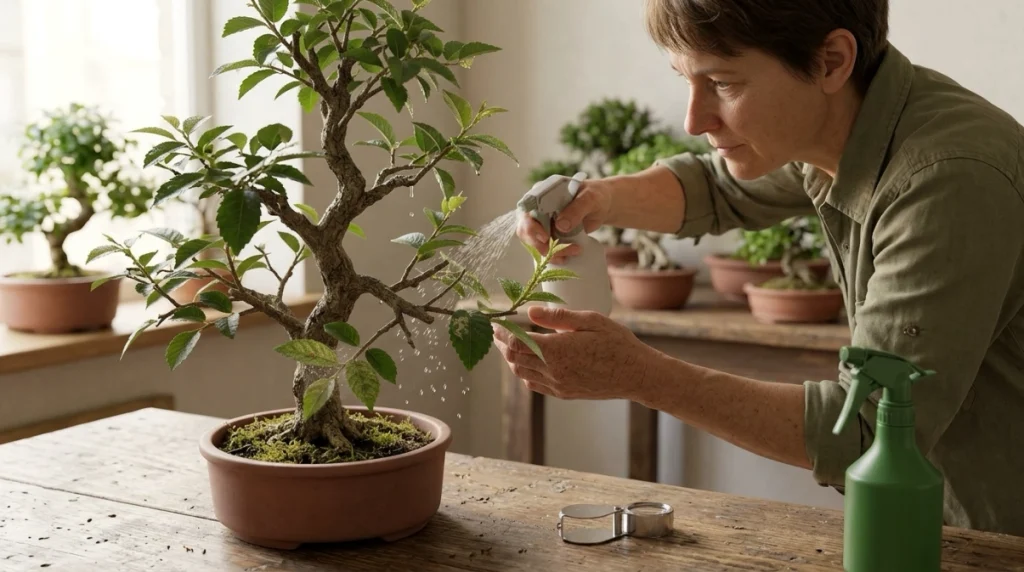
Once you’ve identified the pest, isolate the affected bonsai before treating it. Nearby trees and houseplants should also be inspected because several common pests can spread between suitable hosts.
- Separate the tree: Move it away from healthy plants while keeping suitable light and temperature.
- Confirm active pests: Check several parts of the canopy rather than relying on one damaged leaf.
- Remove what you can physically: A controlled water rinse can dislodge mites, aphids, thrips, and some other exposed pests.
- Choose a pest-specific treatment: Follow the product label and make sure both the pest and plant are listed appropriately.
- Reinspect: Eggs or hidden stages may survive an initial treatment, so continued monitoring matters.
For spider mites, water sprays, properly labeled insecticidal soaps, and horticultural oils are common lower-impact options. Coverage beneath leaves is important because contact products only work where they reach the pest.
Don’t assume every ordinary insecticide will solve a mite problem. Spider mites are arachnids rather than insects, and inappropriate broad-spectrum insecticides can also disrupt natural mite predators.
- Avoid increasing watering blindly just because mites favor dry conditions.
- Keep the bonsai watered according to its species and soil.
- Avoid spraying a stressed tree in excessive heat or direct sun unless the label permits it.
- Test unfamiliar treatments on a small area when appropriate.
The Bonsai Empire pest and disease overview is also useful when comparing several common bonsai pests before choosing a treatment.
Section Takeaway: Correct identification comes before control. Treat the pest you can confirm, not the symptom you happen to notice first.
Frequently Asked Questions
What is the easiest way to know if my bonsai has spider mites?
Tap an affected branch over white paper and watch for tiny moving dots. Then inspect the undersides of leaves with a 10× hand lens for mites, eggs, stippling, and fine webbing before deciding that spider mites are present.
Do spider mites always make webs?
No. Light or early infestations may cause stippling before obvious webbing develops. Webbing becomes more noticeable with many webspinning mite infestations as populations increase, so the absence of visible silk does not rule them out.
How can I tell aphids from spider mites?
Aphids are larger, soft, pear-shaped insects that commonly cluster around tender shoots and may produce sticky honeydew. Spider mites are much smaller and more often cause fine stippling, bronzing, tiny moving specks, and delicate webbing.
Are tiny white dots on bonsai leaves always spider mites?
No. White marks can come from spider mite feeding, thrips, scale, mealybugs, mineral deposits, spray residue, fungal growth, or damaged tissue. Check whether the marks wipe away and inspect both leaf surfaces before treating the tree.
Why are my bonsai leaves sticky if I cannot see spider mites?
Sticky foliage usually points toward honeydew-producing pests rather than spider mites. Inspect for aphids, soft scale, mealybugs, and whiteflies, especially around tender growth, branch forks, stems, and the undersides of leaves.
Can spider mites and another pest infest the same bonsai?
Yes. A stressed or newly acquired bonsai can carry more than one pest at the same time. Inspect several leaves, branches, and growing points instead of stopping after finding the first pest.
Should I spray my bonsai if I only suspect spider mites?
It’s better to confirm active mites first. Unnecessary pesticide applications can stress sensitive foliage, kill beneficial organisms, or fail completely when the real problem is another pest or an environmental issue.
Final Takeaway
The most reliable way to tell spider mites from other bonsai pests is to combine the damage pattern with physical evidence. Spider mites point toward fine stippling, bronzing, tiny moving dots, and close-fitting silk rather than sticky honeydew.
Keep a 10× hand lens and white paper near your bonsai bench. A two-minute inspection can save you from treating aphids, scale, thrips, mealybugs, whiteflies, or simple plant stress as though every problem were spider mites.