
Why Do My Bonsai Leaves Have Black Spots?

Quick Answer
Black spots on bonsai leaves can come from fungal or bacterial leaf diseases, excess moisture, pest-related sooty mold, environmental injury, or damaged roots. The spot pattern matters, so inspect the leaves, soil, recent watering, and pests before treating the tree. This bonsai pest and disease guide is also useful when comparing common symptoms.
Common clues to check
- Spreading spots: Expanding brown-to-black lesions may point toward a fungal or bacterial leaf problem.
- Yellow halos: Dark lesions surrounded by yellow tissue make disease more suspicious.
- Sooty coating: Black material sitting on the leaf surface can develop alongside honeydew-producing pests.
- Wet soil: Persistently saturated bonsai soil can stress roots and contribute to declining foliage.
- Recent spraying: Spots appearing after pesticides, oils, or fertilizers may indicate chemical injury.
Best first move
- Isolate the tree if disease or pests seem possible, then diagnose the pattern before reaching for a fungicide or insecticide.
Finding black spots on bonsai leaves is unsettling because several unrelated problems can look almost identical at first. I treat the spots as a clue rather than a diagnosis.
The fastest way forward is to study where the spots appear, whether they spread, and what changed before they developed. This guide walks through that process without encouraging unnecessary spraying or stressful root work.
In This Guide
What Do Black Spots on Bonsai Leaves Usually Mean?
Black spots usually mean that part of the leaf tissue has died, become infected, or has been covered by material such as sooty mold. The color alone cannot tell you which cause is responsible.
Definition: A bonsai leaf spot is a localized area of discolored or dead leaf tissue. Fungi and bacteria can cause leaf spots, but pests, moisture problems, chemical injury, and environmental stress can produce similar marks.
Fungal leaf spots
Fungal diseases are a common possibility when spots appear repeatedly across several leaves. They may start tan or brown before becoming darker as damaged tissue ages.
- Typical pattern: Round, oval, irregular, or vein-related lesions.
- Progression: Spots may enlarge or merge into larger dead areas.
- Conditions: Prolonged leaf wetness, poor airflow, and humid weather can favor many foliar diseases.
- Extra clue: Fallen leaves may also contain infected tissue or spores.
The exact disease depends heavily on species. Maple bonsai, elm bonsai, azalea bonsai, and other broadleaf species do not share the same disease profile.
Bacterial leaf spots
Bacterial problems can also produce dark brown or black lesions. Some lesions look angular because larger leaf veins limit their expansion.
The University of Minnesota Extension lists black, angular, water-soaked, or haloed lesions among symptoms found in several bacterial leaf diseases. Its tree and shrub leaf-spot resources are useful when comparing disease patterns.
Sooty mold from sap-feeding pests
A black coating is different from dead black tissue. Sooty mold grows on sugary honeydew left by pests such as aphids, scale insects, and some other sap feeders.
- Look for sticky leaves or shoots.
- Inspect leaf undersides closely.
- Check stems for scale-like bumps.
- Look around tender growth for aphids.
- See whether the dark coating partly wipes away.
If the black material sits on top of otherwise green tissue, investigate pests before assuming the leaf itself is infected.
Environmental and root stress
Blackening can also follow excessive soil moisture, poor drainage, cold injury, heat stress, fertilizer burn, or a poorly timed spray. These problems often affect edges, tips, or larger portions of leaves rather than producing uniform disease-like spots.
Recent history becomes especially important here. A sudden change after fertilizing, moving the bonsai, spraying it, or changing watering habits can narrow the diagnosis quickly.
Section Takeaway: Black spots are a symptom, not a diagnosis. Examine their shape, texture, location, and recent growing conditions before deciding what treatment your bonsai needs.
How Can You Identify the Cause of Black Spots?
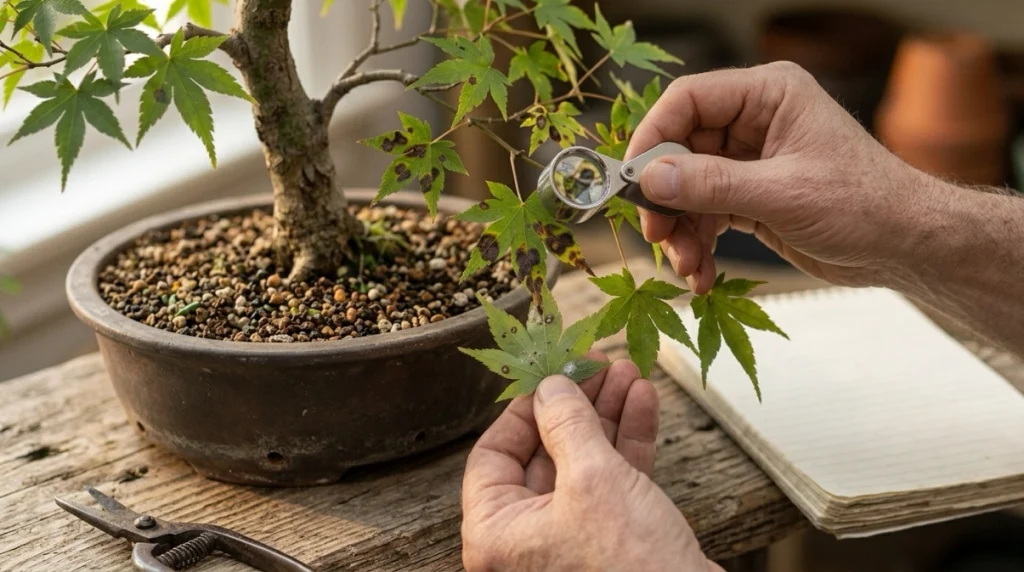
Start by comparing the appearance of the spots with other symptoms on the tree. A magnifying glass or 10× hand lens makes small pests and surface growth much easier to examine.
| What You See | Possible Cause | What to Check Next |
|---|---|---|
| Round or irregular black spots that enlarge | Fungal leaf spot | Humidity, leaf wetness, fallen leaves, spread pattern |
| Dark angular or water-soaked lesions | Possible bacterial disease | Yellow halos, shoot dieback, wet foliage |
| Black soot-like surface coating | Sooty mold | Aphids, scale, sticky honeydew |
| Black or brown crispy margins | Heat, fertilizer, salt, or water stress | Recent feeding, drying, temperature changes |
| Dark leaves plus constantly wet soil | Root stress or drainage problem | Drainage holes, soil condition, watering frequency |
| Spots after pesticide or oil application | Possible chemical injury | Product label, concentration, heat, sun exposure |
Look at the newest damage
Old spots can become dry, faded, torn, or colonized by secondary organisms. Fresh lesions usually give you better diagnostic clues.
Mark one or two affected leaves mentally or with a photo. Compare them again after several days to see whether the spots expand or new lesions appear.
- Fast spread: Makes an active disease or ongoing injury more concerning.
- No new spots: May indicate the original stress has already passed.
- New healthy growth: Suggests the tree may be stabilizing.
Consider the bonsai species
A black spot on a Japanese maple does not automatically have the same cause as a spot on ficus or Chinese elm. Species identification should come before disease naming.
Penn State Extension’s tree and shrub pest and disease resources show how disease susceptibility differs among plant groups.
What Should You Check First?
Check the growing conditions before treating the spots. A bonsai can develop leaf damage from poor care even when no infectious organism is present.
1. Check the soil moisture
Do not judge moisture from the surface alone. Bonsai soil can look dry on top while remaining wet deeper in the pot.
- Check moisture below the surface.
- Make sure drainage holes are open.
- Do not leave the pot standing in drainage water.
- Notice how long the soil stays wet after watering.
Watering frequency should respond to the tree, soil, pot, weather, and season. A fixed calendar schedule can easily keep one bonsai too wet while leaving another too dry.
2. Inspect both sides of the leaves
Turn several leaves over gently rather than examining only the canopy from above. Many pests and early disease symptoms are easiest to see underneath.
- Tiny moving insects
- Fine webbing
- Sticky residue
- White cotton-like material
- Scale-like bumps
- Dark specks or surface mold
3. Review what changed recently
The event immediately before the spots appeared can be more useful than the color itself. Write down any major care change from the previous one to two weeks.
- New fertilizer
- Pesticide, fungicide, or horticultural oil
- Indoor-to-outdoor movement
- Sudden hot or cold weather
- Long periods of rain
- Repotting or root disturbance
- Major pruning
- A newly purchased nearby plant
If several neighboring plants develop similar symptoms, isolate the affected bonsai while you investigate.
How Do You Treat Black Spots on Bonsai Leaves?
The correct treatment depends on the cause. Avoid spraying a fungicide simply because a spot looks black.
Isolate the tree when disease or pests seem possible
Move the bonsai away from healthy trees when practical. Keep its light, temperature, and watering appropriate for the species while it is isolated.
Clean fallen leaves from the pot and surrounding bench. Avoid carrying contaminated debris through the rest of your collection.
- Inspect nearby plants.
- Work on healthy trees first.
- Clean tools between plants.
- Wash your hands after handling an affected tree.
- Avoid letting foliage from different plants touch.
Improve airflow and reduce unnecessary leaf wetness
Many foliar pathogens perform better when leaves stay wet for long periods. Space crowded trees enough for gentle air movement around the canopy.
When possible, direct routine watering toward the root zone instead of repeatedly soaking diseased foliage. Avoid creating stagnant, humid conditions around a susceptible tree.
Remove heavily damaged leaves carefully
A few badly affected leaves can sometimes be removed for sanitation, especially when lesions are clearly spreading. Do not strip most of the foliage from an already weak bonsai.
Pro tip: Removing living foliage or diseased shoots is irreversible. If a valuable or severely stressed bonsai needs substantial pruning, ask an experienced grower or local bonsai club before cutting heavily.
Correct watering and drainage problems
If the growing medium remains saturated for too long, correct the watering pattern first. Make sure the drainage holes are functional and the pot is not sitting in water.
Do not rush into an emergency repot because of several spotted leaves. Root work can add major stress and should match the species, season, root condition, and severity of the problem.
Pro tip: Major root pruning on a declining bonsai can make recovery harder. Seek experienced help before performing aggressive root work outside the normal repotting window.
Control pests when honeydew or insects are present
If black surface growth accompanies aphids, scale, mealybugs, or another honeydew-producing pest, controlling the pest is the main job. Sooty mold usually becomes less important once the honeydew source disappears.
- Identify the pest first.
- Remove visible insects when practical.
- Use physical or cultural controls when suitable.
- Select a labeled pesticide only when necessary.
- Repeat inspections because eggs or immature stages may remain.
Use fungicides only when they fit the diagnosis
Fungicides do not repair tissue that has already died. Their role, when appropriate, is usually to protect healthy tissue or limit further disease development.
If you use a pesticide or fungicide, follow the product label for the plant, problem, concentration, timing, and protective equipment. The EPA’s current pesticide-label guidance emphasizes reading and following label directions.
Never double the concentration because the spots look severe. More product can increase the risk of foliage injury without solving a mistaken diagnosis.
Section Takeaway: Treat the cause rather than the color. Sanitation, correct watering, airflow, pest identification, and careful monitoring should come before aggressive pruning or chemical treatment.
How Can You Prevent Black Spots From Returning?
Prevention starts with keeping the bonsai vigorous and catching small problems early. No routine can guarantee disease-free leaves, but good growing conditions reduce avoidable stress.
Inspect your bonsai regularly
During active growth, make leaf and pest inspection part of normal watering. A quick look at leaf undersides and new shoots can reveal trouble before extensive damage appears.
- Check new growth.
- Turn over several leaves.
- Look along branch junctions.
- Watch for sticky residue.
- Check for webbing or scale-like bumps.
- Notice fresh discoloration.
Keep the growing area clean
Remove fallen diseased leaves rather than allowing them to collect under the canopy. Clean benches, trays, tools, and work surfaces when you have handled a questionable plant.
Quarantine newly acquired bonsai before placing them among an established collection. Hidden pests may not be obvious on the day you bring a tree home.
Match watering to the tree
A bonsai needs water when its root zone requires it, not simply because a certain number of hours have passed. Fast-draining soil, summer heat, wind, pot size, and species can all change water use.
- Avoid prolonged saturation.
- Do not allow moisture-sensitive trees to become bone dry.
- Keep drainage holes unobstructed.
- Adjust watering as seasons change.
Avoid unnecessary chemical treatments
Preventive spraying without a clear reason can create its own problems. Oils, soaps, fungicides, and insecticides can injure sensitive foliage when misused.
As of 2026, the safest general rule remains simple: identify the likely problem and follow the current product label exactly.
When Are Black Spots a Serious Warning Sign?
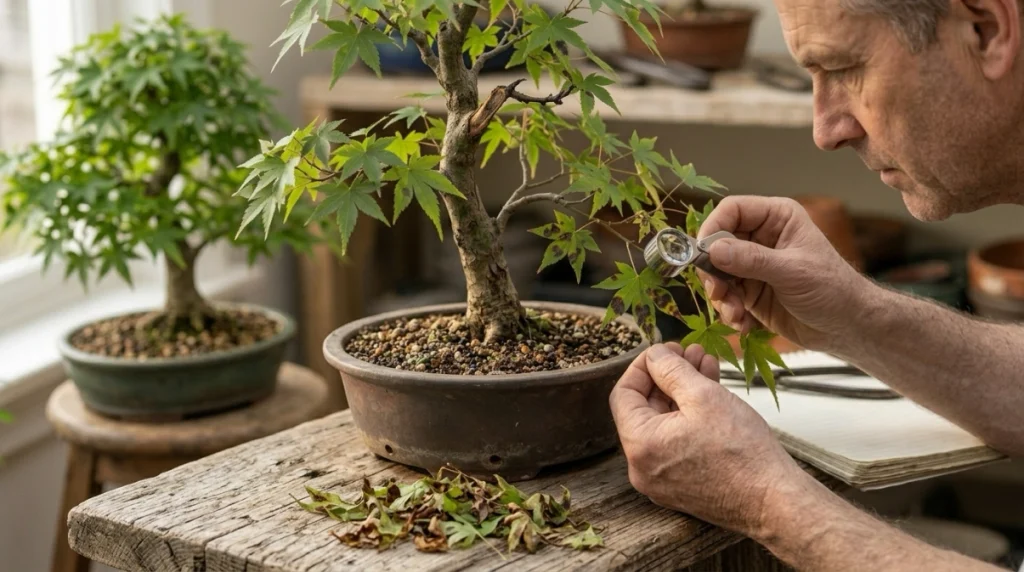
A few stable spots on older leaves are less urgent than rapidly increasing lesions across the canopy. Watch the tree’s overall vigor rather than focusing on one imperfect leaf.
Get experienced help when the symptoms move beyond a minor cosmetic issue.
- Rapid spread: New black lesions appear daily across multiple branches.
- Heavy defoliation: The bonsai begins losing a large amount of foliage.
- Shoot dieback: Young shoots or branches turn dark and die.
- Trunk lesions: Sunken, cracked, or darkened areas appear on woody tissue.
- Root symptoms: The soil smells sour or visible roots appear dark and soft.
- Collection spread: Other bonsai begin showing similar symptoms.
- No recovery: Healthy new growth fails to appear after conditions improve.
Can black-spotted leaves recover?
Dead sections of a damaged leaf normally stay damaged. Your recovery target is healthy new foliage, not restoring black tissue to green.
Monitor buds and new shoots over the following weeks. Fresh leaves without new spots are a stronger recovery signal than the appearance of old damaged foliage.
When should you seek a plant diagnostic service?
Visual symptoms cannot identify every fungal, bacterial, or viral disease reliably. Laboratory diagnosis can be worthwhile when a valuable tree is declining or when several plants show the same unexplained problem.
A local university extension office, plant clinic, experienced bonsai professional, or qualified plant-health specialist may help narrow the diagnosis.
Frequently Asked Questions
Why are black spots suddenly appearing on my bonsai leaves?
Sudden black spots can follow fungal or bacterial disease, excess leaf moisture, pest activity, chemical injury, or environmental stress. Check what changed recently, then compare the spot pattern with soil moisture, pests, weather, and any products you applied.
Does overwatering cause black spots on bonsai leaves?
Overwatering can contribute indirectly by stressing roots and keeping the growing environment excessively wet. However, distinct black leaf spots can have other causes, so do not diagnose overwatering from leaf color alone.
Are black spots on bonsai leaves always fungus?
No. Fungal leaf spots are only one possibility. Bacterial disease, sooty mold from sap-feeding insects, fertilizer injury, cold damage, heat stress, pesticide injury, and root problems can create dark foliage symptoms.
Should I remove bonsai leaves with black spots?
You can remove a small number of severely damaged or clearly diseased leaves when sanitation is useful. Avoid stripping large amounts of foliage from a weak bonsai, because healthy leaves still provide energy for recovery.
Should I spray fungicide on black bonsai leaves?
Not automatically. Fungicide will not solve pest damage, excessive watering, fertilizer burn, or chemical injury. Identify disease as the likely cause first, then choose a product labeled for the relevant plant and problem.
What does a black coating on bonsai leaves mean?
A soot-like black coating may be sooty mold growing on honeydew produced by sap-feeding insects. Inspect stems, new shoots, and leaf undersides for aphids, scale, mealybugs, or related pests.
Can black spots spread to my other bonsai?
Some infectious plant diseases and pests can spread between nearby trees, while environmental damage cannot. If the cause is uncertain and lesions are increasing, temporary isolation and inspection of neighboring plants are sensible precautions.
The main takeaway: If your bonsai leaves have black spots, do not treat the color alone. Check the pattern, pests, soil moisture, drainage, recent weather, and care changes before deciding whether the tree needs sanitation, environmental correction, pest control, or disease treatment.
Keep monitoring the new growth after making corrections. Healthy new leaves are one of the clearest signs that your diagnosis and care changes are moving the bonsai in the right direction.
