Can Aphids Kill a Bonsai Tree?
Quick Answer
Yes, a severe or prolonged aphid infestation can seriously weaken a bonsai and may contribute to its death, especially when the tree is young, stressed, recently repotted, or already unhealthy. A few aphids rarely kill an established tree, but rapidly growing colonies can damage tender shoots, distort leaves, reduce vigor, and produce sticky honeydew. For help distinguishing aphids from other common insects, see this bonsai pest identification guide.
Signs the infestation needs attention
- Growing colonies: Clusters of small, soft-bodied insects cover new shoots or leaf undersides.
- Distorted growth: Tender leaves become curled, puckered, yellow, or misshapen.
- Sticky foliage: Aphid honeydew makes leaves and branches shiny or tacky.
- Weak shoots: New growth becomes stunted or stops extending normally.
- Heavy ant activity: Ants repeatedly climbing the tree can indicate a honeydew-producing pest colony.
What to do first
- Isolate the bonsai, confirm that the insects are aphids, remove as many as practical, then monitor new growth closely.
Aphids are among the bonsai pests I take most seriously during spring growth. They are small, but a colony can expand much faster than many new growers expect.
The good news is that aphids are usually manageable when you catch them early. This guide explains when they become dangerous, how to confirm them, and how to protect a weakened bonsai without creating more stress.
In This Guide
Can Aphids Actually Kill a Bonsai Tree?
Aphids can contribute to the death of a bonsai, but a small infestation rarely kills a healthy tree by itself. The greatest danger comes from large populations feeding for an extended period on a tree that already has limited reserves.
Aphids are soft-bodied insects that use specialized mouthparts to feed on plant sap. Adults are commonly about 2–4 mm long, though size varies by species.
They often gather on tender shoots, developing leaves, buds, and leaf undersides. Those are exactly the parts of a bonsai responsible for much of its active seasonal growth.
- Light infestation: A few insects appear on isolated shoots with little obvious damage.
- Moderate infestation: Colonies develop, leaves curl, and honeydew becomes noticeable.
- Heavy infestation: Large areas of new growth become distorted, yellow, sticky, or stunted.
- High-risk infestation: The bonsai is simultaneously suffering from heat, drought, root trouble, poor light, disease, or recent major work.
University of Minnesota Extension notes that severe aphid feeding can produce curled leaves, yellow foliage, stunted shoots, and poor plant growth. Those effects matter more on a compact bonsai with a comparatively small canopy.
That does not mean every curled leaf is an emergency. The condition of the entire tree matters more than the number of insects you can count on one shoot.
Why bonsai can be more vulnerable than landscape trees
A mature landscape tree has a huge root system and large canopy. A bonsai lives in a deliberately restricted root environment.
Its survival therefore depends heavily on balanced watering, healthy roots, adequate foliage, and appropriate seasonal care. Add a serious sap-feeding infestation to existing stress, and recovery becomes harder.
I become much more concerned when I see aphids on a recently repotted tree than on a vigorous, established specimen. The pest may be identical, but the tree’s ability to tolerate feeding is not.
Section Takeaway: Aphids are most dangerous when their numbers are high and the bonsai is already stressed. A handful of insects on a strong tree is usually a management problem, not a death sentence.
What Does Aphid Damage Look Like on Bonsai?
The classic signs are clustered insects, curled young leaves, distorted shoots, sticky honeydew, and reduced vigor. You may notice the damage before you notice the insects themselves.
Aphids can be green, black, gray, yellow, red, or brown. Many species have two small tube-like structures called cornicles near the rear of the abdomen.
Look closely at soft new growth
Start at the growing tips. Aphids often prefer succulent tissue where sap is readily available.
- Turn over young leaves.
- Inspect leaf stems and branch tips.
- Look inside curled foliage.
- Check buds and fresh shoots.
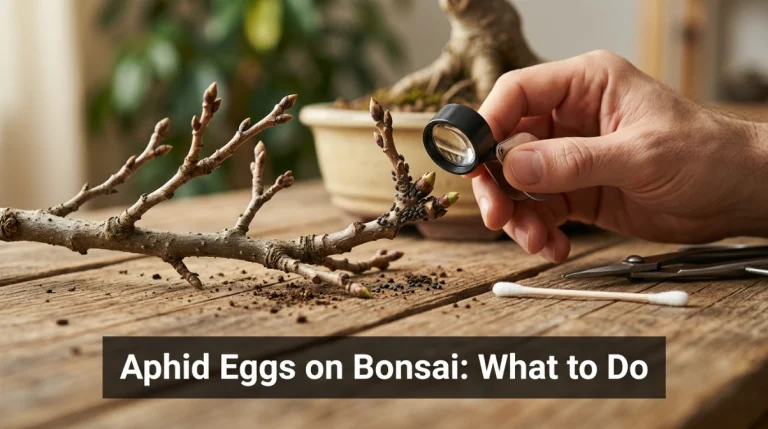
- Use a hand lens when insects are difficult to identify.
Sticky leaves can be an important clue
Feeding aphids excrete a sugary waste called honeydew. University of Maryland Extension describes it as a clear, sticky residue produced by sap-sucking insects.
Honeydew can make leaves glossy and tacky. It may also support the growth of black sooty mold on exposed surfaces.
Sooty mold does not necessarily mean a fungal disease is attacking your bonsai tissue. It often grows on the sugary residue sitting on the surface.
White flakes do not always mean dead aphids
You may notice pale or white shell-like material around a colony. These can be shed skins, known as exuviae, left behind as aphids grow.
Do not assume the infestation is finished because those white skins do not move. Search nearby leaves and shoots for live insects.
| Sign | Possible meaning | Where to inspect |
|---|---|---|
| Tiny clustered insects | Active aphid colony | New growth and leaf undersides |
| Curled young leaves | Feeding damage or another stress | Shoot tips and developing foliage |
| Sticky coating | Honeydew from sap-feeding pests | Leaves and branches below colonies |
| Black surface growth | Sooty mold growing on honeydew | Sticky foliage and branches |
| Frequent ants | Possible honeydew-producing insects | Trunk, pot rim, bench, nearby shoots |
When Do Aphids Become Dangerous?
Aphids become more concerning when populations keep increasing, new growth deteriorates, or the bonsai has another source of stress. Infestation severity and tree health should guide your response.
A healthy tree can often tolerate limited feeding. A weak tree has less room for error.
These situations deserve faster action
- Recent repotting: Reduced or disturbed roots may temporarily limit the tree’s ability to support its foliage.
- Drought stress: A dehydrated bonsai is already struggling to maintain normal water balance.
- Root problems: Poor drainage or damaged roots reduce the tree’s ability to recover.
- Heavy leaf loss: Further damage leaves the bonsai with less productive foliage.
- Rapid colony growth: Aphids can reproduce quickly under favorable conditions.
- Newly purchased tree: Other hidden pests may be present at the same time.
Some aphids reproduce without mating during parts of their life cycle. That helps explain why a few insects can become a noticeable colony surprisingly quickly.
As of 2026, the practical lesson has not changed: early inspection is easier than controlling a dense infestation hidden inside curled foliage.
Do ants make an aphid problem worse?
Ant activity can help alert you to aphids because ants feed on their sugary honeydew. Some ant species also protect honeydew-producing insects from predators.
If ants repeatedly travel up and down your bonsai, inspect every tender shoot. Do not treat ants as proof of aphids, but take the signal seriously.
Section Takeaway: Aphid numbers matter, but tree condition matters just as much. Treat a growing colony on a weak or newly worked bonsai as a higher-priority problem.
How Do You Get Rid of Aphids on a Bonsai?

Start with correct identification and the least disruptive effective control. Physical removal and water can manage small exposed colonies, while labeled insecticidal soap or another suitable product may be needed for persistent infestations.
1. Isolate the affected bonsai
Move the tree away from nearby plants when practical. Aphids can develop winged forms, and infestations can spread within a collection.
Isolation also makes monitoring easier. You can see whether new aphids appear after treatment without confusing them with pests arriving from neighboring plants.
2. Remove exposed aphids
For a small colony, physically removing insects may be enough to reduce the population sharply. A controlled stream of water can also dislodge exposed aphids.
Support delicate branches while rinsing. Do not blast freshly wired shoots or wash large amounts of growing medium from a shallow bonsai pot.
3. Consider a labeled insecticidal soap
Colorado State University Extension identifies aphids as soft-bodied insects susceptible to insecticidal soaps. These products work by direct contact rather than providing long residual protection.
Coverage therefore matters. Aphids hidden inside tightly curled leaves may escape a contact spray.
- Choose a product labeled for the plant and intended use.
- Read the current label before application.
- Test sensitive foliage when the label recommends it.
- Cover the actual insects, including leaf undersides.
- Avoid exceeding the labeled concentration or frequency.
I avoid improvising with concentrated household dish detergent. Extension guidance warns that household cleaning products are not equivalent to formulated insecticidal soaps and can injure plants.
4. Reinspect instead of assuming one treatment worked
Check the tree every few days while the infestation is active. Pay particular attention to emerging leaves because fresh, soft growth attracts aphids.
If you still find live colonies, reassess identification and follow the chosen product’s label for any repeat treatment. More pesticide is not automatically better.
Pro tip: Avoid combining heavy pruning, major root work, and aggressive pest treatment on an already weakened bonsai. If irreversible work seems necessary, get advice from an experienced grower or local bonsai club first.
Section Takeaway: Remove what you can, use targeted treatments when necessary, and keep checking the tree. Successful aphid control depends more on careful follow-up than on one aggressive spray.
Can a Bonsai Recover After an Aphid Infestation?
Yes. Most otherwise healthy bonsai can recover from aphid damage once the infestation is controlled and normal care continues. Damaged leaves may remain curled, but new growth can emerge normally if the tree retains adequate vigor.
Do not judge recovery only by old leaves. Watch what happens at active buds and shoot tips.
Signs your bonsai is recovering
- New leaves open without fresh colonies.
- Shoot extension resumes.
- New foliage holds normal color.
- Honeydew production stops.
- Leaf drop slows or stops.
- The soil continues drying at a normal rate for the tree.
Resist the temptation to overfertilize a weak tree to force faster growth. Maintain appropriate species-specific care and allow recovery to develop naturally.
If decline continues after the aphids disappear, investigate another cause. Watering mistakes, root trouble, poor light, heat stress, disease, or another pest can produce overlapping symptoms.
How Can You Prevent Aphids From Returning?
You cannot guarantee that aphids will never reach a bonsai, but frequent inspection makes outbreaks much easier to control. Prevention is mainly about early detection, quarantine, good growing conditions, and collection hygiene.
A practical routine takes only a few minutes. I inspect tender growth whenever I check water needs during active growth.
- Check weekly: Inspect leaf undersides, shoots, buds, and branch junctions.
- Increase checks in spring: Tender growth can support fast aphid population increases.
- Quarantine newcomers: Keep recently purchased bonsai separate while you observe them.
- Inspect nearby plants: Treating one bonsai will not help much if another plant remains heavily infested.
- Watch for ants: Repeated ant traffic can lead you to hidden honeydew producers.
- Keep trees vigorous: Correct light, watering, drainage, and seasonal care improve resilience.
For general pest diagnosis, Bonsai Empire’s pest and disease overview includes aphids alongside spider mites, mealybugs, scale, and other common bonsai problems.
For broader aphid identification and biology, University of Minnesota Extension’s aphid guide provides useful descriptions of adult aphids, nymphs, honeydew, feeding damage, and natural enemies.
Another useful resource is the University of Maryland Extension guide to aphids, which explains honeydew, shed skins, ant activity, reproduction, and plant symptoms.
Section Takeaway: Regular inspection is your best defense against serious aphid damage. Finding ten aphids early is far easier than finding hundreds after the shoots have curled around them.
Frequently Asked Questions About Aphids on Bonsai
Can one aphid kill a bonsai?
No. A single aphid is extremely unlikely to kill a bonsai. The concern is reproduction and colony growth, especially on a stressed tree. Remove the insect and inspect nearby tender shoots for additional aphids or shed skins.
How fast can aphids damage a bonsai?
Visible damage can develop quickly when conditions favor rapid reproduction. Tender shoots may curl or become distorted as colonies increase. Inspect an active infestation every few days rather than waiting several weeks to see whether it disappears.
Will aphids go away on their own?
Small outdoor populations can sometimes decline because of weather or natural enemies such as lady beetles and lacewing larvae. Do not depend on that outcome when a bonsai already shows significant distortion, weak growth, or a rapidly expanding colony.
Can I spray aphids off my bonsai with water?
Yes, exposed aphids can often be dislodged with water. Use enough pressure to remove insects without damaging tender shoots or disturbing the growing medium. Reinspect afterward because insects hidden inside curled foliage may remain.
Can aphids spread from one bonsai to another?
Yes. Winged aphids can move between suitable plants, and close plant spacing makes pest movement easier. Isolating an infested bonsai and inspecting neighboring trees reduces the chance of a collection-wide problem.
Does sticky residue always mean aphids?
No. Honeydew can also be produced by scale insects, mealybugs, whiteflies, and other sap-feeding pests. Sticky leaves should prompt a close inspection rather than an automatic aphid treatment.
Should I remove all leaves from an aphid-infested bonsai?
Usually not. Complete defoliation adds stress and is rarely necessary just for aphid control. Remove individual badly damaged shoots only when appropriate for the species and season, and avoid major pruning on an already weak tree.
Final Takeaway
So, can aphids kill a bonsai tree? They can seriously weaken a bonsai and may contribute to death when an infestation becomes severe, persistent, or combines with other stress.
Most infestations do not reach that point. Catch the insects early, isolate the tree, remove exposed colonies, use an appropriate labeled treatment when necessary, and keep monitoring new growth.
Make pest inspection part of your normal watering routine. Those few extra minutes can prevent a small aphid colony from becoming a much harder bonsai problem.